What is Carburizing?
Carburizing is one of the most widely used methods, of case hardening. The purpose of case hardening is to increase the surface hardness of steel. In this process, the steel is introduced to a carbon-rich environment and elevated to a temperature range of 850 to 950oC for a certain amount of time. Due to this Carbon starts diffused into the surface layer of the material. The rate of diffusion depends upon the time and temperature zone at which the material is maintained.

Basics of Carburizing and Methods of Carburizing
After carburizing material is quenched so that the carbon is locked in the structure. The hardness is moderately increased, but it can be hardened again through flame or induction hardening. It’s possible to carburize only a particular portion of the component(i.e.., gear tooth). The hardness achieved by Carburizing is 55 to 68 HRC and the carbon content in the surface layer is increased to 0.75 to 1.2%
The surface not to be carburized should be copper plated or covered with asbestos power mixed in fireclay cement.
Carburizing Methods
They are four basics methods of Carburizing are widely used for case hardness. They are
·         Pack or Solid Carburizing
·         Gas Carburizing
·         Liquid Carburizing
·         Vacuum Carburizing
Pack or solid Carburizing
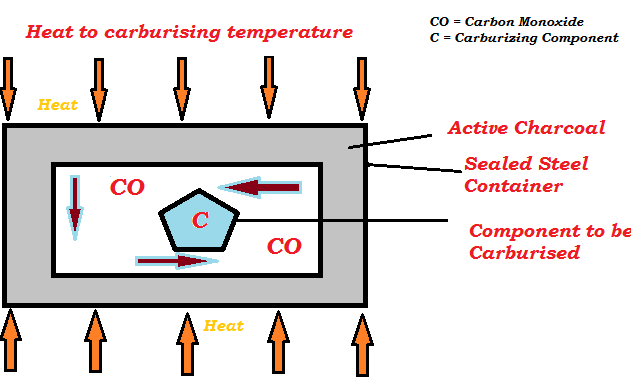
In this process, components to be case harden is packed in an environment with high carbon content such as bone char, charcoal or barium carbonate. The components are heated to a temperature range of 850 to 950oC so that the carbon is diffused into the outer surface of the material. The diffusion rate of carbon is depending upon the composition of the part, temperature and time. The outer surface of the material is hardened whereas the core of the material remains ductile. The case hardens depth is approximately 0.1 to 2 mm.
Normally this method is used for soft steels with a carbon content of 0.2% or less which cannot be hardened by simple heating and quenching.Basics of Carburizing and Methods of Carburizing
Advantages of Pack Carburizing
·         It is the simplest method of Carburizing
·         Less Capital cost
Gas Carburizing
This process contains gases capable of forming atomic carbon at high temperature over parts made of mild steel. The gases wildly used for this process are carbon monoxide, natural gas, a mixture of methane, ethane and propane. The components to be Carburizing is placed in a furnace and heated to a temperature range of 900 to 950oC. Then the Carburizing gas is passed through the chamber for a period of 5 to 10hours. Due to this high temperature, the carbon in the gas is diffused into the surface of the component and it is case hardened.
When compare with pack Carburizing, this method is more easy for Carburizing the components. This method can be used in mass production.
Advantages of Gas Carburizing
·         It takes less time when compared with pack Carburizing method
·         Control is more accurate to achieve surface carbon content and case hardness
·         When compare with pack Carburizing, complicated shape components are carburised by this method.
Liquid Carburizing
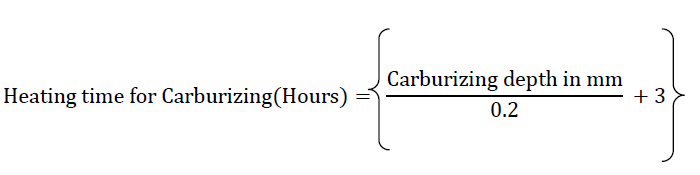
In this process, the steel components are immersed in a liquefied carbon-rich bath of molten salts. The molten salt contains a mixture of sodium carbonate, sodium chloride and silicon carbide. The reaction in the bath is

Basics of Carburizing and Methods of Carburizing
This saturates the metal with carbon. The bath is replenished from time to time. The components are immersed in the bath at a temperature of around 870 to 900oC. So that the carbon is diffused into the surface of the steel. In this method the time required for carburising the metal surface of 0.2 to 0.3mm in 35 to 55min.
Then the metal is then undergone rapid quenching to lock the carbon inside the structure.  By this method uniform case hardening is obtained when compared with other methods.
Advantages of Liquid Carburizing
·         Uniform case hardening depth is obtained
·         Components are free from oxidation
·         Soot is not formed on the surface of the component
Vacuum Carburizing
In vacuum Carburizing method, the component is placed in a very low-pressure vessel. The pressure in the vessel is maintained around 0.5 to 10 bar.  The gases used in this method are acetylene, ethylene and propane. The component is heated to a temperature range of 900 to 1000oC and then the gas is passed through the vacuum chamber. The gas decomposed and the free carbon diffused into the component surface. Uniform Carburizing is obtained by this method.
The problem oxidization is reduced in vacuum Carburizing due to low oxygen present in the vacuum chamber.
Advantage of Vacuum Carburizing
·         Carburizing time is very less when compared with other methods.
·         Uniform Carburizing is obtained by this method.
·         The oxidisation of case hardening material is reduced.

Success in any test automation depends on identifying the right tool for the project. With a plethora of open-source and commercial automation tools to choose from, automation Testing tool selection can become tricky. Here is a curated list of best automated tools -

1) mabl

mabl delivers scriptless end-to-end test automation, integrated with your delivery pipeline, so you can focus on improving your app.
Using proprietary machine learning models, mabl automatically identifies and surfaces application issues quickly, so you can:
  • Fix bugs fast - Robust test output helps you diagnose and fix bugs fast, before they impact your customers.
  • Ship more code - Tests are automatically repaired when your UI changes so you can spend less time maintaining tests.
  • Maintain quality - Prevent bad releases with automated regression insights on every build.

2) Ranorex

Over 14,000 users worldwide accelerate testing with Ranorex Studio, an all-in-one tool for test automation. Ranorex is easy for beginners with a codeless click-and-go interface, but powerful for automation experts with a full IDE for C# or VB.NET, and open APIs.
Features:
  • Functional UI and end-to-end testing on desktop, web, and mobile
  • Cross-browser testing
  • SAP, ERP, Delphi and legacy applications.
  • iOS and Android
  • Run tests locally or remotely, in parallel or distribute on a Selenium Grid
  • Robust reporting
Ranorex integrates with leading solutions like Git, TFS, Jenkins, Bamboo, Bugzilla, SpecFlow, NeoLoad, TestRail and more for a complete testing toolchain.

3) TestCraft

TestCraft is a codeless Selenium test automation platform. The revolutionary AI technology and unique visual modeling allows for faster test creation and execution while eliminating test maintenance overhead. Testers create fully automated test scenarios without coding. Customers find bugs faster, release more frequently, integrate with CI/CD and improve overall quality of their digital products.
Key Features:
  • No programming skills required. Leverage manual testers’ business knowledge and allow them to create automated test scenarios
  • Substantially reduce maintenance costs. Scripts are automatically adjusted to change due to our AI mechanism. Major changes are adapted with a few clicks
  • Selenium based. Quickly integrate and leverage modules developed by the community
  • Provides immediate time to value. Nothing to install (SaaS). Easy to master

4) Squish

Squish is the new GUI Test Automation tool of choice for more than 3000 companies worldwide to automate the functional regression tests and system tests of their graphical user interface (GUIs) and Human Machine Interfaces (HMIs). The Squish GUI testing tool, a 100% cross-platform tool, features
  • In-depth support for all major GUI technologies
  • Full support for all desktop, mobile, web and embedded platforms
  • Test script recording
  • Powerful and reliable object identification and verifications (object-based and image based)
  • No dependency on screenshots or visual appearance
  • Powerful integrated development environment (IDE)
  • A wide range of popular script languages for test scripting
  • Full support for Behavior Driven Development (BDD)
  • Full control via command line tools
  • Integrations with Test Management and CI-Systems

5) TestCafe Studio

TestCafe Studio is a cross-platform, end-to-end web testing platform. TestCafe Studio allows you to create, run and maintain automated web tests with zero code.
Features include:
  • Built-in Visual Test Recorder – No code required.
  • Cross-platform and Cross-browser – run tests on Windows, macOS, Linux, iOS, Android and within Chrome, Firefox, Safari, Edge and IE.
  • No Additional Tools Required – No need for WebDriver, browser plugins or other testing software.
  • Auto-generated Element Selectors - TestCafe Studio generates a selector for each page element used in the test, and provides a list of alternative selectors that cover various test scenarios.
  • Built-in Waiting Mechanism

6) LEAPWORK

LEAPWORK Automation Platform enables you to do test automation without writing code. Test cases are built as flowcharts on a design canvas by putting together powerful building blocks. The blocks include all the commands and logic needed for automating applications. All UI elements and operations are captured and defined with just a few clicks. Anyone can build powerful test cases using the full-featured automation platform features:
  • Test applications in any operating system, any desktop or mobile device, and any browser version.
  • Data driven automation
  • Fast troubleshooting with visual documentation
  • Enterprise Grade platform with encrypted database storage
  • Integrates with your CI/CD pipeline
  • Extensive user support - Live chat with automation engineers, learning center with tutorials and help articles and frequent product releases based on user input.

7) Testim

Testim delivers automated functional testing using artificial intelligence to speed-up the authoring, execution, and maintenance of automated tests.
  • Seamless Integration with all CI/CD tools and collaboration
  • Machine Learning Based Self-Maintenance- Say goodbye to flaky tests
  • Run on different browsers, platforms and mobile
  • Run the tests on your private cloud, on ours, or on premises
  • Get 360° on bugs. In addition to annotated screenshot, video, automated tests, step by step screenshots
  • Reporting on all tests with results as to which fail
8) LambdaTest
LambdaTest is one of the leading cloud based cross browser testing platform which empowers users to perform automated compatibility testing of their website or web applications on a combination of 2000+ real browsers & OS.
Key Features:
  • Automated Cross Browser Testing on 2000+ real Browsers & OS
  • One click bug logging with tools like JIRA, Asana, Github, Slack, Monday.com etc.
  • Integration with various CI/CD tools like Circle CI, Jenkins, Travis CI etc.
  • Live interactive testing through VM hosted on LambdaTest cloud.
  • Automated screenshot testing on 25 combinations at a time

9) Zephyr

Zephyr is the #1 selling test management tool, providing end-to-end solutions for agile teams of all sizes. Get the flexibility, visibility, and insights you need to release better software FASTER
Key Features:
  • 1-click Integration with JIRA, Confluence, Jenkins, Bamboo, and more
  • Cloud, Server, and Data Center Deployment Options
  • Advanced Analytics and DevOps Dashboards
  • No Annual Commitment Required

10) TestArchitect

TestArchitect is a codeless test automation tool that focuses on scaling up automation coverage & productivity by leveraging Keyword Driven Testing. A small number of more-technical testers can support a much larger group of less-technical testers to achieve 80% automation coverage and more with TestArchitect.
Key Features:
  • Codeless automation that uses Action Based Testing, a modern form of Keyword Driven Testing for high reusability and less maintenance costs.
  • Intuitive spreadsheet IDE just like Excel
  • Supported platforms: desktop, cross-browser, mobile testing, API, computer vision testing, etc.
  • Operating Systems: Windows, Linux, macOS, Androids & iOS
  • Integration plugins with most of the leading CI/CD/DevOps tools such as Azure DevOps, TFS, Jenkins, etc.

11) Selenium

Selenium is an open-source web automation tool, currently in demand, and widely used tool in the market. It can automate across multiple OS Like Windows, Mac, and Linux and browsers like Firefox, Chrome, IE, as well as Headless Browsers.
Selenium test script can be written in programming languages like Java, C#, Python, Ruby, PHP, Perl and JavaScript. Selenium offers record and playback features with its browser add-on Selenium IDE. The powerful Selenium WebDriver helps you create more complex and advanced automation scripts.

12) HP UFT (aka QTP)

HPE Unified Functional Test is leading cross-platform automation testing tool. It can automate Web, Desktop, SAP, Delphi, Net, ActiveX, Flex, Java, Oracle, Mobile, PeopleSoft, PowerBuilder, Siebel, Stingray, Visual Basic amongst other applications. The list is of development environment it can automate is huge!
UFT uses VBScript as the scripting language.
The tool is tightly integrated with HP ALM (Test Management Tool) and HP LoadRunner (Performance Testing Tool)
Some of the distinguishing features of UFT include Business Process Testing, keyword driven framework, XML support, robust checkpoints, test results.

13) Watir

Watir is an open source web automation testing too.It is pronounced as "water."
Watir supports IE on windows. Watir + WebDriver supports FireFox, Opera, and headless browser HTML Unit.
The scripting language is Ruby, but you can automate web apps developed in any language.
Using Ruby, Watir gives you features to connect with the database, read flat files, excel – important for data-driven testing. You can reusable test code that can be repeated across test scripts.
Integrates with BDD tools like RSpec, Cucumber, etc.

14) IBM Rational Functional Tester

Rational Functional Tester is commercial automation testing tool from IBM. Its supports a wide range of development environments like Siebel, Net, SAP, Java, PowerBuilder, Flex, Dojo amongst others.
It supports 2 scripting language Java and VB.Net
Rational Functional Tester(RFT) integrates tightly with IBM Rational Quality Manager (test management tool).
The tool supports functional testing, regression testing & Data-driven testing.
Storyboard Testing is a unique feature to RFT where the test script is recorded as a series of a screenshot of the actions performed against the Application Under Test. The tester can make changes to the screenshots to enhance the script.

15) Telerik Test Studio

Test Studio is a latest automation tool by Telerik. It supports automating applications like HTML5, Angular, AJAX, JavaScript, Silverlight, WPF, MVC, Ruby and PHP, iOS, Android. Telerik provides cross-browser support and is a record and playback tool.
It supports 2 scripting language C# and VB.Net
Test Studio can connect with source control systems like Team Foundation Server and GIT and execute Continuous Testing.
Telerik allows you to schedule tests, execute testing in parallel and has robust test reporting features.


The Top Words in Business English with definitions.

Management
Those in charge of running a business
Business
The activity of providing goods and services involving financial and commercial and industrial aspects
Marketing
The commercial processes involved in promoting and selling and distributing a product or service
Profit
The amount of money left over after expenses are taken out
Telecommuting
Involves working at home usually on a computer
Downsizing
A planned reduction in the number of employees needed in a firm in order to reduce costs and make the business more efficient
Outsourcing
Contracting out selected functions or activities of an organization to other organizations that can do the work more cost efficiently
R&D
Research and development: business or government activity that is purposely designed to stimulate invention and innovation
Headquarters
(usually plural) the office that serves as the administrative center of an enterprise
Market
The world of commercial activity where goods and services are bought and sold
Bonus
An additional payment (or other remuneration) to employees as a means of increasing output
Personnel
Staff, employees, work force
Quarter
One of four equal parts into which anything is or may be divided.
Promotion
Act of raising in rank or position
Asset
Anything of value that is owned
Recruitment
Finding new people to join an organization
Sales department
The division of a business that is responsible for selling products or services
Liability
An amount owed by a business
Presentation
A show or display
Meeting
A formally arranged gathering
End user
The person or group who will use the product produced by the project.
Party
A person involved in legal proceedings
Objective
The goal intended to be attained (and which is believed to be attainable)
Entrepreneur
A person who organizes, manages, and takes on the risks of a business
Contract
A binding agreement between two or more persons that is enforceable by law
Commercial
A commercially sponsored ad on radio or television
Venture capital
Money that is invested in new or emerging companies that are perceived as having great profit potential
Investment
Putting money into something in order to make a profit
Credit
Arrangement for deferred payment for goods and services
Opportunity cost
Cost in terms of foregone alternatives
Logistics
The process of strategically managing the efficient flow and storage of raw materials, in-process inventory, and finished goods from point of origin to point of consumption
Agreement
A decision reached by two or more people or groups
Shareholder
Someone who holds shares of stock in a corporation
Stakeholder
Any group within or outside the organization that has a stake in the organization's performance
Interest
The price paid for the use of borrowed money
Customer service department
The department in a retail organization that handles customer inquiries and complaints
Inventory
(accounting) the value of a firm's current assets including raw materials and work in progress and finished goods
Terms
The amount of money needed to purchase something, any of a variety of conditions attached to a financial transaction.
Loan
An amount of money given to the borrower for a set period of time. After the set time has passed, the money must be paid back plus the lending fee, called interest. Payments are normally made over a series of months.
Lien
The right to take another's property if an obligation is not discharged
Manager
Someone who coordinates and oversees the work of other people so that organizational goals can be accomplished
Board of directors
A group of people elected by the stockholders of a corporation to set the policies for the corporation.
Accounting
The occupation of maintaining and auditing records and preparing financial reports for a business
Staff
Personnel who assist their superior in carrying out an assigned task
Human resources
Maintains policies, plans, and procedures for the effective management of employees
Capital
Wealth in the form of money or property owned by a person or business and human resources of economic value
Budget
A summary of intended expenditures along with proposals for how to meet them
Disruption
An unexpected event that throws a plan into disorder; an interruption that prevents a system or process from continuing as usual or as expected.
Networking
Using contacts with friends and family members as a means of finding job leads
Launch
To officially start something
Consumer
A person who uses goods or services
Supply chain
The connected chain of all of the business entities, both internal and external to the company, that perform or support the logistics function
Startup
A new venture that is trying to discover a profitable business model for future success.
Branding
Combination of name, words, symbols, or design that identifies the product and its source and distinguishes it from competing brands
Overhead
The amount of money it takes to run a business
Point of sale
Places where goods are sold to the public - shops, stores, kiosks, market stalls, etc
Cost of sales
The cost of the inventory that the business has sold to customers.
Wholesale
Selling or related to selling goods in large quantities for resale to the consumer
Company
An institution created to conduct business
Revenue
The entire amount of income before any deductions are made
Salary
The money paid for employee services
Account
A statement of recent transactions and the resulting balance
Grant
A sum of money or other payment given for a particular purpose
Non profit organization
An organization whose goals do not include making a personal profit for its owners or organizers
Operations
Performance of a practical work or of something involving the practical application of principles or processes
Ceo
The corporate executive responsible for the operations of the firm
Equity
The difference between the market value of a property and the claims held against it
Competitor
One who competes or is a rival of another business enterprise.
Merger
Combination of two or more companies into a single firm
Acquisition
The taking over the control of one company by another.
Partnership
A contract between two or more persons who agree to pool talent and money and share profits or losses
Agenda
A temporally organized plan for matters to be attended to
Status report
A report summarizing a group's past achievements and future goals
Margin
(finance) the net sales minus the cost of goods and services sold
Sponsor
Businesses or organizations that pay for advertising.
Income statement
A financial statement that gives operating results for a specific period
Balance sheet
A financial statement that reports assets, liabilities, and owner's equity on a specific date
Cash flow statement
A financial statement that shows the flow of money in and out of the business.
C/o
Care of
Platform
The means of delivering a specific piece of media content
Web 2.0
The read/write web; the second generation of web-based services and tools which make content creation on the web easier and more accessible to a wide variety of users
Social media
Media whose content is created and distributed through social interaction
Project
Any piece of work that is undertaken or attempted
Multitask
To do more than one thing at the same time
Reach a consensus
All the people in a group agreeing on an idea or opinion
Resign
Leave (a job, post, post, or position) voluntarily
Cv
A summary of your academic and work history
Conference call
A synchronous virtual meeting in which participants meet at the same time via a voice-communication channel.
Exchange rate
The value of a currency in one country compared with the value in another
Transaction
A business activity that changes assets, liabilities, or owner's equity
Viral marketing
A strategy to get consumers to share a marketer's message, often through e-mail or online video, in a way that spreads dramatically and quickly
Industry
The people or companies engaged in a particular kind of commercial enterprise
Monetization
The process of converting something that once was free into a product that is sold
Scalable
The property of a network that allows you to add nodes or increase its size easily.
Strategy
An elaborate and systematic plan of action
Information technology
The use of technology to move and process information
Trademark
A formally registered symbol identifying the manufacturer or distributor of a product
Cba
The formal decision making process used when considering the economic feasibility of implementing information security controls and safeguards is called a(n) _____.
Business plan
A written description of the business idea and how it will be carried out, including all major business activities.
Deadline
The point in time at which something must be completed


Powered by Blogger.