You should take your vehicle to a service center if something seems to be off, but it helps tremendously if you know something about car maintenance yourself. It helps if you look at a car parts diagram, so you know where the most important parts in your vehicle are located. Learn about car parts so you can have more in-depth discussions with your service technician about how to adequately maintain your vehicle.

Battery

car batteryThe battery is a critical component. It allows your vehicle to turn on in the first place. In a majority of cars, it will be located under the hood, and you can identify it with the (-) and (+) symbols. In the event you need to jump-start your vehicle, you need to connect the red clamp of the jumper cable to the (+) symbol and the black clamp to the (-) symbol.

Axle


The axle is responsible for transferring power from the engine to the wheels. It is an important part when you want to move, brake and turn. You can tell if your axles are in a state of disarray if they start making loud clunking noises. You will also experience severe vibrations throughout your car, especially when you turn or brake.

Brakes

There are numerous components to your car’s brake system. There is the brake pedal, caliper, light switch, pad and rotor. Most of the time when something is amiss with the brakes, it is a result of something going wrong with the caliper, pad, or rotor.
Brake calipers can either be located in the front or rear of the car, but they will be behind a wheel. Brake pads are also behind a wheel, and, over time, the padding will begin to wear down. You know a pad is on its last legs when you start to hear a loud, screeching sound every time you brake.
Finally, there is the brake rotor. This part is located alongside the caliper and pad, and it is exposed to a great deal of heat every time you brake. Braking is impaired when the rotors begin falling apart. Always replace rotors in pairs to stay on the safe side.

Radiator


You will find the radiator underneath the hood. It will be located near the engine because its responsibility is to cool the engine down and prevent it from overheating. It needs to have sufficient quantities of engine coolant to ensure the engine temperature never rises too high.

AC Compressor

The AC compressor is found in the engine compartment. It will be on one of the sides and attached to the serpentine drive belt. The AC compressor cycles through Freon in order to provide cool air throughout the vehicle. If you want to use your car’s AC system during the hot summer months, then you need the compressor to be fully operational. You will know when the compressor is damaged because you will not feel any cold air coming through the vents, and the compressor will make loud, bothersome noises when in operation.

Muffler

The muffler is part of your car’s exhaust system and is responsible for keeping it quiet when you drive around town. The muffler itself is located between the engine in the front and tailpipe in the back. Make sure to repair any muffler problems as soon as you notice them, because total catalytic converter failure can result in costly repair bills.

Transmission

When you look at a car parts diagram, you need to take into consideration whether you own a front-wheel drive or rear-wheel drive vehicle. With front-wheel drive, the transmission will be located between the transaxles behind the engine block. With rear-wheel drive, it will be found bolted directly to the back of the engine.

Shock Absorbers

Shock absorbers help keep your vehicle stable when you drive over uneven roadways. The absorbers will be located on the underside of your car. Immediate replacement is necessary to prevent further wear and tear to your car’s suspension system.
When something feels off with your vehicle’s functionality, take it into a professional service center. Sun Auto Service is here to help you with any car maintenance you need from brake repair to transmission replacement. Feel free to ask our experienced technicians as many questions as you need to, so you can learn about car parts and become a more informed driver.


There are five different types of welded joints for bringing two parts together for joining.
Five types of welded joints are butt joint, corner joint, lap joint, tee-joint and edge joint.

1. Butt joint:

In Butt welded type, the parts lie in the same plane and are joined at their edges.

2. Corner joint:

The parts in a corner joint form a right angle and are joined at the center of the angle.

3. Lap joint:

Lap joint consists of two overlapping parts.butt joint, corner joint, lap joint, T joint and edge joint

4. Tee-joint:

In a Tee-joint, one joint is right angle to the other joint in the approximate shape of the letter “T”.

5. Edge joint:

The parts in edge joint are parallel with at least one of their edges in common and the joint is made at the common edge(s).


Hydraulic Turbines are also known as water turbines.

Types of Hydraulic Turbines are listed below.


Pelton Turbine:

Pelton turbine is a type of impulsive water turbine
Francis Turbine:

Francis turbine is a type of water turbine.  They are used widely.
Kaplan Turbine:

We can notice the little variation from the Francis turbine
Turgo turbine:

   Pelton wheel modification is turgo turbine.
Cross flow turbine:

It is also known as Ossberger turbine or banki Michell Turbine.
Wind turbine:

The Wind turbines are operated at the single stage but there is working without nozzle and inter-stage guide vanes.
Mercury vapour turbine:

In the mercury vapour turbine working fluid is mercury. It is used to improve the efficiency of the fossil fueled generating station. In some power plants we can see notice the combination of the conventional steam turbine and mercury vapours. The toxicity of the metal mercury was quickly outward.


Tesla and other car companies are selling a record number of electric vehicles (EVs). But even at
souped-up “supercharger” stations, the cars still require more than 1 hour to top off their
batteries. A new advance may change that.
One strategy for boosting battery charging speeds has been to raise the battery temperature
during charging, which accelerates the chemical reactions inside the battery. But keeping
batteries at high temperatures can cause components to break down quickly.
Now, researchers report they can prevent this breakdown, and allow fast charging, if the heat
is added just for short periods. By heating up a charging device to 60°C for just 10 minutes,
they were able to speed the incorporation of lithium ions into layers of graphite that make
up the anode (as shown in the above artist’s representation), the key step in recharging the
battery. If scaled up, this would allow them to add 320 kilometers in driving range to
conventional lithium-ion batteries, they report today in Joule. The heated batteries
were also stable, able to go through 1700 charge-discharge cycles with little degradation.

Next up, the researchers are looking to cut their charging time in half, adding enough juice
to power an EV in just 5 minutes.


Steam turbines may be classified into different categories depending on their construction, working pressures, size and many other parameters. But there are two basic types of steam turbines:
  • impulse turbines
  • reaction turbines.
The main distinction is the manner in which the steam is expanded as it passes through the turbine.
Main Differences of Impulse & Reaction Turbines:
Impulse turbine
Reaction turbine
01. Steam expands completely in the nozzle.
01. Steam expands partially in the moving blades and partially in the fixed blades.
02. Pressure of steam remains constant during its flow through the blade passages.
02. Pressure of steam is not constant during its flow through moving and fixed blade passages.
03. Steam flow over the blades is uniform due to symmetrical blade profile.
03. Steam flow over the blades varies due to aerofoil section (unsymmetrical) blade profile.
04. Due to complete pressure drop in the nozzle, steam velocity and rotor speed are very high, resulting in centrifugal stresses acting on the blades. This may result in blade failure.
04. Since pressure drop occurs partially in the fixed blades, steam velocity and rotor speed are not high. Hence stresses developed are less.
05. The initial and final velocity of steam over the blades is constant or the final relative velocity can never be greater than the initial value, i.e. Vr₁ ≥ Vr
05. The initial and final relative velocities over the blades are not constant and the final relative velocity is always greater than the initial relative velocity.
06. As pressure drop in each stage is large, number of stages required is less. Hence turbine is compact.
06. Due to small pressure drop in each stage, it requires large number of stages. Hence size of turbine is bigger.
07. Part load efficiency of turbine is poor.
07. Part time efficiency of the turbine is good due to more efficient blades.
08. Speed of turbine is very high and hence requires compounding.
08. Speed of turbine is low and hence does not require compounding.
09. Turbine is compact and hence occupies less space.
09. Turbine is bigger and hence requires more space.
10. It is installed in small capacity power plants.
10. It is generally used in medium and large capacity power plants.


Flat plate collector:


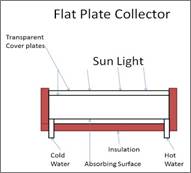
In a flat plate collector, the radiation energy of sun falls on a flat surface coated with black paint having high absorbing capacity. It is placed facing the general direction of sun. The materials used for the plate may be copper, steel or aluminum. The thickness of the plate is 1 mm to 2 mm. tubing of copper is provided in thermal contact with the plate.
Heat is transferred from the absorber plate to water which is circulated in the copper tubes through the flat plate collector.
Thermal insulation is provided behind the absorber plate to prevent heat losses from the rear surface. Insulation material is generally fiber glass or mineral wool. The front cover is made up of glass and it is transparent to the in-coming solar radiation.

Cylindrical parabolic concentrator collector:
Concentrator collectors are of reflecting type utilizing mirrors. The reflecting surface may be a parabolic mirror. The solar energy falling on the collector surface is reflected and focused along a line where the absorber tube is located. As large quantity of energy falling on the collector surface is collected over a small surface, the temperature of absorber fluid is very much higher than in flat plate collector.
While flat plate collectors may be used to heat water upto 80’C (low temperature), the concentrating type of collectors are designed to heat water to medium and high temperature ranges.
Butane boilers:
The water heated in flat plate solar collector to 80’C is used for boiling butane at high pressure in the butane boiler. Boiling point of butane is about 50’C.
Turbine:
The butane vapour generated at high pressure in the boiler is used to run the vapour turbine which drives the electrical generator.
The vapour coming out of the turbine at low pressure is condensed in a condenser using water. The condensed liquid butane is fed back to the butane boiler using feed pump.

Tower concept for power generation:


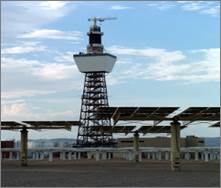
Steam is generated in the boiler, which may attain a temperature upto 2000’K.
Electricity is generated by passing steam through the turbine coupled to a generator. A 50 KW plant based on this concept has been built and successfully operated in Italy.

Advantages of solar power plant:

1.    Sun is essentially an infinite source of energy. Therefore solar energy is very large inexhaustible and renewable source of energy and is freely available all over the world.
2.    It is environmentally very clean and is hence pollution-free.
3.    It is dependable energy source without new requirements of a highly technical and specialized nature for its wide spread utilization.

Disadvantages of solar power plant:

1.    It is available in a dilute form and is at a low potential. The intensity of solar energy on sunny day in India is about 1.1 KW/Square meter area. Hence very large collecting areas are required.
2.    Also the dilute and diffused nature of the solar energy needs large land area for the power plant; for instance, about 30 square kilometer area is required for a solar power station to replace a nuclear plant on a 1 square kilometer site. Hence capital cost is more for the solar plant.
3.    Solar energy is not available at night or during cloudy or rainy days.


In the future all electronic devices will be wirelessly powered. Small, battery-powered gadgets make powerful computing portable.

Title: 02-powermat-iphone-4-wireless-battery-charger-wireless charging mat-wireless receiver case-new wireless technology - Description: 02-powermat-iphone-4-wireless-battery-charger-wireless charging mat-wireless receiver case-new wireless technology

The battery charger should be capable of charging the most common battery types found in portable  devices today.  In addition, the charging  should be  controlled from the base station and a bidirectional communication system between  the pickups  and base  station  should be developed.
Inductive Power Systems:
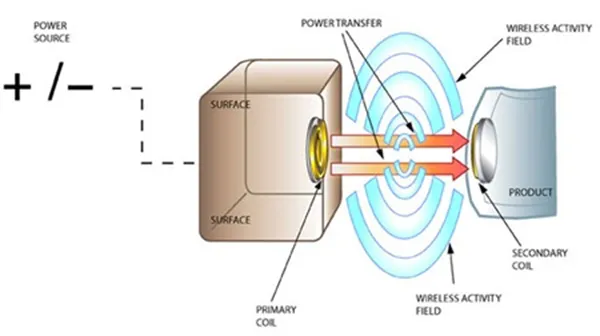
Inductive Power Transfer (IPT)  refers to the concept of transferring electrical power between two isolated circuits across an air gap.  While based on the work and concepts developed by pioneers such as  Faraday and Ampere, it  is  only recently that IPT has been developed into working systems.
Essentially, an IPT system can be divided into two parts;
       Primary and
       Secondary.
The primary side of the system is made up of a resonant power supply and a coil. This power supply produces a high frequency sinusoidal current in the coil.  The secondary side (or ‘pickup’) has a smaller coil, and a converter to produce a DC voltage.
Title: 01-ecoupled wirelss charging technology-inductive coupling-keep battery life higher-concept-illustration - Description: 01-ecoupled wirelss charging technology-inductive coupling-keep battery life higher-concept-illustration
Working of Inductive Power Transfer:
In this system communications signals are encoded onto the waveform that provides power to the air gap. Communication from the primary side to the secondary is implemented by switching the power signal at the output of the resonant converter between its normal level  and a lower level which is detectable by the pickup but still provides enough power to control the pickup microcontroller. This process is called Amplitude Shift Keying (ASK). This is achieved by varying the output voltage of the buck converter which provides an input DC voltage to the resonant converter.
Title: 01-electric vehicles-charging-batteries-wireless charging of electric cars-Delphi_Witricity_Wireless - Description: 01-electric vehicles-charging-batteries-wireless charging of electric cars-Delphi_Witricity_Wireless
Communication from the secondary to the primary is achieved by a process called Load Shift Keying (LSK).  This involves varying the loading on the pickup.   Any load on the pickup will reflect a voltage on the primary circuit proportional to the load.  Therefore a variation in the load on the pickup can be detected by the charging station.
The communications system must provide two discrete levels of voltage reflected onto the primary side,  to represent the on and off states for digital communications. The difference must be easily detected on the primary side to provide a robust communications channel. Signals are decoded by simple filters and comparators which feed a  digital signal to the microcontrollers.
Advantages:
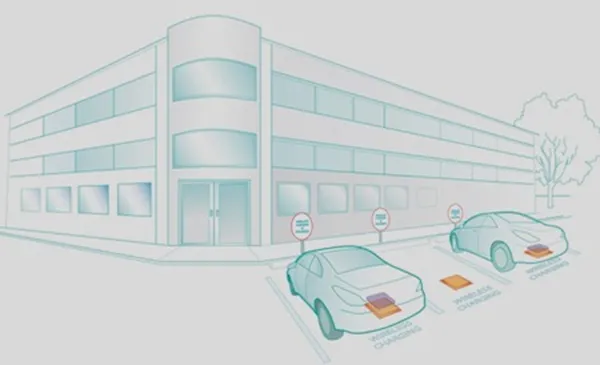
Title: EV wireless charging parking 9-29 - Description: EV wireless charging parking 9-29
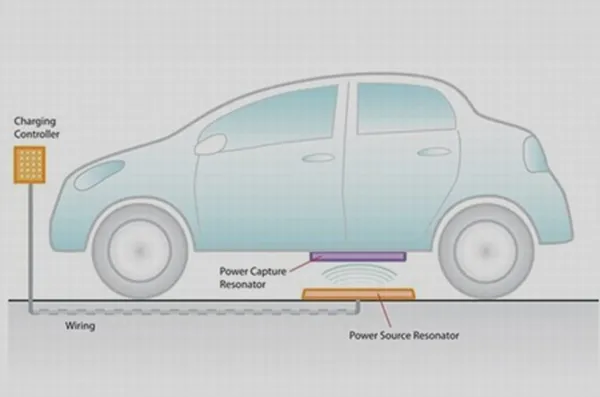
IPT has a number of advantages over other power transfer methods  – it is unaffected by dirt, dust, water, or chemicals.  In situations such as coal mining IPT prevents sparks and other hazards.  As the coupling is magnetic, there is no risk of electrocution even when used in high power systems.  This makes IPT very suitable for  transport  systems where vehicles follow a fixed track,  such as  in factory materials handling.

A rivet gun is a very useful tool that fastens metal parts with rivets. Working with a rivet gun can increase productivity without degrading the quality of the finished product. There is more to the operation of a rivet gun is more than just learning the triggering mechanism.

      A rivet gun is a special type of tool that is used to drive rivets into metallic objects to bind them. This tool is also known as a pneumatic hammer because it is a pneumatically powered tool, i.e., it uses pressurized gas to drive the force. When a rivet is used to fasten metal pieces, the gun produces the head of the rivet while a bucking bar is used to tighten tail. Rivet guns that are used for fastening steel parts are quite large while those used in aircraft assembling are comparatively small. They differ from air hammers only by the level of driving force; the underlying concept used in both the tools is same.

How the Rivet Gun Works

      There are various sizes and shapes of rivet guns with different handles and grips. The basic parts of a rivet gun are the regulator, throttle valve, trigger, piston, and rivet set. The regulator is used for adjusting the amount of air entering the tool. The air, controlled by regulator, passes through the throttle valve. A trigger present in the handgrip controls this throttle valve. When the trigger is pressed, the throttle valve opens immediately. The controlled air flows into the piston through the opened valve. The piston starts moving due to this pressurized air and opens a port from where air starts to escape. The moving piston strikes the rivet set on the tip of the rivet gun. This force is responsible for pushing the rivet towards the work piece against the buck. The buck then deforms the tail of the rivet fastening it in place. A spring then returns the piston to its original position.

Equipment Required

      Scrap piece of wood
      Safety glasses
      Air tool oil
      Drill
      Compressor

Riveting

      Preparing Rivet Gun for the Operation
      Lubricating the inside of the rivet gun is very important. Follow this procedure to lubricate all of the moving parts of the gun.
      Turn on the air compressor.
      Air fittings are located on the rivet gun, find them and add air tool oil to them.
      Attach the air line to the air fittings of the rivet gun.
      Press the trigger so that the O-rings present in the rivet gun are also lubricated.
      Prepare the Work Pieces
      Next, prepare the work pieces that need to be fastened.
      Decide on the type of joint you will use. If you want to apply a lap joint then place one part over another, for a butt joint butt the parts using other metal pieces over them on both sides.
      Place the combined work pieces on the table with a piece of wood beneath of them.
      You will need to drill holes in the metal pieces. Secure the desired size drill bit into the drill motor and drill the required number of holes through the metal pieces. Drilling of the holes should be done after selecting style of the riveting (for example straight or zigzag style).
      Set the Rivets into the Holes
      Insert rivets into the holes you drilled.
      Precision setting of the rivet gun is very important in this process. You have to position it onto the metal pieces at a 90 degree angle so that maximum pressure can be applied to the metal pieces and there is no slippage.
      Depress the trigger when the head of the rivet rests flush on the surface of the metal piece.
      Check the back side of the rivet to assure that the back side is tightened accurately.

Precautions When Using Rivet Gun

      The rivet gun should be lightly oiled every day before use.
      Do not press the trigger of the rivet gun without a set secured by a retained spring.
      When the rivet gun is not being used disconnect it from the air source.
      Disconnect the gun for routine maintenance or when sets are being changed.
      Always wear safety glasses when operating the rivet gun.

Summary

      The operation of a rivet gun requires a skill set that includes more than just operational knowledge. Maintenance of the gun and all of its moving parts is an essential component to ensuring a clean, flush rivet. Proper placement of rivets involves predrilling seat holes for the rivets and securing a buck to the back to give resistance to the pneumatic thrust. This resistance creates the pleat in the back of the rivet that secures it in place. Not following safety precautions or failing to assure a precise alignment of the rivet
Powered by Blogger.