Showing posts with label Aptitude. Show all posts

 Q1) Which of the suggested answers best matches the relationship between the shapes in the image? 
A, B, C, D 


Answer: 
The arrow changes direction and the shape on the right has 1 more side than its counterpart on the left. 
Correct Answer; D 


Q2) Which shape is the odd one out? 
A, B, C, D 


Answer 
This question is asking you to identify a rule that applies to all but one shape. Things to consider include what shapes are present, how many shapes are present, relative position, colour. In this example, there are 2 consistent rules the largest shape is consistently the same colour and the shape closest to the bottom of each square is orange. There is only one square that the latter rule doesn’t apply to. 
Correct Answer; C 

Q3) Which domino comes next in the sequence? 
A, B, C, D 

 
Answer 
This question is a bit trickier, as it is asking you to notice that there are two patterns appearing at the same time with alternating dominos. If you consider the 1st, 3rd and 5th dominos the pattern becomes more obvious; the top number is decreasing by 1 and the bottom is increasing by 1. Now look at the 2nd and 4th dominos, there is a similar progression happening with increasing and decreasing dots. 
Correct Answer; A


Answer: B

Explanation:
Weight B requires a force equal to 5 Kg whereas A requires a force equal to 10
Single pulley questions are relatively straightforward.
If the pulley is fixed, then the force required is equal to the weight. If the pulley moves with the weight, then the
force is equal to half of the weight.
Another way of thinking about this is to divide the weight by the number of sections of rope supporting it to obtain the force needed to
lift it.
In A there is only one section of rope supporting the weight, so 10/1 = 10Kg required to lift the weight. In B there are two sections of rope supporting the weight,
so, 10/2 = 5 Kg required to lift it.


The answer is A.
Explanation:
The lever is not the same length on both sides Of the fulcrum. As, whenever force is applied to a point more distant from the fulcrum, less force is needed to accomplish the same amount of work. Both levers must accomplish the same amount of work (i.e., move a 50 pound load); however, Lever A will do so more easily because there is more distance from the point of force to the fulcrum on Lever A than on Lever B.

More about Levers:

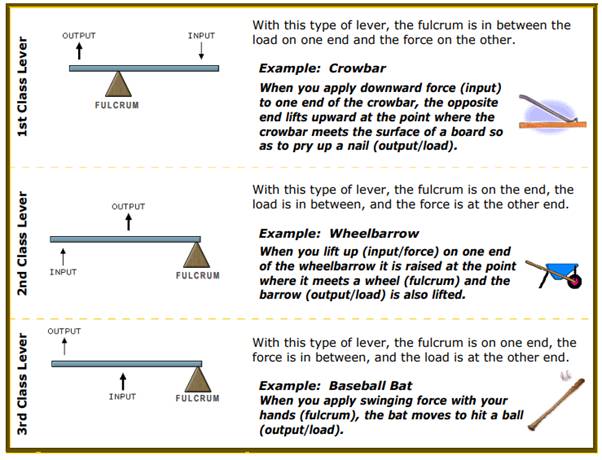
A lever is a simple machine made with a bar that moves on a surface point called a fulcrum. Force (input) is exerted upon the bar to move (output) an object or load. The following information about these simple machines will help you answer questions about how they work.

As depicted below, there are several types of levers which vary according to the location of the fulcrum:

Most questions about levers focus on the 1st class of lever and are generally designed to test your understanding of the concepts of leverage and weight distribution. 

Key Facts

·         The fulcrum can be moved depending on the weight of the load to be lifted or the force you wish to exert.

·         The closer the load is to the fulcrum, the easier it is to move.

·         The shorter side of a lever has more work to do to counter the effect of a longer side.

·         Generally, whenever force is applied to a point more distant from the fulcrum, less force is needed to accomplish the same amount of work (i.e., more leverage is given). Hence, an equal amount of force will do more work as it moves away from the fulcrum.


Answer is C

Regardless of their size, all free falling objects on Earth accelerate downwards at the same rate.


Gravity Summary

·         Essentially, gravity is the constant downward force that keeps people and objects on the Earth.

·         The force of gravity is such that it will create resistance for any other force or effort that tries to elevate an object above a resting point.

·         In general, the force of gravity exerted upon every object is the same, regardless of the object’s weight, size, shape, etc. Thus, objects moving only by the force of gravity (i.e., in free fall) will move at the same rate toward a resting point.


The answer is B.

Reason:
Because the boxes weigh the same and are on the same degree of incline,
the only factor to consider is the surface-to-surface contact area (friction), as indicated by
the dotted lines.
 As friction hinders the movement of an object. Thus, the box with less friction will slide down the ramp more easily. Considering
only the amount of contact (since the boxes are made of the same material), Box B has less
surface-to-surface Contact with the ramp when compared to Box A and the ramp. Thus, it
will move down the ramp more easily.

If the boxes were the same size and weight, and were made of the same material, gravity
would be the only factor affecting movement down the plane and they would move with
equal ease.
If the boxes had the same weight and size, but were made of different materials, it would
be impossible to determine which one moves more easily without information about the
materials. This is because the Smoothness or coarseness of the material on the surface
of an object affects the amount or degree of friction that is created when it is moved or
slid across another surface.


Powered by Blogger.