Showing posts with label Mechanical Engineering.. Show all posts

Pig iron is the crude form of iron and is used as a raw material for the production of various other ferrous metals, such as cast iron, wrought iron and steel. The pig iron is obtained by smelting iron ores in a blast furnace.

The iron ores are found in various forms as shown below:
The metallic contents of these iron ores are given in the following table:
The haematite is widely used for the production of pig iron. Since pyrite contains only 30 to 40% iron, therefore it is not used for manufacturing pig iron.
The pig iron is obtained from the iron ores in the following steps:
1. Concentration. It is the process of removing the impurities like clay, sand etc. from the iron ore by washing with water.
2. Calcination or roasting. It is the process of expelling moisture, carbon dioxide, sulphur and arsenic from the iron ore by heating in shallow kilns.
3. Smelting. It is process of reducing the ore with carbon in the presence of a flux. The smelting is carried out in a large tower called blast furnace.
The blast furnace is a chimney like structure made of heavy steel plates lined inside with fire bricks to a thickness of 1.2 to 1.5 metres. It is about 30 metres high with a maximum internal diameter of 9 meters as its widest cross-section. The portion of the furnace above its widest cross-section is called stack. The top most portion of the stack is called throat through which the charge is fed into the furnace. The charge of the blast furnace consists of calcined ore (8 parts), coke (4 parts) and lime stone (1 part). The portion of the furnace, below its widest cross-section is known as bosh or the burning zone (or zone of fusion). The bosh is provided with holes for a number of water jacketed iron blowing pipes known as tuyers. The tuyers are 12 to 15 in number and are connected to bustle pipe surrounding the furnace.

In the lower part of the blast furnace (called zone of fusion), the temperature is 1200° C to 1300° C. In the middle part of the blast furnace (called zone of absorption), the temperature is 800° C to 1000°C. In the upper part of the blast furnace (called zone of reduction), the temperature is 400° C to 700° C.

At the bottom of the blast furnace, the molten iron sinks down while above this floats the fusible stage which protects the molten iron from oxidation. The molten iron thus produced is known as pig iron. The slag from the blast furnace consists of calcium, aluminum and ferrous silicates. It is used as a ballast for rail roads, mixed with tar for road making and in the cement manufacture.

The pig iron from the blast furnace contains 90 to 92% of iron. The various other elements present in pig iron are carbon (1 to 5%), silicon ( 1 to 2%), manganese (1 to 2%), sulphur and phosphorus (1 to 2%).

Note : Carbon plays an important role in iron. It exists in iron in two forms i.e. either in a free form (as graphite) or in a combined form (as cementite and pearlite). The presence of free carbon in iron imparts softness and a coarse crystalline structure to the metal, while the combined carbon makes the metal hard and gives a fine grained crystalline structure.

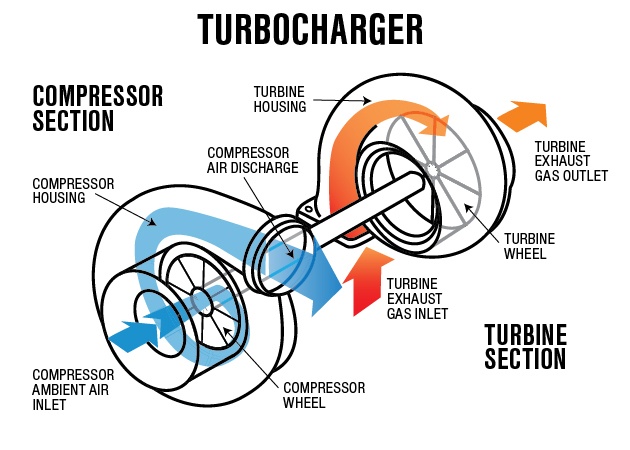


A turbocharger, (or turbo), is a turbine-driven forced induction device that increases an internal combustion engine’s efficiency and power output by forcing extra air into the combustion chamber.
The objective of a turbocharger is to improve an engine’s efficiency by increasing the density of the intake gas (usually air), thereby allowing more power per engine cycle.


How does it work?
A turbo is made up of two halves joined together by a shaft. On one side, hot exhaust gasses spin the turbine that is connected to another turbine which sucks air in and compresses it into the engine. This compression is what gives the engine the extra power and efficiency because as more air can go in the combustion chamber, more fuel can be added for more power.
The turbocharger’s compressor draws in ambient air and compresses it before it enters into the intake manifold at increased pressure. This results in a greater mass of air entering the cylinders on each intake stroke. The power needed to spin the centrifugal compressor is derived from the kinetic energy of the engine’s exhaust gases.
turbocharger-operation-diagram

Advantages
In addition to the extra power, turbochargers are sometimes referred to as devices that offer “free power” because unlike a supercharger, it does not require the engine’s power to drive it. The hot and expanding gasses coming out of the engine are what power a turbocharger so there is no drain of the engine’s net power. Turbocharged engines are also not affected in the same way as naturally aspirated engines are when they go at higher altitudes. The higher in altitude a naturally aspirated engine climbs, the harder it becomes for it to get oxygen due to the thinning atmosphere. A turbocharger gets around this problem because it forces the oxygen into the engine’s combustion chamber, sometimes at 2 times the pressure of the atmosphere.
Turbochargers also improve the fuel efficiency of a vehicle however there is a misconception when it comes to turbocharged vehicles and fuel efficiency. Taking a naturally aspirated engine and slapping on a turbocharger on it will not improve fuel efficiency. The way that manufacturers improve fuel efficiency though turbocharging is by down-sizing an engine and then turbocharging it. For example, take a 2.5L inline-4 cylinder naturally aspirated engine and decrease the displacement to 1.4L and then turbocharger it. The smaller, turbocharged engine would still have the same performance figures (or slightly better) but because of the smaller displacement, it would also use less fuel.
Disadvantages
Turbochargers have 2 main disadvantages when compared to a naturally aspirated or supercharged engine. Firstly is heat. Because a turbo is powered by hot exhaust gasses, it gets very hot. Sometimes under certain engine conditions, the turbocharger itself could start glowing red but of course this doesn’t happen in everyday driving conditions; it happens when the engine is pushed to its limits for a continuous amount of time. This is why you see some turbocharged sports cars with vents in the hood or down the side, it’s to try to get air moving through the engine bay and keep things cool.
The other big disadvantage of a turbocharger is something called turbo lag. Under certain conditions, whenever you put your foot down on the throttle, there is a delay between the time you demand power from the engine and the moment you actually start to feel it. That is turbo lag. When the engine’s speed is low, there isn’t a lot of exhaust gasses passing through the turbocharger so when you do demand power from the engine, the turbocharger turbine needs time to start spinning at an optimal speed. The effects of this can be reduced by downshifting to a lower gear but keen drivers can still sometimes notice the split delay in response.


Powered by Blogger.