Showing posts with label Thermodynamics. Show all posts

High velocities and a direct and severe entry into an atmosphere induce very high heat loads on a craft, passing through different flow regimes and thus involving different flow theories (kinetic, continuum etc.). Heat fluxes are high and phenomena such as ablation and radiation are strong. As a consequence, modelling these phenomena is a difficult task.

Within the different flux regimes of the entry, the stability of the capsule must be ensured for the sake of mission safety. Generally, the stability of blunt bodies is good at high Mach numbers but these shapes suffer a loss of dynamic stability at low supersonic and transonic Mach numbers.
The unsteady aerodynamic coefficients have to be predicted for this range of Mach numbers to analyse the behaviour of selected shapes from an aerodynamic point of view.The only available solution to ensure the stability of the vehicle is to study selected vehicle shapes adapted to direct entry. This involves looking at radiation and ionization processes and related impacts which are essential to perform the design of the thermal protection system.
The main and final objective is to assess and improve the research, tools and methodologies for the design of heat shields and capsules for high-speed entry. Work will be focused on an Earth vehicle demonstrator but will help in addressing aerocapture issues.
In this framework, the activity can be split into two phases. First, past experience of the existing physical and numerical models for the phenomena affecting high-speed entry will be reviewed together with existing test facilities and their capabilities. The activity shall also allow the definition of requirements for measurement techniques, flight instruments, flow conditions and environments applicable to the study. Two vehicle shapes will be analysed for which only the cone angle will be different (45 and 60 degrees).
Within the second phase, technology applications will be described and the tool limits and potentials will be assessed. This phase will be mainly devoted to test campaigns and numerical modelling. The requirement and feasibility of developing new models and instruments will be evaluated along with the uncertainties involved. The possibility of performing accurate test campaigns both with ground facilities and in-flight will be analysed in order to validate and improve shape design and existing tools.
Whilst this activity will benefit from past experience from the ARD capsule and the Hermes Programme, Earth re-entry from a Mars trajectory is even more challenging because of the higher speed and higher loads to be faced. Hence this activity has to be integrated together with other related activities (TPS ablators) in the overall technology strategy towards the aim of returning samples back to Earth.

Following are the Four laws of thermodynamics : 
(Zeroth law of thermodynamics, First law of thermodynamics ,Second law of thermodynamics ,Third law of thermodynamics).
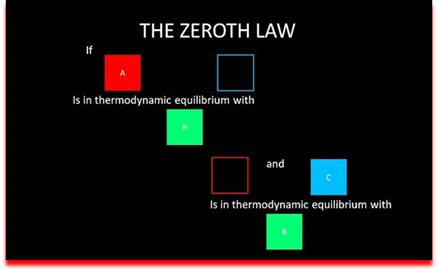
Zeroth law of thermodynamics. This law states that when two bodies are in thermal equilibrium with a third body, they are also in thermal equilibrium with each other
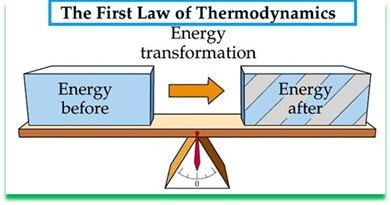
First law of thermodynamics. This law states that the heat and mechanical work are mutually convertible. According to this law, a definite amount of mechanical work is needed to produce a definite amount of heat and vice versa.
This law also states that the energy can neither be created nor destroyed, though it can be transformed from one form to another. According to this law, the energy due to heat supplied (Q) must be balanced by the external work done (W) plus the gain in internal energy (E) due to rise in temperature. In other words,
Q= W + E
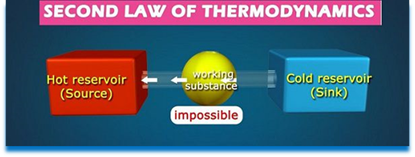
Second law of thermodynamics. This law states that there is a definite limit to the amount of mechanical energy, which can be obtained from a given quantity of heat energy.
According to Claussius, this law may be stated as "It is impossible for a self acting machine working in a cyclic process, to transfer heat from a body at a lower temperature to a body at a higher temperature without the aid of an external agency".
The second law of thermodynamics has also been stated by Kelvin-Planck as "It is impossible to construct an engine working on a cyclic process, whose sole purpose is to convert heat energy in to work." According to this statement, the second law of thermodynamics is sometimes called as law of degradation of energy.
Third Law of Thermodynamics .
The Third Law of Thermodynamics is the lesser known of the three major thermodynamic laws. Together, these laws help form the foundations of modern science. The laws of thermodynamics are absolute physical laws - everything in the observable universe is subject to them. Like time or gravity, nothing in the universe is exempt from these laws. In its simplest form, the Third Law of Thermodynamics relates the entropy (randomness) of matter to its absolute temperature. 

The Third Law of Thermodynamics refers to a state known as "absolute zero." This is the bottom point on the Kelvin temperature scale. The Kelvin scale is absolute, meaning 0° Kelvin is mathematically the lowest possible temperature in the universe. This corresponds to about -273.15° Celsius, or -459.7 Fahrenheit. 

In actuality, no object or system can have a temperature of zero Kelvin, because of the Second Law of Thermodynamics. The Second Law, in part, implies that heat can never spontaneously move from a colder body to a hotter body. So, as a system approaches absolute zero, it will eventually have to draw energy from whatever systems are nearby. If it draws energy, it can never obtain absolute zero. So, this state is not physically possible, but is a mathematical limit of the universe. 

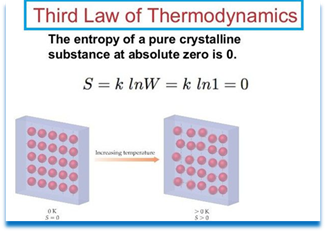
In its shortest form, the Third Law of Thermodynamics says: "The entropy of a pure perfect crystal is zero (0) at zero Kelvin (0° K)." Entropy is a property of matter and energy discussed by the Second Law of Thermodynamics. The Third Law of Thermodynamics means that as the temperature of a system approaches absolute zero, its entropy approaches a constant (for pure perfect crystals, this constant is zero). A pure perfect crystal is one in which every molecule is identical, and the molecular alignment is perfectly even throughout the substance. For non-pure crystals, or those with less-than perfect alignment, there will be some energy associated with the imperfections, so the entropy cannot become zero. 

The Third Law of Thermodynamics can be visualized by thinking about water. Water in gas form has molecules that can move around very freely. Water vapor has very high entropy (randomness). As the gas cools, it becomes liquid. The liquid water molecules can still move around, but not as freely. They have lost some entropy. When the water cools further, it becomes solid ice. The solid water molecules can no longer move freely, but can only vibrate within the ice crystals. The entropy is now very low. As the water is cooled more, closer and closer to absolute zero, the vibration of the molecules diminishes. If the solid water reached absolute zero, all molecular motion would stop completely. At this point, the water would have no entropy (randomness) at all. 

Most of the direct use of the Third Law of Thermodynamics occurs in ultra-low temperature chemistry and physics. The applications of this law have been used to predict the response of various materials to temperature changes. These relationships have become core to many science disciplines, even though the Third Law of Thermodynamics is not used directly nearly as much as the other two. 

Study of the Third Law of Thermodynamics mainly supports the implications of the first two laws. However, some questions do arise. The Third Law of Thermodynamics demonstrates another detectable, absolute, all-encompassing, important natural law. The Laws of Thermodynamics demonstrate very ordered rules of energy interactions, which the entire universe must obey. Why is the Third Law of Thermodynamics true? Why are there no exceptions in the entire universe? This law cannot be an accident, since none of the thermodynamic laws are random. Organization implies an Organizer. Design implies a Designer. If the laws are not random, then who created them? 


The zeroth law of thermodynamics states that if two systems are both in thermal equilibrium with a third system, then the first two systems are also in thermal equilibrium with each other.
Key Takeaways: Zeroth Law of Thermodynamics
  • The zeroth law of thermodynamics is one of the four laws of thermodynamics, which states that if two systems are in thermal equilibrium with a third system, then they are in thermal equilibrium with one another.
  • Thermodynamics is the study of the relationship between heat, temperature, work, and energy.
  • Most generally, equilibrium refers to a balanced state that does not change overall with time.
  • Thermal equilibrium refers to the situation where two objects that can transfer heat to each other stay at a constant temperature over time.
Understanding Thermodynamics
Thermodynamics is the study of the relationship between heat, temperature, work—which is performed when a force applied to an object causes that object to move—and energy, which comes in many forms and is defined as the capacity to do work. The four laws of thermodynamics describe how the fundamental physical quantities of temperature, energy, and entropy change in various situations.
As an example of thermodynamics in action, placing a pot of water on a heated stove will cause the pot to heat up because heat is transferred to the pot from the stove. This in turn causes the molecules of water to bounce around in the pot. The faster movement of these molecules is observed as hotter water.
If the stove had not been hot, it would not have transferred any thermal energy to the pot; thus, the water molecules could not have begun moving faster and the pot of water would not have heated up.
Thermodynamics emerged in the 19th century, when scientists were building and improving steam engines, which use steam to help move an object such as a train.
Understanding Equilibrium
Most generally, equilibrium refers to a balanced state that does not change overall with time. This does not mean that nothing is happening; rather, that two influences or forces are balancing each other out.
Consider, for example, a weight hanging from a string attached to the ceiling. At first, the two are in equilibrium with one another and the string does not break. If more weight is attached to the string, however, the string will be tugged downward and may eventually break as the two are no longer in equilibrium.
Thermal Equilibrium
Thermal equilibrium refers to the situation where two objects that can transfer heat to each other stay at a constant temperature over time. Heat can be transferred several ways, including if the objects are in contact with one another or if heat is radiated from a source like a lamp or a sun. Two objects are not in thermal equilibrium if the overall temperature changes with time, but they can approach thermal equilibrium as the hotter object transfers heat to the colder one.
Consider, for example, a colder object touching a hotter object—like ice that has been dropped in a hot cup of coffee. After some time, the ice (later water) and the coffee will reach a certain temperature that is in between that of the ice and the coffee. Though the two objects were not in thermal equilibrium at the beginning, they approach—and eventually reach—thermal equilibrium, the temperature in between the hot and cold temperatures.
What Is the Zeroth Law of Thermodynamics?
The zeroth law of thermodynamics is one of the four laws of thermodynamics, which states that if two systems are in thermal equilibrium with a third system, then they are in thermal equilibrium with one another. As seen from the above section on thermal equilibrium, these three objects will approach the same temperature.
Applications of the Zeroth Law of Thermodynamics
The zeroth law of thermodynamics is seen in many everyday situations.
  • The thermometer may be the most well-known example of the zeroth law in action. For example, say the thermostat in your bedroom reads 67 degrees Fahrenheit. This means that the thermostat is in thermal equilibrium with your bedroom. However, because of the zeroth law of the thermodynamics, you can assume that both the room and other objects in the room (say, a clock hanging in the wall) are also at 67 degrees Fahrenheit.
  • Similar to the above example, if you take a glass of ice water and a glass of hot water and place them on the kitchen countertop for a few hours, they will eventually reach thermal equilibrium with the room, with all 3 reaching the same temperature.
  • If you place a package of meat in your freezer and leave it overnight, you assume that the meat has reached the same temperature as the freezer and the other items in the freezer


Thermodynamics is a Greek work Thermo, which means heat and dynamic force. It is a branch of physics which deals with the temperature and their relationship between the work and energy. It defines the variables like Entropy, enthalpy and equilibrium. The thermodynamics deal with the system in equilibrium.


Classification of Thermodynamics:
Thermodynamics are classified into two types they are
  • Equilibrium Thermodynamics
  • Non-equilibrium thermodynamics
Equilibrium thermodynamics are further divided into three types they are

  • Classical Thermodynamics
  • Kinetic Theory
  • Statistical Thermodynamics
Classical Thermodynamics:
Classical thermodynamics is a science which deals with the large-scale and microscopic properties of matter. Common parameters are coefficient of expansion, specific heat capacities, compressibility, magnetic and dielectric coefficient, heat transformations etc., are established with the help of the classical thermodynamics. We cannot determine the actual magnitude with the help of the classical thermodynamics.
Kinetic Theory:
Kinetic energy is used to identify the numerical values of the individual quantities. It deals with the molecular models in which, an individual molecule monitor the laws of mechanism.
Statistical Thermodynamics:
Statistical thermodynamics ignores the detailed consideration of molecules as individuals and the statistical considerations are applied to find the distribution of a large number of molecules that make up a macroscopic piece of matter over their energy states.
Non-equilibrium thermodynamic is also known as irreversible thermodynamics.
Irreversible thermodynamics is also another branch of thermodynamics, which deals with the non-equilibrium irreversible processes.
Classical Thermodynamics:
Thermodynamic system:
“A thermodynamic system is defined as the quantity of the matter or a region in the space upon which attention is concentrated in the analysis of a problem”.
The quantity of the matter can vary as solids, liquids or gases, electric field, magnetic field or even photons.
System are classified into three types they are
  • Open system
  • Closed system
  • Isolated system
Closed system:
In a closed system, there is no mass transfer but the energy transfer takes place.
Open system:
In an open system, there is both mass and energy transfer that takes place. The boundary line is observed in broken or dotted lines.
Isolated system:
In an isolated system, there is no mass and energy transfer across the boundary.
Boundary:
The separation between the system and the surroundings is known as the boundary. The boundary may be real or imaginary. The shape and size may increase or decrease.
Surroundings:
The entire space around the system is known as the surroundings. By using different types of walls, the system and the surrounding are divided. The walls are classified as diathermal, rigid wall, and adiabatic walls.
Diathermal Wall: With the help of the diathermal wall the system is supposed to communicate thermally with its surroundings. If two systems are separated with the help of the diathermal wall then it is known as the thermal contact.
Rigid walls: The rigid walls restrict to bring changes in the volume of the system
Adiabatic Wall: It is the one that is impermeable to the thermal energy. With the help of the wall between the system and the surrounding, the thermal interaction is restricted cut off.
Properties:
We can see two properties they are intensive property and extensive property
Intensive Property:
The system which is independent of the size is known intensive property. Pressure and temperature are the properties of the intensive system.
Extensive properties:
Extensive property depends upon the size of the system. The volume of the system is an example of the extensive property.
The ratio of mass to the extensive property or the property for unit mass or mole is known as specific property.
The ration of an extensive property to the number of moles of the substance, within a system or the property per mole of the substance is known as the molar property.
Energies associated with the thermodynamic processes:
Potential energy:
The energy possessed by a body by virtue of its position is known as the potential energy.
PE = mgh
where,
m= mass of the body,
g = acceleration due to gravity (9.8 ) and
h = height from the ground
Kinetic Energy:
The energy possessed by a body by virtue of its motion is known as the kinetic energy.
KE = 1/2 
where,
m = mass of the body and
v = velocity of moving particle
A thermodynamic system consists of a fluid; it may possess both the potential energy and kinetic energy. The potential energy plus the kinetic energy are expressed in macroscopic terms, and the quantities are measured directly. The thermodynamic system may possess constitute macroscopic form of mechanical energy. The potential energy and kinetic energy are in the form of inter-convertible. Matter is composed of molecules or atoms which have the capacity to rotate, translate and vibrate. With respect to the motion of electrons, intra-atomic interactions, spin of electrons are associated with the energy. Molecules which are in inter-molecular interaction are in electromagnetic nature mainly at short intermolecular separation distance.
All the energy is in the microscopic form, and are not readily to estimate in terms of macroscopic measurable properties of matter. The microscopic form of energy is different from the kinetic energy and the potential energy of a system, or body and they are normally independent of the velocity or position of the body. Due to the macroscopic mode the energy possessed by the matter, the motion is referred as an internal energy. The microscopic transformation is observed in the thermodynamic system. In the thermodynamic system and its surroundings, the exchange may take place through the system boundary as either work or heat or both.
Laws of Thermodynamics:
Thermodynamic laws are divided into four types they are
  • Zeroth law of thermodynamics
  • First law of thermodynamics
  • Second law of thermodynamics
  • Third law of thermodynamics
 Zeroth law of thermodynamics

If the two systems are in thermal equilibrium with the third system then it known as the zeroth law of thermodynamics. And the two systems are thermal equilibrium with each other.
First law of thermodynamics:
According to the first law of thermodynamics the energy can be transformed, but the energy cannot be destroyed or created. The energy must pass in the form of heat, work, or matter into the system or outside of the system.
Second Law of Thermodynamics:
According to the natural thermodynamic process increase in the participating thermodynamics system, takes place with the sum of the entropies.
Third Law of Thermodynamics:
The third law of thermodynamics introduces the absolute entropy concept. When the total entropy of the pure elements approaches zero degrees, as the absolute temperature elements zero degrees.



Powered by Blogger.