Energy is the ability to do work. It is what makes matter move or change.
Energy helps you walk across the street, throw a ball into the air, vacuum your house, watch television and ride the bus to school. Some of the above are possible because we have figured out how to convert energy from one form into another and use it to do our work.
Types of energy
There are many types of energy, but they can be categorized into 2 types:
Potential energy
Kinetic energy
Potential Energy has 4 forms:
Chemical energy – the energy stored in the bonds between atoms that holds molecules together
Nuclear energy – the energy stored in the nucleus of the atom that holds the nucleus together
Gravitational energy – the energy an object has because of its position or height
Elastic energy – or stored mechanical energy, is energy stored in an object by the application of force
Kinetic Energy has 5 forms:
Mechanical energy – or motion, is the movement of objects or substances from one place to another
Electrical energy – the energy from flow of electric charge (movement of electrons in one direction)
Thermal energy – or heat energy, the internal energy of a substance due to the vibration of atoms and molecules making up the substance
Radiant energy – or light energy, or electromagnetic energy that travels in transverse waves
Sound energy – the movement of energy through substances in the form of compression waves
As we know that inverters are finding their extensive uses now a days. Previously they were only used in some main applications, which would be large scale and expensive. But now a days, inverters are like a small compulsory electronic device, on which many of our other main electronic equipment depend.They are extensively used, not only because of their universal function of converting DC power to AC power, but also because of their high efficiency, reduced power costs and versatile applications.
These days, they are being used extensively in applications where there is a frequent power cut off, because in case of power failures, inverters are a very good and efficient power remedies. For every classification, we form some basis first, depending upon which we can further categorize our results for easier understanding and a better approach. This is done in order to promote better understanding and a more extensive classification of different things.In the same way, we primarily classify inverters on the basis of their output characteristics. So there are three different types of outputs we get from inverters, and hence we classify inverters into three primary classes, which are:
The Square Wave inverter.
The Modified Sine wave inverter or quasi sine wave inverter.
A Pure sine wave inverter
The Square Wave inverter
A square wave inverter is one of the simplest inverter types, which convert a straight DC signal to a phase shifting AC signal. But the output is not pure AC, i.e. in the form of a pure sine wave, but it is a square wave.At the same time they are cheaper as well. The simplest construction of a square wave inverter can be achieved by using an on-off switch, before a typical voltage amplifying circuitry like that of a transformer. The output of this type of a circuit is a square wave.
The modified Sine wave inverter
The construction of this type of inverter is a bit more complex than a simple square wave inverter, but still it is a lot simpler than a pure sine wave inverter.A Modified sine wave shows some pauses before the phase shifting of the wave, i.e. unlike a square it does not shift its phase abruptly from positive to negative, or unlike a sine wave, does not make a smooth transition from positive to negative, but takes brief pauses and then shifts its phase.It is also called as quasi sine wave inverter.
A Pure Sine Wave Inverter
The electrical circuit of a pure sine wave inverter is far more complex than a square wave or modified sine wave inverter. Another way to obtain a sine output is to obtain a square wave output from a square wave inverter and then modify this output to achieve a pure sine wave. A pure sine wave inverter has several advantages over its previous two forms:
More efficiency, hence consumes less power.
They can be adjusted according to your personal power requirements, since several types are available with different power outputs.
The output of a pure sine wave inverter is very reliable, but at the same time, there is a tradeoff between the price and reliability.
Due to this reason they are the best option for sensitive equipment.
The first biochip was invented by an American company namely Affymetrix, and the product of this company is GeneChip (DNA microarrays). These products comprise the number of individual DNA sensors used for sensing defects. Biochip plays an essential role in the field of biology research like systems biology as well as disease biology while the number of clinical applications is rising. It is a set of microarrays which are placed on a strong surface of a substrate to allow thousands of reactions to be performed in less time. The development of biochip mainly includes the combination of molecular biology, biochemistry, and genetics. Biochips are used for analyzing organic molecules connected with a live organism. This article discusses about a Biochip, its types,their uses, disadvantages, and its applications.
What is a Biochip?
A biochip is a set of diminished microarrays that are placed on a strong substrate that allows many experiments to be executed at the same time to obtain a high throughput in less time. This device contains millions of sensor elements or biosensors. Not like microchips, these are not electronic devices. Each and every biochip can be considered as a microreactor that can detect a particular analyte like an enzyme, protein, DNA, biological molecule or antibody. The main function of this chip is to perform hundreds of biological reactions in a few seconds like decoding genes (a sequence of DNA).
Working Principle of a Biochip:
The working of Biochip mainly includes the following steps.
Step1: The operator generates a low-power electromagnetic field through radio signals
Step2: The fixed biochip gets turn on
Step3: The activated chip transmits the identification code reverse to the operator through radio signals
Step4: Reader strengthens the received code to change it into digital form and finally exhibits it on LCD.
Components of BioChips
The Biochip comprises two components namely the transponder as well as reader.
1) Transponder
Transponders are two types’ namely active transponder and passive transponder. This is a passive transponder which means that it doesn’t contain any of its own energy or battery whereas in passive, it is not active until the operator activates it by giving it a low electrical charge. This transponder consists of four parts such as antenna coil, computer microchip, glass capsule, and a tuning capacitor.
The computer microchip stores a unique identification (UID) number that ranges from 10 digits to 15 digits long.
The antenna coil is very small, primitive and this type of antenna is used to send and receive the signals from the scanner or reader.
The charging of the tuning capacitor can be done with the small signal i.e, 1/1000 of a watt which is sent by the operator.
The glass capsule holds the antenna coil, capacitor, and microchip, and it is made with a biocompatible material namely soda lime glass.
2) Reader
The reader comprises of a coil namely “exciter” and it forms an electromagnetic field through radio signals. It offers the required energy (<1/1000 of a watt) to activate the biochip. The reader carries a receiving coil for receiving the ID number or transmitted code sent back from the excited implanted biochip.
Types of Bio chips
1) DNA Microarray
A DNA microarray or DNA biochip is a set of tiny DNA spots fixed to a strong surface. A researcher utilizes to calculate the expression levels for a large number of genes. Every DNA mark comprises picomoles of particular genes which are termed as probes. These can be a short segment of a genetic material under high rigidity situations. Usually, probe-target hybridization is noticed and counted by recognition of fluorophore or chemiluminescence labeled targets to decide the relative quantity of nucleic acid series in the target. Innovative arrays of nucleic acid were macro arrays about 9 cm X 12 cm and the initially automated icon based analysis was published in the year 1981.
2) Microfluidic Chip
Microfluidic biochips or lab-on-a-chip are a choice to usual biochemical laboratories and are transforming several applications like DNA analysis, molecular biology procedures, proteomics which is known as the study of proteins and diagnostic of diseases (clinical pathology). These chips are becoming more complex by using 1000’s of components, but those components are designed physically called as bottom-up full-custom plan, which is a very large workforce.
3) Protein Microarray
A protein microarray or protein chip method is used to follow the actions as well as connections of proteins, and to find out their function on a large scale. The main advantage of protein microarray is that we can track a large number of proteins in parallel. This protein chip comprises of a surface for supporting like microtitre plate or bead, nitrocellulose membrane, the glass slide. These are automated, rapid, economical, very sensitive, consumes less quantity of samples. The first methodology of protein chips was introduced in antibody microarrays of scientific publication in the year 1983. The technology behind this chip was quite easy to develop for DNA microarrays, which have turned into the most generally used microarrays.
Biochips Advantages and Disadvantages
The advantages of biochip include the following.
The biochip is used to rescue the sick
Very small in size, powerful and faster.
Biochips are useful in finding the lost people
Biochips can be used to identify the persons individually
Biochips perform thousands of biological reactions in a few seconds.
The disadvantages of biochip include the following.
Biochips are expensive
Biochip raises dangerous problems of individual privacy.
Biochip marks the end of human being liberty and self-respect.
There will be a chance of turning every person into a controlled person
Biochips can be fixed into the human’s body without their interference.
Biochips Applications
The applications of biochip include the following.
By using this chip we can trace a person or animal anywhere in the world.
This chip is used to store and update the information of a person like medical financial and demographics.
A biochip leads to safe E-commerce systems
These chips are effective in restoring the records of medical, cash, passport, etc.
The biochip can be applicable in the medical field as a BP sensor, glucose detector, and oxygen sensor.
From the above-discussed information finally, we can conclude that biochips are accurate, fast, and miniaturized. The biochip space lies at the intersection between chip manufacturing, molecule biology, genomics, and signal processing. The market for Biochips and its applications has been increased in a number of core research regions.
It is the process used to help identify the correctness, completeness, security, and quality of developed computer software. Testing is a process of technical investigation, performed on behalf of stakeholders, that is intended to reveal quality-related information about the product with respect to the context in which it is intended to operate. This includes, but is not limited to, the process of executing a program or application with the intent of finding errors. Quality is not an absolute; it is value to some person. With that in mind, testing can never completely establish the correctness of arbitrary computer software; testing furnishes a criticism or comparison that compares the state and behavior of the product against a specification. An important point is that software testing should be distinguished from the separate discipline of Software Quality Assurance (SQA), which encompasses all business process areas, not just testing.
White box and black box testing are terms used to describe the point of view a test engineer takes when designing test cases. Black box being an external view of the test object and white box being an internal view. Software testing is partly intuitive, but largely systematic. Good testing involves much more than just running the program a few times to see whether it works. Thorough analysis of the program under test, backed by a broad knowledge of testing techniques and tools are prerequisites to systematic testing. Software Testing is the process of executing software in a controlled manner.Software testing is just one kind of verification, which also uses techniques as reviews, inspections, walk-through. Validation is the process of checking what has been specified is what the user actually wanted.
A dam is a hydraulic structure of fairly impervious material built across a river to create a reservoir on its upstream side for impounding water for various purposes. These purposes may be Irrigation, Hydropower, Water-supply, Flood Control, Navigation, Fishing and Recreation. Dams may be built to meet the one of the above purposes or they may be constructed fulfilling more than one. As such, Dam can be classified as: Single-purpose and Multipurpose Dam.
Different parts & terminologies of Dams:
Dam illustration
§Crest: The top of the Dam. These may in some cases be used for providing a roadway or walkway over the dam.
Parapet walls: Low Protective walls on either side of the roadway or walkway on the crest.
Heel: Portion of Dam in contact with ground or river-bed at upstream side.
Toe: Portion of dam in contact with ground or river-bed at downstream side.
Spillway: It is the arrangement made (kind of passage) near the top of dam for the passage of surplus/ excessive water from the reservoir.
Abutments: The valley slopes on either side of the dam wall to which the left & right end of dam are fixed to.
Gallery: Level or gently sloping tunnel like passage (small room like space) at transverse or longitudinal within the dam with drain on floor for seepage water. These are generally provided for having space for drilling grout holes and drainage holes. These may also be used to accommodate the instrumentation for studying the performance of dam.
Sluice way: Opening in the dam near the base, provided to clear the silt accumulation in the reservoir.
Free board: The space between the highest level of water in the reservoir and the top of the dam.
Dead Storage level: Level of permanent storage below which the water will not be withdrawn.
Diversion Tunnel: Tunnel constructed to divert or change the direction of water to bypass the dam construction site. The dam is built while the river flows through the diversion tunnel.
Various types of dams
Dams can be classified in number of ways. But most usual ways of classification of dams are mentioned below:
Based on the functions of dam, it can be classified as follows:
Storage dams: They are constructed to store water during the rainy season when there is a large flow in the river. Many small dams impound the spring runoff for later use in dry summers. Storage dams may also provide a water supply, or improved habitat for fish and wildlife. They may store water for hydroelectric power generation, irrigation or for a flood control project. Storage dams are the most common type of dams and in general the dam means a storage dam unless qualified otherwise.
Diversion dams: A diversion dam is constructed for the purpose of diverting water of the river into an off-taking canal (or a conduit). They provide sufficient pressure for pushing water into ditches, canals, or other conveyance systems. Such shorter dams are used for irrigation, and for diversion from a stream to a distant storage reservoir. A diversion dam is usually of low height and has a small storage reservoir on its upstream. The diversion dam is a sort of storage weir which also diverts water and has a small storage. Sometimes, the terms weirs and diversion dams are used synonymously.
Detention dams: Detention dams are constructed for flood control. A detention dam retards the flow in the river on its downstream during floods by storing some flood water. Thus the effect of sudden floods is reduced to some extent. The water retained in the reservoir is later released gradually at a controlled rate according to the carrying capacity of the channel downstream of the detention dam. Thus the area downstream of the dam is protected against flood.
Debris dams: A debris dam is constructed to retain debris such as sand, gravel, and drift wood flowing in the river with water. The water after passing over a debris dam is relatively clear.
Coffer dams: It is an enclosure constructed around the construction site to exclude water so that the construction can be done in dry. A cofferdam is thus a temporary dam constructed for facilitating construction. A coffer dam is usually constructed on the upstream of the main dam to divert water into a diversion tunnel (or channel) during the construction of the dam. When the flow in the river during construction of the dam is not much, the site is usually enclosed by the coffer dam and pumped dry. Sometimes a coffer dam on the downstream of the dam is also required.
Based on structure and design, dams can be classified as follows:
Gravity Dams: A gravity dam is a massive sized dam fabricated from concrete or stone masonry. They are designed to hold back large volumes of water. By using concrete, the weight of the dam is actually able to resist the horizontal thrust of water pushing against it. This is why it is called a gravity dam. Gravity essentially holds the dam down to the ground, stopping water from toppling it over.
Gravity dams are well suited for blocking rivers in wide valleys or narrow gorge ways. Since gravity dams must rely on their own weight to hold back water, it is necessary that they are built on a solid foundation of bedrock.
Examples of Gravity dam: Grand Coulee Dam (USA), ( Nagarjuna Sagar Dam (India) and Itaipu Dam ( Between Brazil and Paraguay).
Earth Dams: An earth dam is made of earth (or soil) built up by compacting successive layers of earth, using the most impervious materials to form a core and placing more permeable substances on the upstream and downstream sides. A facing of crushed stone prevents erosion by wind or rain, and an ample spillway, usually of concrete, protects against catastrophic washout should the water overtop the dam. Earth dam resists the forces exerted upon it mainly due to shear strength of the soil. Although the weight of the earth dam also helps in resisting the forces, the structural behavior of an earth dam is entirely different from that of a gravity dam. The earth dams are usually built in wide valleys having flat slopes at flanks (abutments).The foundation requirements are less stringent than those of gravity dams, and hence they can be built at the sites where the foundations are less strong. They can be built on all types of foundations. However, the height of the dam will depend upon the strength of the foundation material.
Examples of earthfill dam: Rongunsky dam (Russia) and New Cornelia Dam (USA).
Rockfill Dams: A rockfill dam is built of rock fragments and boulders of large size. An impervious membrane is placed on the rockfill on the upstream side to reduce the seepage through the dam. The membrane is usually made of cement concrete or asphaltic concrete. In early rockfill dams, steel and timber membrane were also used, but now they are obsolete.
Mohale dam, Lesoto Africa
A dry rubble cushion is placed between the rockfill and the membrane for the distribution of water load and for providing a support to the membrane. Sometimes, the rockfill dams have an impervious earth core in the middle to check the seepage instead of an impervious upstream membrane. The earth core is placed against a dumped rockfill. It is necessary to provide adequate filters between the earth core and the rockfill on the upstream and downstream sides of the core so that the soil particles are not carried by water and piping does not occur. The side slopes of rockfill are usually kept equal to the angle of repose of rock, which is usually taken as 1.4:1 (or 1.3:1). Rockfill dams require foundation stronger than those for earth dams.
Examples of rockfill dam: Mica Dam (Canada) and Chicoasen Dam (Mexico)
Arch Dams: An arch dam is curved in plan, with its convexity towards the upstream side. An arch dam transfers the water pressure and other forces mainly to the abutments by arch action. An arch dam is quite suitable for narrow canyons with strong flanks which are capable of resisting the thrust produced by the arch action.
Hoover Dam, USA
The section of an arch dam is approximately triangular like a gravity dam but the section is comparatively thinner. The arch dam may have a single curvature or double curvature in the vertical plane. Generally, the arch dams of double curvature are more economical and are used in practice.
Examples of Arch dam: Hoover Dam (USA) and Idukki Dam (India)
Buttress Dams: Buttress dams are of three types : (i) Deck type, (ii) Multiple-arch type, and (iii) Massive-head type. A deck type buttress dam consists of a sloping deck supported by buttresses. Buttresses are triangular concrete walls which transmit the water pressure from the deck slab to the foundation. Buttresses are compression members. Buttresses are typically spaced across the dam site every 6 to 30 metre, depending upon the size and design of the dam. Buttress dams are sometimes called hollow dams because the buttresses do not form a solid wall stretching across a river valley.The deck is usually a reinforced concrete slab supported between the buttresses, which are usually equally spaced.
Buttress Dam
In a multiple-arch type buttress dam the deck slab is replaced by horizontal arches supported by buttresses. The arches are usually of small span and made of concrete. In a massive-head type buttress dam, there is no deck slab. Instead of the deck, the upstream edges of the buttresses are flared to form massive heads which span the distance between the buttresses. The buttress dams require less concrete than gravity dams. But they are not necessarily cheaper than the gravity dams because of extra cost of form work, reinforcement and more skilled labor. The foundation requirements of a buttress dam are usually less stringent than those in a gravity dam.
Examples of Buttress Dam: Bartlett dam (USA) and The Daniel-Johnson Dam (Canada)
Steel Dams: A steel dam consists of a steel framework, with a steel skin plate on its upstream face. Steel dams are generally of two types: (i) Direct-strutted steel dams, and (ii)
Steel Dam
Cantilever type steel dams. In a direct strutted steel dam, the water pressure is transmitted directly to the foundation through inclined struts. In a cantilever type steel dam, there is a bent supporting the upper part of the deck, which is formed into a cantilever truss. This arrangement introduces a tensile force in the deck girder which can be taken care of by anchoring it into the foundation at the upstream toe. Hovey suggested that tension at the upstream toe may be reduced by flattening the slopes of the lower struts in the bent. However, it would require heavier sections for struts. Another alternative to reduce tension is to frame together the entire bent rigidly so that the moment due to the weight of the water on the lower part of the deck is utilised to offset the moment induced in the cantilever. This arrangement would, however, require bracing and this will increase the cost. These are quite costly and are subjected to corrosion. These dams are almost obsolete. Steel dams are sometimes used as temporary coffer dams during the construction of the permanent dams. Steel coffer dams are supplemented with timber or earthfill on the inner side to make them water tight. The area between the coffer dams is dewatered so that the construction may be done in dry for the permanent dam.
Examples of Steel Dam: Redridge Steel Dam (USA) and Ashfork-Bainbridge Steel Dam (USA)
Timber Dams: Main load-carrying structural elements of timber dam are made of wood, primarily coniferous varieties such as pine and fir. Timber dams are made for small heads (2-4 m or, rarely, 4-8 m) and usually have sluices; according to the design of the apron they are divided into pile, crib, pile-crib, and buttressed dams.
The Conveyor Equipment Manufacturers Association of the United States defines a conveyor as a horizontal, inclined, or vertical device for moving or transporting bulk materials or objects in a path predetermined by the design of the device.
Principally, a conveyor is a device to move objects from one location to another by gravity or with external power.
The integration of an exit conveyor for packaging machines is the primary use of our conveyor products. Although conveyors can be used for a variety of different uses; product size, weight, and shape should be considered when choosing a conveyor.
Gravity Roller Conveyors
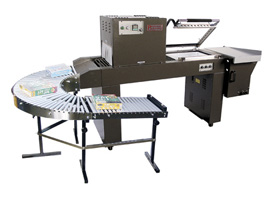
Gravity roller conveyors are made of stainless steel rollers with durable aluminum legs and casters. They are capable of holding up to 200 lbs. per linear ft. Many businesses use gravity rollers as an exit conveyor from a variety of shrink wrap machines.
The 180° gravity roller conveyor is used as an exit conveyor to return finished products to the operator. It is an excellent option to be used with our TL-1519 shrink wrap combo system or the TL-1622 shrink wrap combo system. A single operator can seal film and package the finished product while remaining stationary.
The straight gravity roller conveyors are often used with a variety of shrink tunnels as an exit conveyor. The straight conveyors are available in 3 ft. and 6 ft. lengths. The recommended length of the conveyor depends on the average length of the products being wrapped and the speed of production.
Rotary Conveyors
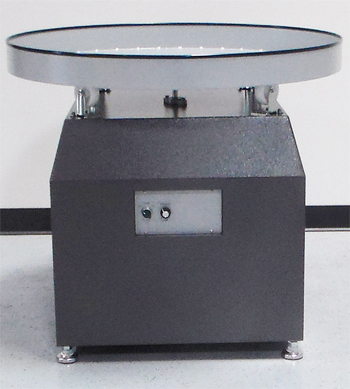
A rotary conveyor, often referred to as a lazy Susan conveyor is an excellent option for a variety of packaging needs. Customers often use a rotary conveyor coupled with a shrink tunnel. Workers positioned at the exit of the shrink tunnel can easily package and sort wrapped products.
rotary conveyors are available in 36", 48", and 60" diameters. Motors for all sizes run on 110V.
Skate Wheel Conveyors
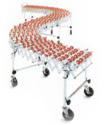
Skate wheel conveyors are common throughout the world and can be used in a variety of applications. The advantage of skate wheel conveyors is the adaptability to a variety of spaces. Skate wheel conveyors are accordion style gravity systems that can expand and contract based on specific needs.
It is often used for a wide variety of products as an exit conveyor for a shrink wrap machine as well as several other warehouse and industrial uses.