Showing posts with label news. Show all posts


Narendra_Modi_Donald_Trump_15747_56777
Modi and Trump have a personal equation and have common friends across the world. (PTI)

The election of Donald Trump to the presidency marked a major shift in global geopolitics, sparking intense discussions about what his second term in office might mean for India and other Asian countries. According to Moody’s, a leading global credit rating agency, India stands to gain significantly from this transition of power. This article explores the potential benefits for the Indian economy, the impact of Trump's policies on global trade, and how the evolving dynamics in the Asia-Pacific region could shift in favor of India.

The Global Shift: Trump’s Impact on US-China Relations

One of the primary ways that Donald Trump's presidency is expected to benefit India is through the changing nature of US-China relations. Moody's forecasts that as tensions between the United States and China continue to rise, there will be a reallocation of trade and investment flows away from China, providing new opportunities for India and other nations in the Asia-Pacific region.

The United States, under Trump’s administration, is likely to impose more stringent scrutiny on China, especially in critical sectors such as technology, manufacturing, and infrastructure. These restrictions, alongside the growing economic decoupling between the two giants, could negatively impact China’s economy. As a result, countries like India and those within the ASEAN (Association of Southeast Asian Nations) bloc are poised to benefit from this shift, attracting new investments and trade opportunities that may have previously gone to China.

The Trump Administration’s Economic Policy and Its Effect on India

During his first term, President Trump’s economic policies were characterized by tax cuts, deregulation, and a strong focus on American businesses. As Moody’s suggests, this approach is likely to continue during his second term. One of Trump’s key economic strategies is to make the 2017 Tax Cuts and Jobs Act permanent, which includes significant reductions in corporate tax rates and individual income tax relief.

These tax reforms could create a more favorable business environment for foreign companies, particularly in India. Lower corporate tax rates in the US might encourage American companies to expand their operations abroad, and India could be one of the prime beneficiaries of such investments. Furthermore, with reduced tax rates, US companies may have more capital to invest in international markets, potentially leading to increased foreign direct investment (FDI) in India’s technology, manufacturing, and services sectors.

A Shift in Trade Policy: What It Means for India

Another key aspect of Trump’s presidency is his protectionist stance on trade. During his first term, he imposed steep tariffs on Chinese imports, signaling his intention to protect American industries and reduce trade imbalances. Moody's anticipates that a similar approach will be adopted in his second term, leading to a more insular trade policy focused on American interests.

While such protectionist policies could disrupt global supply chains and negatively impact sectors that rely heavily on imported materials and goods—such as technology, manufacturing, and retail—they could also create opportunities for countries like India. As US tariffs on Chinese products escalate, Indian companies could step in to fill the void by providing alternative goods and services to the US market. This could help boost India’s exports, particularly in sectors like textiles, electronics, and pharmaceuticals.

Climate Change Policies Under Trump: Impact on Green Energy and Fossil Fuels

One of the more controversial aspects of Donald Trump’s presidency is his approach to climate change. During his first term, Trump sought to reduce environmental regulations and supported policies that favored fossil fuel production. Moody's predicts that this trend will continue, with a focus on “American energy dominance” through increased production of oil, gas, and coal.

For India, this shift could have mixed effects. On one hand, Trump’s policies could lead to more competitive prices for fossil fuels, which could benefit countries that rely on these resources, including India. On the other hand, Trump’s proposed reduction in funding for clean energy initiatives and a potential withdrawal from the Paris Agreement may slow the global push towards renewable energy. India, however, remains committed to expanding its renewable energy sector, and while US policies may not align with global sustainability goals, India’s continued focus on green energy could offer new avenues for international cooperation.

How Trump’s Presidency May Shape Global Supply Chains

A critical factor in the global economy is the functioning of supply chains, and Trump's policies are expected to have a profound impact on them. His administration has already shown a tendency to implement tariffs and other trade restrictions that disrupt the flow of goods across borders. This has led to some rethinking of supply chain strategies by multinational companies, which may look to diversify production away from China to avoid tariffs.

India, with its large labor force, growing infrastructure, and improving business climate, is well-positioned to attract companies looking to diversify their supply chains. As China faces increased scrutiny and restrictions, India could become a more attractive destination for foreign manufacturing, especially in sectors like electronics, automobiles, and textiles. This shift could create millions of jobs in India, further boosting its economic growth.

Trump’s Impact on Immigration Policies: Consequences for India

Trump’s policies on immigration have also been a subject of much discussion. Throughout his campaign and presidency, Trump has advocated for stricter immigration controls, particularly with regard to high-skilled workers from countries like India. These policies could lead to a more difficult environment for Indian professionals looking to work in the US, especially in fields like technology and engineering.

However, this could have a silver lining for India. As immigration policies become more restrictive in the US, Indian companies may find it easier to attract top talent in industries like information technology, engineering, and finance. With a larger pool of highly skilled workers remaining in India, the country could become a more significant global hub for technology and innovation. This could lead to the growth of Indian tech companies and the creation of more high-paying jobs in the country.

The Bigger Picture: What Does Trump’s Presidency Mean for India?

Overall, Donald Trump’s second term in office could present a mix of challenges and opportunities for India. While some of his policies, such as protectionist trade measures and a focus on fossil fuels, may pose obstacles, India is also well-positioned to capitalize on the shifting global dynamics. The reallocation of trade flows away from China, the potential for increased foreign investment, and the opportunities in global supply chains could significantly benefit India.

Furthermore, as US-China tensions escalate, India’s role as a global economic player may continue to grow, particularly in the Asia-Pacific region. With continued reforms, a favorable business environment, and a focus on infrastructure development, India could solidify its position as one of the world’s leading economies during Trump’s presidency.

Conclusion: India’s Strategic Advantage Under Trump

While there is no denying that Donald Trump’s presidency will bring challenges, it is clear that India stands to gain in several key areas. Moody’s analysis points to the shift in global trade, the potential for increased foreign direct investment, and India’s role in global supply chains as crucial factors that will drive India’s growth during Trump’s second term. India’s ability to adapt to these changes, coupled with its economic reforms and growing global stature, means that it is well-positioned to benefit from the evolving global landscape.


The $1 trillion digital loan sector in India is the next fight for internet behemoths.

India’s digital loan market is becoming a battleground for companies from Facebook Inc. to Xiaomi Corp.

Companies ranging from Facebook Inc. to Xiaomi Corp. are vying for a piece of India's digital lending market, which is expected to be worth $1 trillion by 2020.

This month, Facebook said that India would be the first country to implement its small business lending programme, which will provide loans to companies that advertise on its platform through a partner. The loans will be available in amounts ranging from 500,000 rupees ($6,720) to 5 million rupees, with interest rates ranging from 17 percent to 20 percent with no collateral required.

The social media giant's entry into India coincides with Xiaomi's plans to offer loans, credit cards, and insurance products in partnership with some of the country's biggest banks and startup digital lenders, according to the Press Trust of India, citing local head Manu Jain. Xiaomi is a Chinese manufacturer of everything from rice cookers to gaming monitors.

This month, Amazon.com made its first investment in the country's wealth management business, investing in a $40 million round led by fintech firm Smallcase Technologies Pvt.

Google, owned by Alphabet Inc., is likewise stepping up its game. After launching wealth management products such as digital gold and mutual funds on its famous Google Pay platform, it has now partnered with local Indian lenders to give users time deposits.

After online transactions soared during the pandemic and traditional lenders became wary due to a rise in bad debt, India's digital payments business has piqued the interest of some of the world's top IT companies. According to Boston Consulting Group predictions, digital financing will triple to $350 billion by 2023 and reach a total of $1 trillion in the five years after 2019.

“The payment sector earns very little money, but lending makes a lot of money,” says the expert "BCG's financial institutions practise managing director and senior partner Saurabh Tripathi remarked. “Indian consumers are looking for better-designed digital experiences, and many companies are taking advantage of this potential."

While India's lending industry has a lot of potential, it also has a lot of hazards. For the second year in a row, the country's bad loan ratio is predicted to grow to 11.3 percent by March, making it the poorest performance among big economies.

The Reserve Bank of India plans to supervise internet lenders, which include more than 300 startups, in addition to dealing with debt collections by digital enterprises.


The International Space Station module has small cracks, according to a report.
On Dec. 6, 1998, the STS-88 space shuttle crew captured the Russian-built Zarya module, which launched on Nov. 20 of that year, and mated it with the Unity node. (Image credit: NASA)

It's unclear whether the cracks are allowing air to escape the orbiting laboratory.


According to a fresh report, small cracks have been discovered in the Zarya module of the International Space Station.

"Superficial fractures have been identified in several spots on the Zarya module," Vladimir Solovyov, head engineer of Moscow-based Energia, Russia's main contractor for human spaceflight, told Russia's state-owned RIA news agency, Reuters reported today (Aug. 30). "This is awful news, and it means that the cracks will widen over time."

According to Reuters, Solovyov did not disclose whether the cracks detected by Russian cosmonauts have caused any air to seep from Zarya (Russian for "Dawn").

Zarya, commonly known as the FCB (short for "Functional Cargo Block"), is a section of the Russian segment of the International Space Station (ISS). With its launch in November 1998, it was the first section of the station to reach orbit.

This isn't the first time cracks have been discovered on the International Space Station, which has been occupied by rotating astronaut crews since November 2000. Fissures in the Russian Zvezda module, for example, caused a tiny air leak on the orbiting lab in September 2019. The Zvezda breaches were patched by cosmonauts in October 2020 and March this year, but the problem has remained; Russia reported another pressure decrease in the module, which was sent into Earth orbit in July 2000, last month.

(An air leak was discovered by ISS controllers in August 2018, however it was quickly confirmed that it was caused by a drill hole in an attached Russian Soyuz spacecraft.) It's unclear how that hole got there in the first place. The majority of specialists believe it was caused by human mistake on the ground, but a Russian space official recently attempted to accuse NASA astronaut Serena Auón-Chancellor. According to NASA officials, this claim is without merit.)

In July 2021, Russia's long-awaited Nauka scientific module arrived at the International Space Station. That meeting did not go as planned; immediately after docking, Nauka's thrusters fired wildly, causing the entire station to rotate about 540 degrees. The issue was eventually brought under control, and the orbiting lab was returned to its regular orientation.


A new driverless bullet train connecting the Chinese cities of Beijing and Zhangjiakou is capable of reaching a top speed of up to 217mph (350km/h), making it the world’s fastest autonomous train in operation.


The new train which comes as a preparation for the 2022 Beijing Winter Olympics, would connect the Chinese capital to Zhangjiakou, another town that would host the sporting events.It would complete the 108-mile long journey to just 47 minutes from the earlier three hours.


The train has stoppages at 10 stations out of which many would be in close proximity to the Winter Olympics sporting venues.Belonging to China's Fuxing series of bullet trains, the vehicle is capable of speeds up to 350 km/h and that too without anyone on the driver's seat.


The trains will start and stop at stations automatically to a precise timetable, and change speed depending on limits between stations. However, a monitoring attendant will still be on board in case of emergencies.

The line, also known as the Jingzhang intercity railway, took four years to complete and has 10 stations, including Badaling Changcheng, for access to the Great Wall of China. The first train began operating on 30 December, running from Beijing to Taizicheng, which will also hold some Olympic skiing events and is the closet station to the Olympic village.

Cabins on the “smart” autonomous trains have large storage areas for winter sports equipment, seats with 5G touchscreen control panels, intelligent lighting, thousands of real-time safety sensors and removable seats for passengers in wheelchairs. Facial-recognition technology and robots will be used in stations to assist with directions, luggage and paperless check-in

China’s vast high-speed rail network spans almost 22,000 miles and includes the fastest train in commercial operation, the Shanghai Maglev, capable of reaching a speed of 268mph.

“While we argue about HS2, China has created a nationwide high-speed network,China’s high-speed lines are ruthlessly efficient – once booked, a swipe of your ID card or passport at the ticket gates is all you need to travel,”


The Earth's inner core is hot, under immense pressure and snow-capped, according to new research that could help scientists better understand forces that affect the entire planet.
The snow is made of tiny particles of iron -- much heavier than any snowflake on Earth's surface -- that fall from the molten outer core and pile on top of the inner core, creating piles up to 200 miles thick that cover the inner core.
The image may sound like an alien winter wonderland. But the scientists who led the research said it is akin to how rocks form inside volcanoes.
"The Earth's metallic core works like a magma chamber that we know better of in the crust," said Jung-Fu Lin, a professor in the Jackson School of Geosciences at The University of Texas at Austin and a co-author of the study.
The study is available online and will be published in the print edition of the journal JGR Solid Earth on December 23.
Youjun Zhang, an associate professor at Sichuan University in China, led the study. The other co-authors include Jackson School graduate student Peter Nelson; and Nick Dygert, an assistant professor at the University of Tennessee who conducted the research during a postdoctoral fellowship at the Jackson School.
The Earth's core can't be sampled, so scientists study it by recording and analyzing signals from seismic waves (a type of energy wave) as they pass through the Earth.
However, aberrations between recent seismic wave data and the values that would be expected based on the current model of the Earth's core have raised questions. The waves move more slowly than expected as they passed through the base of the outer core, and they move faster than expected when moving through the eastern hemisphere of the top inner core.
The study proposes the iron snow-capped core as an explanation for these aberrations. The scientist S.I. Braginkskii proposed in the early 1960s that a slurry layer exists between the inner and outer core, but prevailing knowledge about heat and pressure conditions in the core environment quashed that theory. However, new data from experiments on core-like materials conducted by Zhang and pulled from more recent scientific literature found that crystallization was possible and that about 15% of the lowermost outer core could be made of iron-based crystals that eventually fall down the liquid outer core and settle on top of the solid inner core.
"It's sort of a bizarre thing to think about," Dygert said. "You have crystals within the outer core snowing down onto the inner core over a distance of several hundred kilometers."
The researchers point to the accumulated snow pack as the cause of the seismic aberrations. The slurry-like composition slows the seismic waves. The variation in snow pile size -- thinner in the eastern hemisphere and thicker in the western -- explains the change in speed.
"The inner-core boundary is not a simple and smooth surface, which may affect the thermal conduction and the convections of the core," Zhang said.
The paper compares the snowing of iron particles with a process that happens inside magma chambers closer to the Earth's surface, which involves minerals crystalizing out of the melt and glomming together. In magma chambers, the compaction of the minerals creates what's known as "cumulate rock." In the Earth's core, the compaction of the iron contributes to the growth of the inner core and shrinking of the outer core.
And given the core's influence over phenomena that affects the entire planet, from generating its magnetic field to radiating the heat that drives the movement of tectonic plates, understanding more about its composition and behavior could help in understanding how these larger processes work.
Bruce Buffet, a geosciences professor at the University of California, Berkley who studies planet interiors and who was not involved in the study, said that the research confronts longstanding questions about the Earth's interior and could even help reveal more about how the Earth's core came to be.
"Relating the model predictions to the anomalous observations allows us to draw inferences about the possible compositions of the liquid core and maybe connect this information to the conditions that prevailed at the time the planet was formed," he said. "The starting condition is an important factor in Earth becoming the planet we know."
The research was funded by the National Natural Science Foundation of China, Fundamental Research Funds for the Central Universities, the Jackson School of Geosciences, the National Science Foundation and the Sloan Foundation.


Adani Logistics, a subsidiary of Adani Ports and SEZ, announced that it had signed an agreement to acquire a 40.25 per cent stake in Snowman Logistics from Gateway Distriparks for Rs 296 crore.

The purchase price of Rs 44 per share is a 3.2 per cent premium to the market price of December 27, and a 12 per cent premium to the 60-day volume weighted average price (VWAP), said a company release.
“The acquisition is in line with our strategy and vision to be a leader in providing integrated logistics services in India and moving from port gate to customer gate. Cold chain is key product in customer gate strategy given India’s consumer driven demand,” Karan Adani, chief executive officer at APSEZ was quoted as saying.
The announcement of this acquisition by Adani has come at the time when India is grappling with economic slowdown where domestic companies of several sectors are cutting capex amid not-so-strong revenue visibility.

As part of the transaction, Adani Logistics will make a mandatory open offer as per the Substantial Acquisition of Shares and Takeover Guidelines, 2011 for a maximum 26 percent of the public shareholding in the company.The acquisition is subject to customary condition precedents and is expected to close by March 31, 2020, informed Adani via release.
“We will double the (cold chain) capacity in next five years. With focus on increase in utilisation, higher realisation from product mix and operational efficiencies, this vertical will help further improve returns of logistics business,” Adani was quoted as saying.
Snowman Logistics has presence in 31 locations in the country across 15 cities. Promoter Gateway Distriparks had listed Snowman Logistics in 2014 and had plans to grow in neighbouring geographies in the long-term.

We eagerly await for the new year as 2020 will see a long list of luxury cars that will make it to the Indian market. Here are some that are expected to arrive in India.


While the Indian automobile market struggled with demand, manufacturers continued to introduce new models in the Indian market. Brands like Porsche saw, for the first time, three-car launches in a single year with the new 911, Macan and the Cayenne Coupe. BMW launched its flagship 7-Series saloon and X7 SUV, Mercedes-Benz with the new GLC and many more. All these manufacturers have not exhausted their line up and they will be launching many more model in the forthcoming year. Here are some of the luxury cars that we expect to arrive in India in 2020.

Mercedes-Benz


Recently, Mercedes-Benz has stated that it will launch a new product in India every month. While the GLC arrived with the new MBUX infotainment system in December, the brand is expected to introduce more models in 2020. With the GLC and G-Wagon models already updated, Mercedes-Benz India is likely to update its entire SUV line up with the all-new GLE which is expected to be launched in January 2020. 

BMW


For the Bavarian automaker, the brand showed all its cards it seems in 2019. The model that is currently expected to receive an update from BMW is the 2020 Model Year update to the X1 compact SUV which will rival the Mercedes-Benz GLA, Volvo XC40 and the Audi Q3. The X1 will feature updated styling, features and BS6 standard powertrains with a petrol and diesel offering. Another BMW that is expected to be launched in 2020 is the all-new BMW X6, the coupe-styled SUV was given a redesign with BMW’s new design language and latest technology and powertrains, the X6 will arrive next year with its large and illuminated front grille.

Audi

Audi has kept it calm in the year 2019. the brand didn’t make much noise with new launches nor updates. However, it did launch the all-new A6 mid-size sedan in the Indian market and showcased its first all-electric model, the Audi E-Tron. While the E-Tron and the A8L was said to be introduced in India before the end of the year, both launches have been pushed back to 2020. Along with the launch of the Audi A8 and the E-Tron, the manufacturer may also introduce the Q8 flagship SUV in addition to the all-new generation Q3. Whether Audi will also the opportunity to introduce the Sportback versions of the Q3, or the new RS6 Avant and RS7 Sportback is something we will have to wait to be confirmed.

Land Rover

The all-new Defender that was unveiled at the Frankfurt Motor Show, was announced that it will be sold in 128 countries. One of them is expected to be India and the Defender will be launched in the Indian market in 2020. Globally, there are two basic variants, 3-door (90) and 5-door (110). India is more likely to see the 5-door model being offered with petrol and diesel offerings. All the powertrains will with an 8-speed with 2-speed transfer case automatic transmission sourced from ZF. Additionally, there will be model year updates for the Land Rover models in India, especially the new Discovery Sport which will for the first time come with Apple CarPlay and Android Auto.

Jaguar

The Jaguar F-Type has recently revamped from the ground up and it offers a brand new line of powertrains. With new sharper styling, and new underpinnings, the new F-Type sportswear uses its V6 engine being reserved for the US market while in Europe and other Asian markets, the S and the R models will both be powered by supercharged V8 engines in different state of tunes, the top of the line R model will be offered with AWD only. The new F-Type is likely to arrive in India in 2020 and it would be offered in both convertible and coupe forms.

Porsche


Porsche’s India line up is all brand new and features all of its latest generation cars. Whether it is the Cayenne or Macan SUVs, or the Panamera or even the 911 and 718 range of sports cars. However, there is one model which Porsche currently does not offer in the Indian market, but will be launching in India in 2020. It is confirmed that the all-electric model from Stuttgart, the Porsche Taycan will be launched in 2020 to complete the entire Porsche range in India.

Harmful bacteria can create all sorts of uncomfortable, and dangerous, health situations. However, a team of scientists at McMaster University in Canada has now created a repelling non-stick coating that can keep these bacteria at bay. 


Coming in the form of a flexible plastic wrap, it prevents the transfer of antibiotic-resistant bacteria from surfaces and people.
It'll prove especially useful in hospitals but can also be used in kitchens in homes.

How does the wrap work?
Taking their inspiration from nature itself, the scientists took the water-repellent lotus leaf as an example for their plastic wrap. Their surface works through a mixture of nano-scale surface engineering and chemistry.
The way a lotus leaf repels liquids is through its wrinkly surface, which excludes all external particles. For example, if water or blood drops onto the surface, it merely bounces off. It would be the same for bacteria on the recreated plastic. 
On top of this, the scientists added chemicals to the surface layer that further enhance its bacteria-repelling properties. The end result? A flexible, durable and inexpensive material that stops the harmful spread of bacteria.
The material can be likened to a plastic wrap, "that can be applied to all kinds of things," as Leyla Soleyman, lead engineer and researcher of the study, said. 
The plastic wrap can be shrink-wrapped onto door handles, railings, IV stands, and other bacteria-'friendly' surfaces. Furthermore, it can be used for food packaging, stopping the transfer of harmful bacteria such as E. coli, and Salmonella from raw chicken. 

Co-author of the study, Tohid Didar, said "We can see this technology being used in all kinds of institutional and domestic settings. As the world confronts the crisis of anti-microbial resistance, we hope it will become an important part of the anti-bacterial toolbox."
All that's left for the researchers to do now is to find a commercial partner in order to develop commercial applications for the wrap. 
Their findings were published in the journal ACS Nano on December 13. 

Science fiction has teased the idea of flying cars for decades, but in the real world they’ve been nothing more than a concept. That’s beginning to change, as companies around the world begin to look at making personal air travel feasible. Called VTOL (VEE’-toll), short for vertical takeoff and land, these vehicles may be in our skies as soon as the next decades.


Of course, no one is ready for flying cars quite yet. There’s no infrastructure to support them, and regulations are needed to govern their use (like personal drones, but a thousand times worse). You won’t find the first commercial VTOLs at a dealership, instead they’ll be taxi services built to shuttle people from one part of a city to another.
Uber’s VTOL taxis
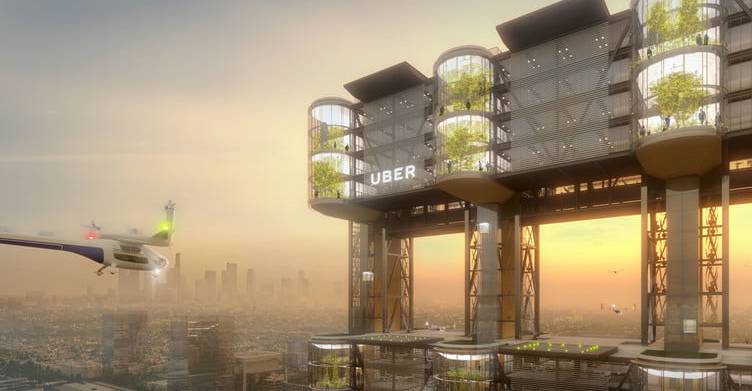
Of all the VTOL taxi projects, Uber’s is the biggest so far. The company targets 2023 as the year its services will first become commercially available, but we could see the first Uber Air taxies as soon as next year.  Uber’s had its eyes on air travel as early as 2016, and last year it committed to offering the first tests in Dallas, Los Angeles, and Dubai in 2020. The planned crafts look kind of like a modern miniaturized version of a turboprop plane, but with a key difference: They will take off and land from massive skyports placed throughout the cities they serve. Each plane will be capable of a speed of 150 mph and a range of about 60 miles on non-reserve power with one pilot and four passengers on board, and run completely on electric power using an automated system (although the pilot can take control in case of an issue).
Also cognizant of the footprint of the massive skyports necessary to take this to scale (Uber expects 1,000 landings an hour), Uber is tapping top architects to design densely packed structures on plots of land as small as 1-2 acres. Uber’s expansion is important because it gives us a good idea of the challenges involved in adopting flying cars around the world. For example, personal VTOLs just don’t function dependably in a city with lots of harsh weather, so Uber is limited to choosing cities with very mild conditions and little rain for safety reasons, as well as cities with the right shape and metro areas for air taxis. Uber also needs real estate partners and friendly governments so it can work through all the associated regulations. Since Uber’s ideal taxis will be electric in nature, the company also needs a very reliable, scalable electrical grid to work with. These requirements add up quickly, and show how much work these flying car entrepreneurs have ahead of them.
AeroMobil’s prototype
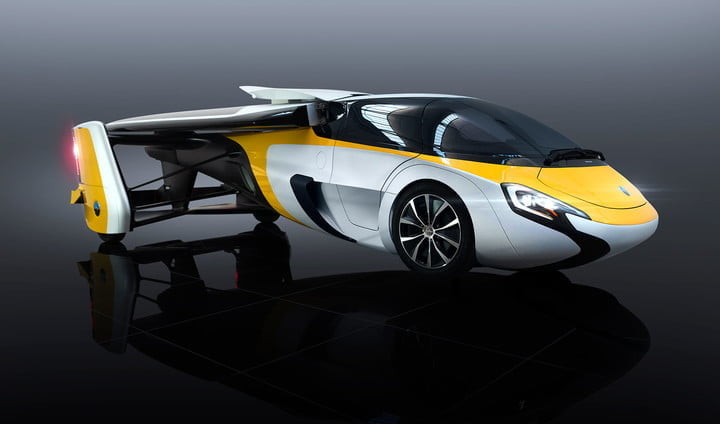
AeroMobil Car
AeroMobil, based in Slovakia, is determined to making a functioning flying car. They are on their fourth prototype, so you know they aren’t joking. All the prototypes are loosely known as the “AeroMobil” and the first of the cars should ship to private owners in 2020.
The company has plenty of concept art to show how the car would work in its final form. It’s one of the more notable “hybrid” models, and we aren’t talking about fuel. Unlike true VTOLs, hybrid flying cars are often designed to take off from runways to gain flight, but also have the ability to revert to a more car-like shape that allows them to drive on roads. As you can tell, this requires both retractable wheels and wings, along with a very efficient fuel system. AeroMobil is hoping it can create a functional electronic model. The company has partnered with notable organizations including Starburst, an aerospace “accelerator,” to help get its car to market ASAP.
Airbus Vahana
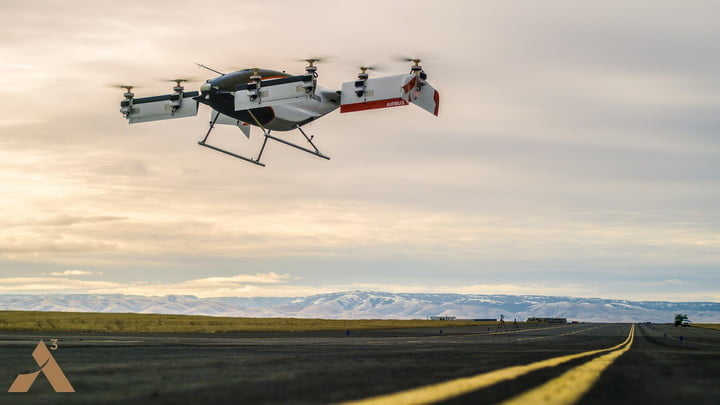
Airbus' Vahana
Project Vahana,from Airbus, seeks to create an electric VTOL aircraft that is entirely self-piloted. There are a lot of advantages to the self-piloting model. It can save costs when it comes to hiring and training pilots (who typically expect a higher salary than a taxi driver), and software engineers already have plenty of experience creating autopilot system for larger planes that can be applied to these VTOLs. It’s also an ideal way to run a taxi service, since the cars can automatically return themselves to centers for maintenance or take a different route based on current orders.
In early 2018, the Vahana prototype had its first successful full-scale flight test. It wasn’t much — the 20-foot aircraft simply rose 16 feet into the air, and stayed there for 53 seconds. However, it did this entirely with the autopilot technology. Airbus has flown about 50 test flights since, and says its on track for a 2020 debut.
Kitty Hawk’s flying prototype
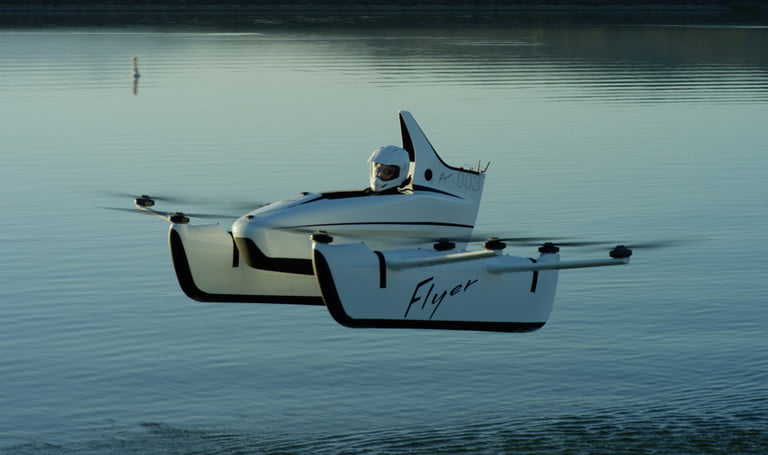
Kitty Hawk's flying protoype
Kitty Hawk CEO Sebastian Thrun claims that flying its latest prototype is “as easy to use as playing Minecraft,” so we’re already sold. This also means there’s currently no pilot’s license required to drive it. The latest prototype, appropriately called “Flyer,” is a 250-pound model created by the startup to show off its ultralight design. Kitty Hawk, started by Thurn and Google cofounder Larry Page, plans on creating both a personal flying machine that’s largely for “off-road” fun (ultralight vehicles like this can’t fly over urban areas by law), and an air taxi for more urban environments. The small, drone-like personal flyer holds a lot of promise for those who want a quick and dirty flying car experience, but so far it’s only available for test flights at a lakeside training center.
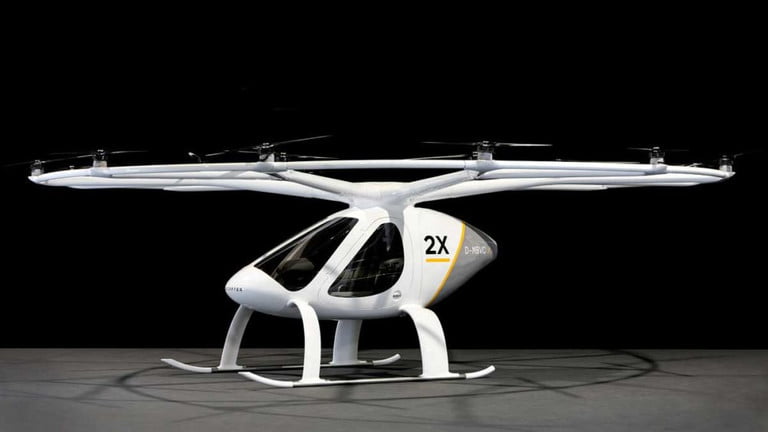
Volocopter 2X
Volocopter 2X
The Volocopter design is ambitious — and it looks really cool. The mini-copter is designed for personal flight and features 18 rotors, controlled via a single joystick and powered via electric batteries. We’d say that the whole thing isn’t very practical, but then they went ahead and made a full-sized test model and ran it across the stage at CES 2018 thanks to a little sponsorship by Intel.
The 2X can carry two passengers and has a flight time of 30 minutes and a range of 17 miles between charge centers. Intel’s work on the project includes complex tech, including four independent sensor units to control positioning, nine different electric battery packs with built-in redundancies, and even a parachute stowed on top of the vehicle in case something goes wrong. It’s no wonder Volocopter is Dubai’s latest pickfor its upcoming air taxi fleet (although Dubai has dumped other prototypes in the past, so it’s not a guaranteed deal).
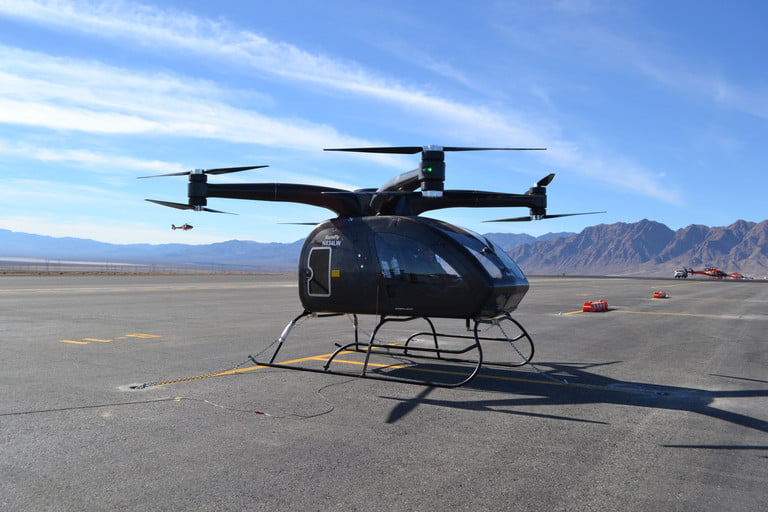
Workhouse SureFly
Workhouse SureFly
The SureFly is a robust VTOL that’s aimed at commercial services and personal consumers looking for a durable, self-controlled flying experience — and don’t mind paying around $200,000 per unit. It’s not just a concept model, either: interested buyers can already plunk down a $1,000 refundable deposit for the first commercially available models. A release date is not known yet as the Federal Aviation Administration must certify the SureFly before it can be sold, which may take up to two years.
The Surefly has eight propellers and a top speed of 75mph. While,  unlike other VTOLs, it does operate on gasoline, a battery pack will provide an extra 10 minutes of flying time if necessary. The initial version will be able to carry about 400 pounds of cargo, although a more heavy-duty version capable of carrying up to 650 pounds is currently in development.
Another aim of Workhorse is to make the SureFly easy to pilot, which is why most of the controls are automated. Just two controls are in the aircraft: A joystick to control direction and a throttle control on the pilot’s door.
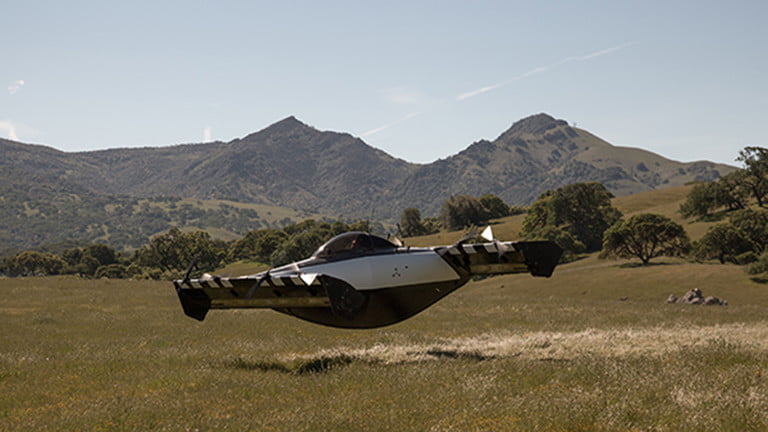
Opener BlackFly
opener blackfly flying car takeoff small
Coming from Canadian designer Opener, the BlackFly is a highly distinctive VTOL that combines personal piloting with a wealth of automatic features, including auto-landing and automated return-home functions, thus enabling flight without the need for formal licensing (a popular trend, as you may have noticed). Despite the design, BlackFly flies via a familiar method. Eight drone-like rotors are positioned across two wings. Taking off, however, is a bit more unique, as the VTOL is made to rock back and forth to literally pick up momentum to launch upward. Specs allow for a lengthy 40-mile range at 7 2mph, although regulations limit those numbers substantially for those who want to fly their own aerial vehicles.
What’s really special here is the promise of affordability and availability: The company is aiming to release its first crafts this year at roughly the same cost as an SUV. We’ll see if they’re able to do it.
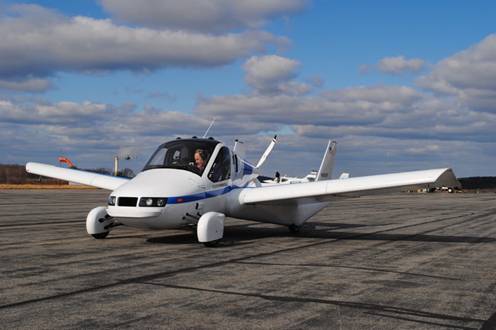
Terrafugia’s Transition
Weird cars
With retractable wings and wheels, the Transition is another hybrid model designed to convert between the road and the skies as needed. But that’s not the only way that the Transition is a true hybrid model. It also uses a combination of gas and electric engines to help power the model, and a boost mode for an extra burst of speed when flying (which sounds a little dangerous to us, but what do we know). In the past, the Transition was expected to eventually sell at $280,000, but these days the company is refraining from providing a list price.
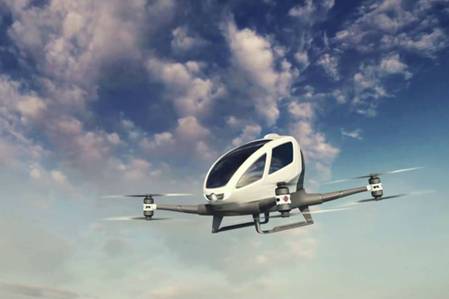
Ehang 184
Ehang 184
When the Ehang 184 first showed up at CES a few years ago, it seemed pretty impossible – a personal quadcopter VTOL that was fully automated, totally safe, completely comfortable, and powered via a basic touchscreen interface that anyone can use. Frankly, it all seemed like so much vaporware with a bunch of claims that couldn’t really be substantiated. These days, Ehang is still making some pretty crazy claims. For example, it’s hard to believe the company has tested its model more than a thousand times in all types of situations (including gale-force winds, with 500 pounds of extra weight, and so on), as they claim — the only test footage available is decidedly more pedestrian. After all, this sort of thing has happened before.
However, other details give us reason to believe that some version of the Ehang 184 will go into operation. Ehang has specified that each taxi will have a command center that will automatically ground the flying car in poor weather conditions, and that the models are primarily designed to fly in basic U-shapes from one port to another, which sounds much more in line with what other prototypes are capable of.
On the other hand, Ehang filed for U.S. bankruptcy protection in May 2018. The move was called “strategic,” and the company is still in operation, but it doesn’t exactly inspire confidence.
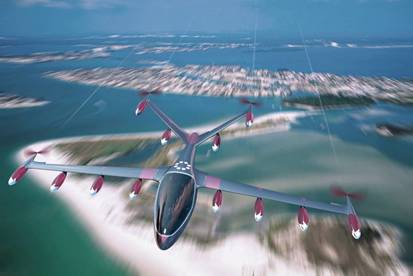
Joby Aviation’s air taxi
Joby
After working for years on personal aerial craft, Joby Aviation recently received a massive cash infusion from the likes of Toyota and Intel that provides $100 million to create an electric air taxi. This model is interesting, because it’s larger than many projects (able to seat up to five), and while it is called a VTOL, the model appears to be based on a more traditional aircraft with multiple propellers, which raises a lot of questions about how it’ll work in practice. Hopefully we will be able to see a real prototype before too long.
Powered by Blogger.