Showing posts with label working. Show all posts


In its 100-year history, the electric vacuum cleaner has become an indispensable home appliance for most people, and it's obvious why. Imagine picking all this sawdust out of the carpet by hand!

When you sip soda through a straw, you are utilizing the simplest of all suction mechanisms. Sucking the soda up causes a pressure drop between the bottom of the straw and the top of the straw. With greater fluid pressure at the bottom than the top, the soda is pushed up to your mouth. ­

This is the same basic mechanism at work in a vacuum cleaner, though the execution is a bit more complicated. In this article, we'll look inside a vacuum cleaner to find out how it puts suction to work when cleaning up the dust and debris in your house. As we'll see, the standard vacuum cleaner design is exceedingly simple, but it relies on a host of physical principles to clean effectively.

It may look like a complicated machine, but the conventional vacuum cleaner is actually made up of only six essential components:

·         An intake port, which may include a variety of cleaning accessories

·         An exhaust port

·         An electric motor

·         A fan

·         A porous bag

·         A housing that contains all the other components


When you plug the vacuum cleaner in and turn it on, this is what happens:

1.      The electric current operates the motor. The motor is attached to the fan, which has angled blades (like an airplane propeller).

2.      As the fan blades turn, they force air forward, toward the exhaust port (check out How Airplanes Work to find out what causes this).

3.      When air particles are driven forward, the density of particles (and therefore the air pressure) increases in front of the fan and decreases behind the fan.

This pressure drop behind the fan is just like the pressure drop in the straw when you sip from your drink. The pressure level in the area behind the fan drops below the pressure level outside the vacuum cleaner (the ambient air pressure). This creates suction, a partial vacuum, inside the vacuum cleaner. The ambient air pushes itself into the vacuum cleaner through the intake port because the air pressure inside the vacuum cleaner is lower than the pressure outside.

As long as the fan is running and the passageway through the vacuum cleaner remains open, there is a constant stream of air moving through the intake port and out the exhaust port. But how does a flowing stream of air collect the dirt and debris from your carpet? The key principle is friction.

LiDAR, or light detection and ranging, is a popular remote sensing method used for measuring the exact distance of an object on the earth’s surface. Even though it was first used in the 1960s when laser scanners were mounted to aeroplanes, LiDAR didn’t get the popularity it deserved until twenty years later. It was only during the 1980s after the introduction of GPS that it became a popular method for calculating accurate geospatial measurements.


Now that its scope has spread across numerous fields, we should know more about LiDAR mapping technology and how it works. Here are a few insights about it that are good to know.
LiDAR Technology
According to the American Geoscience Institute, LiDAR uses a pulsed laser to calculate an object’s variable distances from the earth surface. These light pulses — put together with the information collected by the airborne system — generate accurate 3D information about the earth surface and the target object.
There are three primary components of a LiDAR instrument — the scanner, laser and GPS receiver. Other elements that play a vital role in the data collection and analysis are the photodetector and optics. Most government and private organizations use helicopters, drones and airplanes for acquiring LiDAR data.
Types of LiDAR Systems
LiDAR systems are divided into two types based on its functionality — Airborne LiDAR & Terrestrial LiDAR.
Airborne LiDAR
Airborne LiDAR is installed on a helicopter or drone for collecting data. As soon as it’s activated, Airborne LiDAR emits light towards the ground surface, which returns to the sensor immediately after hitting the object, giving an exact measurement of its distance. Airborne LiDAR is further divided into two types — Topological LiDAR and Bathymetric LiDAR.
Terrestrial LiDAR
Unlike Airborne, Terrestrial LiDAR systems are installed on moving vehicles or tripods on the earth surface for collecting accurate data points. These are quite common for observing highways, analysing infrastructure or even collecting point clouds from the inside and outside of buildings. Terrestrial LiDAR systems have two types — Mobile LiDAR and Static LiDAR.
How Does LiDAR Work?
LiDAR follows a simple principle — throw laser light at an object on the earth surface and calculate the time it takes to return to the LiDAR source. Given the speed at which the light travels (approximately 186,000 miles per second), the process of measuring the exact distance through LiDAR appears to be incredibly fast. However, it’s very technical. The formula that analysts use to arrive at the precise distance of the object is as follows:
The distance of the object = (Speed of Light x Time of Flight) / 2
LiDAR can be used to accomplish many developmental objectives, some of which are:
Oceanography
When the authorities want to know the exact depth of the ocean’s surface to locate any object in the case of a maritime accident or for research purposes, they use LiDAR technology to accomplish their mission. Other than locating objects, LiDAR is also used for calculating phytoplankton fluorescence and biomass in the ocean surface, which otherwise is very challenging.
Digital Elevation or Terrain Model
Terrain elevations play a crucial role during the construction of roads, large buildings and bridges. LiDAR technology has x, y and z coordinates, which makes it incredibly easy to produce the 3D representation of elevations to ensure that concerned parties can draw necessary conclusions more easily.
Agriculture & Archaeology
Typical applications of LiDAR technology in the agriculture sector include analysis of yield rates, crop scouting and seed dispersions. Besides this, it is also used for campaign planning, mapping under the forest canopy, and more.
Apart from the applications mentioned above, LiDAR is used by geoscientists for unearthing geomorphology related secrets, as well as by military for carrying out various security operations near the national borders.

The stock market works like an auction where investors who buy and sell shares of stocks. These are a small piece of ownership of a public corporation. Stock prices usually reflect investors’ opinions of what the company’s earnings will be.
Traders who think the company will do well bid the price up, while those who believe it will do poorly bid the price down. Sellers try to get as much as possible for each share, hopefully making much more than what they paid for it. Buyers try to get the lowest price so that they can sell it for a profit later.
How to Invest in the Stock Market
Average investors can’t trade on the stock market directly. Instead, they must hire a broker-dealer to execute the trades. There’s a wide variety of choices:
  • Fee-only financial advisers who charge an annual fee, usually 1 percent of assets.
  • Online dealers like E-Trade, who charge a small fee per transaction. 
  • Large banks, like Goldman Sachs or Well Fargo Advisers, provide financial planning in addition to executing trades. 
  • Small brokers who just execute orders. 
Many investors buy stocks through mutual funds. These are companies that buy a collection of stocks. The investor buys shares in the mutual fund instead of owning the stocks themselves. They take advantage of the mutual fund manager’s expertise. Since there are so many stocks, this diversified investment has a lower risk than a single stock.
Most of the stocks traded are common stocks. But some investors buy preferred stocks. They pay an agreed-upon dividend at regular intervals and they don’t have voting rights. They are less risky but they also offer a smaller return.
Where Is the Stock Market?
The two largest exchanges in the world are both in the United States. The New York Stock Exchange lists 2,400 companies. Combined, they are worth around $21 trillion in market capitalization. That’s the value of all its shares. The NYSE is located on Wall Street. The Nasdaq has 3,800 companies with a market cap of $11 trillion. It’s located in Times Square.
Each exchange matches buyers with sellers, but they do it differently. The NYSE is a true auction house. It matches the highest bid for the lowest sales price. There is a market maker for each stock who will fill in the gap to make sure trades go smoothly. At the Nasdaq, buyers and sellers trade with a dealer instead of each other. It’s done electronically, so trades happen in split seconds.
A third exchange, the BATS Global Marketplace, was formed to create a more efficient technology. Its goal was to avoid a flash crash like the one that hit the NASDAQ in August 2013.
There are also many small exchanges to serve specific types of traders. For example, “Dark Pools” like Liquidnet, cater to high-volume, frequent traders like hedge funds. Dark Pools hide their client’s strategies from the competition. They not only ensure their anonymity but can also match up large orders to avoid suspicion. 
The major countries have their own stock exchanges for their domestic corporations. The five biggest are the London, Tokyo, Shanghai, Hong Kong, and Euronext exchanges.
Current Stock Market
The stock markets use indices to report their current conditions. The top three are the Dow Jones Industrial Averages, the S&P 500 and the Nasdaq. The DJIA tracks the stock prices of the top 30 U.S. companies. The S&P 500 tracks the stocks of 500 large-cap U.S. companies. The Nasdaq tracks the stocks on its exchange. Each of these also has many smaller indices that track specific aspects of the companies they track. For example, the Nasdaq 100 tracks the largest stocks on its exchange.
Each exchange around the world has an index that reports on its current status. The indices for the top five exchanges are the FTSE 100, Nikkei 225, Shanghai Stock Exchange, Hang Seng, and the Euronext 100.
In addition, there are many indices that report on various types of companies listed on the exchanges. The Russell 2000 reports on 2,000 small-cap companies. The MSCI Index reports on emerging market companies.
Advantages 
Companies sell stocks because it’s a good way to get an enormous sum of financial capital. However, the company itself must be generating a lot of income to make it worthwhile. Issuing an Initial Public Offering is very expensive. After that, there is no privacy, as investors review the company’s profits and strategy every quarter. The other ways of obtaining financing are private, through personal loans or private investors, or through bonds, which are loans traded publicly. The advantage of stocks vs. bonds is that a stock doesn’t require a monthly repayment of interest.
Individuals use the stock market because the returns, on average, outpace those of other investments, such as bonds or commodities. Stock market investing is an excellent way to make sure your investments do better than inflation.
The Stock Market Isn’t the Economy But Does Affect It
The stock market contributes to the U.S. economy. If investors believe the economy is growing, then they will invest in stocks. That’s because a strong economy helps companies improve their earnings. That’s known as a bull market. It usually occurs along with the expansion phase of the business cycle. Most commodities also do well. That’s because expanding businesses will demand more oil, copper, and other natural goods. The most recent bull market occurred from March 2009 until August 2013.
If investors think the economy is slowing or stagnant, they will invest in bonds, which are a safer investment. That’s because bonds give a fixed return over the life of the loan. Bonds do well during the contraction phase of the business cycle. When bonds do well, stocks lose value. That’s known as a bear market, and it typically lasts 18 months. The last bear market was from December 2007 to March 2009. For more, see Dow Closing History.


If there are threats to the global economy, investors also move toward gold and other safe havens. That usually happens along with a stock market correction, when share prices drop 10 percent or more. It’s even more apparent in a stock market crash when stocks can lose that much in a day. A bad crash could even cause a recession. The history of stock market crashes shows this is a frequent occurrence.


If you’ve ever taken a sip from a glass of water that came from the home of someone with a reverse osmosis system, you know how pure and refreshing it tastes.
Or, perhaps you have concerns about water quality and want to make sure your family is drinking healthy water that reduces contaminants as much as possible.
Reverse osmosis (R.O.) drinking water truly is the purest choice for any home. It’s water the way nature intended us to drink it.
But how exactly do these systems work, and what do they do to your home’s water?
What is Reverse Osmosis?

Osmosis is defined as the process of molecules passing through a semi-permeable membrane from a less-concentrated solution into a more-concentrated solution.
An example or osmosis from nature is the roots of plants drawing water from the soil.
Reverse osmosis is simply the opposite of that process.


The Reverse Osmosis Process

Molecules are forced through a semi-permeable membrane to form a less concentrated solution. Essentially, the membrane acts like a type of filter as it has extremely tiny pores that help remove microscopic contaminants from the water you drink by straining them out.
In the case of reverse osmosis drinking water systems, the semi-permeable membrane only lets water molecules through while other contaminants are collected and flushed away.
How Reverse Osmosis Filtration Works
There’s a bit more to the process when using a reverse osmosis  system to purify drinking water.
If you’ve ever seen an R.O. system, you’ve likely noticed the three cylindrical canisters on a manifold. One of these is the membrane and the other two are carbon filters. Let’s take a closer look at what each of these cartridges do.

Step 1: Pre-filtration
The first step in purifying water with reverse osmosis is meant to protect the membrane. It removes larger sediment, including some dissolved solids, and helps reduce chlorine.
This first cartridge is referred to as the sediment filter or carbon block filter. It helps conserve the membrane, which can get clogged by excess sediment or damaged by exposure to too much chlorine, which you’ll find in municipal water.
Reverse osmosis works best when you start with good water and then make it great. That’s why you should never use a reverse osmosis system with hard water unless it is under 10 grains per gallon.
Step 2: The Reverse Osmosis Membrane
Following the initial filtration comes the real magic of an R.O. system.
Your water is forced through the semi-permeable membrane under pressure. The membrane is a synthetic plastic material that allows the passage of water molecules. However, sodium, chlorine, and calcium as well as larger molecules like glucose, urea, bacteria and viruses cannot pass.
Following Substances can be removed from the Water Completely;


  • lead
  • arsenic
  • copper
  • nitrates and nitrites
  • chromium (hexavalent & trivalent)
  • selenium
  • fluoride
  • radium
  • barium
  • cadmium
  • cyst (cryptosporidium)
  • total dissolved solids (TDS)

    Steps 3 & 4:  Post Filtration and Final Polish
    Before your home’s water is ready to drink, it goes through a second carbon filter (or post filter), which removes any remaining contaminants in the unlikely case they slipped past the membrane.
    Then the water fills up a storage tank where it waits until you’re ready to use it.
    Finally, there’s the in-line activated carbon filter, which gives your water one last polish as it comes out your faucet. This is used to remove any remaining odors or flavors that may come from the system hoses or the holding tank.
    The polish is a “just in case” step to make sure the water you drink tastes incredibly fresh!
    Is Reverse Osmosis Drinking Water Right for Your Home?
    Soft water is excellent for cleaning, showering, and laundry. However, some people would rather not drink it. Depending on how hard your water is to start with, it could still have high total dissolved solids (TDS), which can negatively affect the taste. That’s because the hard minerals are replaced by sodium, and there may be other contaminants in your water that a softener will not remove.
    A reverse osmosis system can remove that sodium along with other contaminants and dissolved solids, which makes a water softener and an R.O. system an ideal combination for most homes.
    When you install a reverse osmosis system, you’ll enjoy better-tasting coffee and tea, clearer ice cubes, and pure, healthy water right from your kitchen sink. If you’re still using bottled water for drinking, you’ll be making a smart investment that saves you money in the long run and is better for the environment.


Most failures in equipment—whether electrical, mechanical, process, or electronic—are signaled by a significant rise in operating temperature long before failure occurs. Infrared thermography can detect heat patterns in the infrared wave-length spectrum that are not visible to the unaided eye. These heat patterns can help identify deteriorating components before they fail.
Infrared thermography is the science of detecting infrared energy emitted from an object, converting it to apparent temperature, and displaying the result as an infrared image. Literally, infrared thermography means "beyond red" (infrared) "temperature picture" (thermography).

How an infrared camera works

With an infrared camera you can capture thermal images without making direct contact with equipment. That means you can capture thermal information from operating equipment at a safe distance and have a better chance of seeing temperature anomalies under normal operating conditions. Most popular infrared cameras (also known as thermal imagers) capture radiometric thermal images that contain apparent temperature measurements for each pixel within the image. With that capability, you can identify an anomaly and then drill down to calculate the apparent temperatures of the points in question.

When to use infrared thermography

The non-contact nature of infrared thermography makes it ideal for a wide range of applications where components are moving, very hot, dangerous to contact, difficult to reach, impossible to shut off, or could be contaminated or damaged through contact. Infrared cameras are also very helpful in detecting energy or moisture-related problems in a building envelope. Learn more about thermal imaging.

The benefit of today’s technology

Unlike early thermal cameras that were large, very expensive, difficult to use, slow to acquire data, and offered poor image resolution, the technology has evolved to produce compact, ergonomic cameras that are easy and fast to use, are much more affordable and provide high resolution images. With the proper infrared camera and lens, you can scan details from targets as small as 25 microns to targets several hundred feet tall. The speed and convenience of today’s infrared cameras enable you to conduct inspections faster and find problems in areas that you might have otherwise overlooked.


What are LEDs?


LEDs are a type of semiconductor called "Light Emitting Diode". White LEDs, which have achieved practical realization through the use of high-brightness blue LEDs developed in 1993 based on Gallium Nitride, are attracting increased attention as a 4th type of light source.


How do LEDs Emit Light?

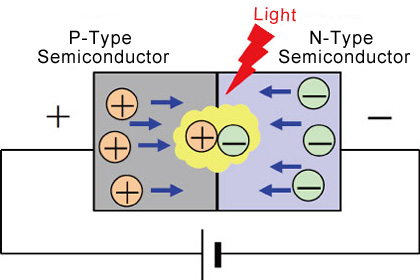
LEDs (Light Emitting Diodes) are semiconductor light sources that combine a P-type semiconductor (larger hole concentration) with an N-type semiconductor (larger electron concentration). Applying a sufficient forward voltage will cause the electrons and holes to recombine at the P-N junction, releasing energy in the form of light.


Compared with conventional light sources that first convert electrical energy into heat, and then into light, LEDs (Light Emitting Diodes) convert electrical energy directly into light, delivering efficient light generation with little-wasted electricity.


Types of LEDs

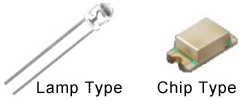
Two types of LEDs are available, a lamp type (leaded) and a chip type (surface mount). Users can select the ideal type based on set requirements.


Wavelength and Color

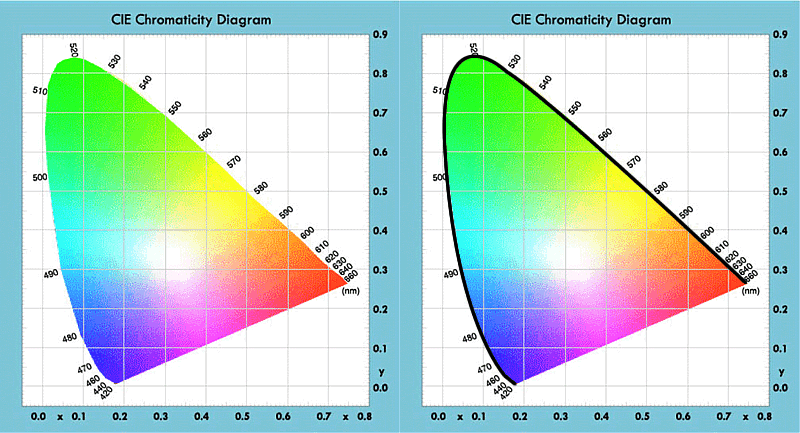
The LED color (emission wavelength) will change depending on materials used. This makes it possible to customize the color to meet certain wavelength specifications required for applications that use traditional bulbs as light sources (for which standards exist), such as traffic lights and automotive lamps.


Two specifications for wavelength are used to indicate color: λP (Peak Wavelength) and λD (Dominant Wavelength), with λD corresponding to the color actually seen by the human eye.


Different wavelengths involved in the process determine the different colors produced from the LEDs. Hence, light emitted by the device depends on the type of semiconductor material used.
Infrared light is produced by using Gallium Arsenide (GaAs) as a semiconductor. Red or yellow light is produced by using Gallium-Arsenide-Phosphorus (GaAsP) as a semiconductor. Red or green light is produced by using Gallium-Phosphorus (GaP) as a semiconductor.


What is Naturalistic Decision Making (NDM)? 

NDM is the research tradition begun in the 1980s to study how people actually make decisions — people such as firefighters, military commanders, nurses, design engineers, pilots, and petrochemical unit managers. NDM examines the kinds of decisions they make in the course of their work, and how they use their experience to cope with challenging conditions such as time pressure, uncertainty, vague goals, high stakes, organizational constraints, and team coordination requirements. The NDM approach is thus a contrast to judgment and decision paradigms that use pre-defined tasks given to naïve subjects under controlled laboratory conditions. 

How NDM got started ?

In the late 1980s, Judith Orasanu, working in the Basic Research group at the Army Research Institute, assembled a cadre of researchers who were investigating decision making in natural settings, using cognitive ethnographic methods. Orasanu and Gary Klein, one of these researchers, convened a small workshop in 1989 to bring this community together to share ideas. One outcome of this workshop was an edited book, Decision Making in Action (1993). Since that time, a dozen NDM conferences have been held, at roughly two-year intervals, alternating between the U.S. and Europe. Many of the conferences have generated edited volumes. In addition, the Cognitive Engineering and Decision Making Technical Group was established in 1995 to provide an annual opportunity for NDM researchers to exchange ideas; it quickly grew to become the largest Technical Group within the Human Factors and Ergonomics Society.

What has the NDM movement achieved?

Many people are excited by the NDM approach and the possibilities it opens up. But other people are skeptical about whether we can learn anything without carefully controlled experiments. The way to assess NDM research is to see what it has discovered. Here is a summary, taken from some recently published articles.
We used to believe that expertise depends on learning rules and procedures. NDM research demonstrated that expertise primarily depends on tacit knowledge.

We used to believe that projects had to start with a clear description of the goal. NDM researchers saw that challenging projects involve wicked problems and ill-defined goals that cannot be specified in advance. The goals become clarified while they are being pursued.
We used to believe that people make sense of events by building up from the data to information to knowledge and finally to understanding. NDM studies showed that experienced decision makers use their mental models to define what counts as data in the first place.
And as discoveries are made about the nature of a situation, different aspects of the data are revealed.
We used to believe that we could reduce uncertainty by gathering more information. NDM researchers found that performance seems to suffer when too much information is gathered, and that uncertainty can result from inadequate framing of data, not just the absence of data.

We used to believe that we could improve performance by fostering critical thinking practices such as listing assumptions. NDM researchers noted that the flawed assumptions are often unconscious, and thus could never get listed.

Where is NDM heading?

As you can see from the preceding section, NDM researchers have broadened their investigations. They are not just interested in decision making. They study other cognitive processes such as situation awareness, sensemaking, problem detection, and anticipatory thinking. They use naturalistic inquiry methods to explore a range of macrocognitive phenomena (as opposed to microcognitive phenomena studied under controlled laboratory conditions).
In addition to trying to understand more aspects of thinking in complex settings, NDM researchers are also seeking ways to improve performance: better decision making, better sensemaking, quicker and more accurate problem detection. In contrast to the behavioral decision making community which focuses on human limitations and tries to reduce biases, NDM researchers try to understand human capabilities. While it is important to cut down on mistakes, good performance is not just the absence of mistakes — it consists of discoveries and achievements. It depends on the strengths of decision makers. Unlike research approaches that seek to debunk experts, NDM practitioners are impressed by experts, whether they are expert firefighters or physicians or pilots or military commanders. And so NDM practitioners are seeking ways to bring people up to speed more quickly.


Whether it is steam powered or has a diesel engine as the main form of propulsion, a ship without a boiler is really difficult to imagine; a boiler, in one form or another will be found on a ship. For example if a ship is a steam powered ship, two or more boilers will be provided to produce high temperature, high pressure steam. If a ship is carrying a diesel engine as the main propulsion system, one or two smaller boilers are used for running various ship's machinery and services. So let us find out how boilers work and learn about their construction.

How do Boilers Work?
A basic boiler is a machine with the simplest arrangement of the internal parts. The main job of a boiler is to make high pressure steam. The feed water supplied to the boiler drum utilizes the heat of the energy released by burning the fuel. This energy of the burning fuel is stored in the form of steam with high temperature and pressure. The fuel is burnt in a combustion chamber inside the boiler. To attain high efficiency and complete combustion, air is supplied to this combustion chamber through a separate arrangement. The heat generated in this combustion chamber is transferred to the water from the boiler drum through a large surface area, which enables the highest rate of energy transfer.

The Steam Generation Process

The process of steam generation starts when the feed water enters the steam drum through both internal tubes and the tubes that surround the furnace. The system of tubes that surrounds the furnace are known as waterwall or floor tubes. The feed water gets heated when passed through these tubes. Addition to this, there are Large-bore downcomer tubes that passes outside of the furnace and are used to circulate water between the drums, to which the tubes are attached from outside of the furnace.
The steam produced in the steam drum is known as wet or saturated steam. This steam cannot be used directly as it contains high amounts of moisture. To make this steam usable, it is first dried and heated with the help of a superheater located within the boiler. Once all the moisture content is removed from the steam, the superheated steam can be supplied to other systems. It is utmostly important to monitor and control the temperature of the superheated steam, or else it can cause damage to the systems to which it is supplied. For this reason, an implement known as an attemperator is used. The attemperator is a kind of cooler which is used to cool down the superheated steam to the right temperature. Thus, all the steam used in various system is taken out from the main steam drum of the boiler.
The energy from the fuel burning are used for various other purposes, the main two are as follows:
  • For heating feed water to produce steam
  • For superheating the steam from the boiler drum

To increase the efficiency of the boiler, the feed water that enters the boiler is pre-heated with the help of an economizer through which the feed water passes before entering the boiler. The exhaust gas of the boiler is also put to use by making it pass over an air heater, which heats up the combustion air entering the furnace. Thus, even the energy exhausted from the boiler is not allowed to go waste, which increases the overall efficiency of the system.
All these boilers are fitted with various safety fittings and control systems to monitor and control various aspects such as fuel oil flow rate, flow of combustion air, and feed water supply. All these systems should work in co-ordination to supply the amount of steam required by various system. The boiler is also provided with various mountings to ensure safe operation of the boiler.

Types of Boilers

  • Water tube boiler
  • Fire tube boiler
The design and arrangement of both the types is just the opposite. In water tube boilers, the feed water passes through the tubes and the hot gases are made to pass over them, while in fire tube boilers, the hot gases passes through the tubes and the feed water surrounds them.


Tesla cars have revolutionized the electric vehicle industry. In fact, these electric vehicles have received much attention in every corner of the world. These cars are environmentally friendly and have the potential to deliver superior performance to the users. The Tesla Model S was even able to win the award for the Motor Trend Car of the Year back in 2013. But how do Tesla cars actually work? Well, the answer to this question requires a little explanation.

Tesla cars have a powerful battery, which is charged with electricity. This gives juice for the car to run for a certain period of time. This battery is somewhat similar to the batteries that you can find in your laptop and smartphone. In other words, Tesla uses lithium-ion batteries in order to power up their supercars. However, these batteries are extremely powerful. In fact, a battery that you can find in a Tesla car is made out of thousands of lithium-ion cells. As a result, these batteries weigh a lot.

In other words, the battery of a Tesla car weighs about several thousand pounds. All these batteries are made at the headquarters of the Tesla Bay Area. Therefore, the quality and durability of the batteries are guaranteed. All the batteries come along with a dedicated heating system as well. This heating system would help people to start their cars under cold weather conditions. Therefore, people who spend their money to purchase Tesla cars will not have to come across any battery related issues because of their advanced car technology.


This is a rechargeable battery and each full charge would give you the chance to drive your Tesla for a journey of a few hundred kilometers. When the battery level goes down, you will need to recharge it. The process of recharging a Tesla battery is not much different from the process that you follow in order to recharge the portable gadgets that you carry in day to day life. This can be considered as the primary difference that you can find in between a Tesla car and a hybrid car such as a Toyota Prius. The hybrid vehicles use hydrocarbon fuel along with the battery in order to cater to the power requirements. However, Tesla cars only use battery power. In hybrid cars, the battery recharges automatically while you are driving, but it would not happen in Tesla cars. You will need to recharge the battery and you can do it at a charging outlet or even at your home.

As mentioned earlier, several methods are available for the Tesla car owners to recharge their vehicles. Out of those methods, the best option would be to seek the assistance of a professional electrician in order to get a recharging station installed at your home. If that is not possible, you can think of plugging your Tesla to 100-volt outlets for recharging the battery. Tesla has also taken the initiative to install hundreds of supercharging stations across the country for the convenience of drivers.


Tesla cars are equipped with a small motor, which is about the size of a watermelon. This is one of the latest innovations in electronic engineering. It converts electrical energy drawn from the batteries to mechanical power in order to move the vehicle. This is a more efficient technology when compared to the combustion engines that you can find on traditional cars. In other words, people who drive Tesla cars will be able to get a longer range for their charge, which can help them to save money in the long run.


 An electrical motor is such an electromechanical device which converts electrical energy into a mechanical energy. In case of three phase AC operation, most widely used motor is Three phase induction motor as this type of motor does not require any starting device or we can say they are self starting induction  motor.For better understanding the principle of three phase induction motor, the basic constructional feature of this motor must be known to us. This Motor consists of two major parts:

Stator: 
Stator of three phase induction motor is made up of numbers of slots to construct a 3 phase winding circuit which is connected to 3 phase AC source. The three phase winding are arranged in such a manner in the slots that they produce a rotating 
magnetic field after 3Ph. AC supply is given to them.

Rotor:
Rotor of three phase induction motor consists of cylindrical laminated core with parallel slots that can carry conductors. 
Conductors are heavy copper or aluminum bars which fits in each slots & they are short circuited by the end rings. The slots are not exactly made parallel to the axis of the shaft but are slotted a little skewed because this arrangement reduces magnetic humming noise & can avoid stalling of motor.

Working of Three Phase Induction Motor
Production of Rotating Magnetic Field
The stator of the motor consists of overlapping winding offset by an electrical angle of 120°. When the primary winding or the stator is connected to a 3 phase AC source, it establishes a rotating magnetic field which rotates at the synchronous speed. 

 Secrets Behind the Rotation:
According to 
Faraday’s law an emf induced in any circuit is due to the rate of change of magnetic flux linkage through the circuit. As the rotor winding in an induction motor are either closed through an external resistance or directly shorted by end ring, and cut the stator rotating magnetic field, an emf is induced in the rotor copper bar and due to this emf a current flows through the rotor conductor.
Here the relative speed between the rotating flux and static rotor conductor is the cause of current generation; hence as per 
Lenz's law the rotor will rotate in the same direction to reduce the cause i.e. the relative velocity.

Thus from the working principle of three phase induction motor it may observed that the rotor speed should not reach the synchronous speed produced by the stator. If the speeds equals, there would be no such relative speed, so no emf induced in the rotor, & no current would be flowing, and therefore no torque would be generated. Consequently the rotor can not reach the synchronous speed. The difference between the stator (synchronous speed) and rotor speeds is called the slip. The rotation of the magnetic field in an induction motor has the advantage that no electrical connections need to be made to the rotor.


Thus the three phase induction motor is:
●     Self-starting.
●     Less armature reaction and brush sparking because of the absence of commutators and brushes that may cause sparks.
●     Robust in construction.
●     Economical.
●     Easier to maintain.


Powered by Blogger.