Start a Online Kirana Store Business 


"An online grocery store may net you profit if you start your business out the right way. Use your talent for picking the best produce and sleuthing out seasonal bargains to launch an online grocery store that will keep customers well fed and your bottom line operating in the green."


Our local grocery or kirana store owners have constantly endeavoured to make our lives convenient. Traditionally, kirana stores have emphasised on the "customisation approach" - they take your delivery orders on the phone, arrange for home delivery of groceries, allow you to keep monthly accounts and even offer to remind you on items that you may miss out from your monthly grocery list. And with the advent of increased FDI and MNC players in the retail sector, it would naturally be expected that kirana stores may be impacted to a moderate extent. 


Overview


Setting up Online Kirana is one of the best business idea. This is one of the new concept and there are only few online kirana stores in India which can be counted on finger tips. One can get benefitted by entering early into the business as there are very few competitors in India.

What is this business idea about ?

We know that groceries/kirana items are sold in kirana shops available near to us. However , one may or may not find time to buy during the day time due to our busy schedules. Online Kirana stores offer the services through online websites where one can fill the details and the products would be delivered to home with small service charges.

How to start this new business?

Below steps can be followed to enter in to this business.

 1)     Selecting the location of business : Since the products are sold online, the location need not be near to the center of the market nor in the centre in the city. The only criteria we feel would be, selecting the location which should be nearer to transportation facilities. The products should be able to dispatch easily through local transportation.

     2)    Identifying the areas where we need to sell the products. To start with, the base location needs to be selected. Once the services are provided within the City where the business is located, it could be extended to various cities nearer to us.

      3)    Building an e-commerce website to sell the products :  Since it involves building a good websites, going for free website creation methods would not help. Identify professional e-commerce building institutions to create the e-commerce. Ensure that proper training is given to the team, else we end up struggling in updating the inventory into the websites and delay the online  sales.

4)    Starting with a fewer products. Start this business with a few products.
          There are various benefits of going with this approach.
            a) When you order buying bulk of quantity of same products, you get maximum discounts.

                 b)In case you have variety of items, but low quantity, this would create supply problem. You may not be able to fulfill the requirements of customer.

5)  Manpower : One cannot be able to guess about the manpower requirement in initial stages as it depends on the size of the business. There are three main teams required for the business.

a). Purchasing team : This team need to work on identifying what to purchase and getting the products at lower prices.
b). Inventory team : This team would keep accounting for the products received and products sold and returned. 
c) Sales team : This team need to primary work on two areas. One is the ways to identify and attract customers and second is to ensure that the products are sold and dispatched to customers. The success of this business depends on how we are trying to be closer to customers and how the services are being delivered within the promised time.

 6) Other ways to attract the customers and to be success in this online Kirana business

a) In initial stages of business, offer huge discounts. You may end up in zero profit for few months. But treat this as investment.
b) Provide quick service to the customer. Deliver the products within the promised time, Customer can trust only when we deliver, what we say
c) Resolve customer complaints at a faster pace. 

Thing You 'll Need
  • Competitor Analysis
  • Business Plan
  • Business Loan
  • Insurance
  • Warehouse
  • Refrigeration Unit
  • Racking, Store and Bins
  • Websites
  • Marketing Program

Business Overview

Here's a high-tech option for starting a grocery delivery service. Develop a website that features grocery items for sale. To start, offer only the most popular grocery items, like milk and bread, and as the business expands, so can your product line. Contract the delivery aspect of the service to people in your local community seeking to earn a part-time income. The operating format for the site would be very basic and easy to establish. Customers would simply log on to the site, select the items they wish to purchase, enter payment and shipping information and wait for their groceries

Selling online


You may decide that your type of shop is best suited to the internet, in which case you will need to consider a different set of factors.
Setting up your website is your first priority and if you are serious about your business it is best to get it professionally designed and developed. This is especially true when you need a shop-front function as this needs to work smoothly and give customers confidence in you when they are handing over their credit card details.
Many people think that just creating a website is enough and that the customers will start flocking to it in their droves. Of course when you consider just how many websites and more importantly, online retailers, there are on the internet you’ll know that this is far from the case.
Invest time in learning how to optimise your site to rank near the top for the search engine terms that fit your business. Key things to work on are creating intelligent, relevant content and getting other relevant websites to link to your site.
Other things to consider when running an online shop are: the amount of stock to buy and where you will store it; how you will deliver goods to customers and what your terms will be; how you will take payment and what payment options you’ll be able to offer to customers; how you will keep your website up-to-date with new products and new content; where you can advertise and how you will differentiate your business from its competitors.
Detail your Customers, Competitors and Research
Deciding exactly which markets you want to target will help give your business activities focus. In your plan you should include customer profiles, i.e. who are they, where do they live, what types of products do they buy and what type of lifestyle do they lead? Once you have done so, go back to your business description and make sure that the product or service you are offering matches your target market.
In this section you should also give information about your competitors. Even if you feel you have a unique product, you will always have competitors so think this through carefully. Re-iterate what separates your business from your compeititon.
If you have conducted any research into the viability of your business, which supports your projections, include it here.

Ordering Food Online

  • An online grocery store is a website that allows users to purchase food over the Internet to be delivered to the person at a later time. Ordering food on the Internet is similar to ordering any other product--the desired food items can be searched for specifically, or one can browse through listings of products or sections, similar to sections one might walk through at an actual grocery store. The products offered by an online grocery store are identical to a normal grocery store. When one has finished shopping, checkout is made with a credit card, and the buyer must specify certain hours that he will be available to receive the food for delivery. Since Internet groceries must deliver the food to the customers, they typically pay a fee for delivery based on the amount of food they buy.

The Online Grocery Market in India [Report]

You will be surprised to know that India is the sixth largest grocery market in the world. So much for a country where 41.6 per cent people are below the poverty line. The food and grocery segment constitutes about 70 per cent of the $470 billion retail market in India. While only 5-8 per cent of this market is organized, the rest are actually disorganised mom and pop shops run by family members. But the trend is fast changing. More and more food and grocery stores are falling in line and growing at a rate of 18.4 per cent YoY.
And now with the growth in nuclear urban couples, internet friendly shoppers, rising disposable incomes and rising e-commerce reliability, times are changing. Grocery e-tailing has caught on as one of the new verticals and spawned many a start ups, including a few mentioned above. According to a study conducted by D’Essence Consulting, 85 per cent of those who shop for groceries online are in the age bracket of 22-45. While studies show more men shop online, women e-shoppers are also growing rapidly.
etailing_demographics
So what is it that really influences people to come online and buy groceries? Has the touch-and-feel factor we always preferred, diminished? What is it really? When questioned some said it was because of convenience of shopping within the premises of a comfortable zone and to avoid crowds, hankering over prices, rising conveyance costs, and ease of delivery. Some others felt that it was also due to the fact that ecommerce has opened up, people are more informed about possible transaction risks and the modes of payment are numerous. The study portrays other factors that influence people to shop online are the advantages of discovering products that are not so easy to find on the retail shelf, valuable discounts/offers, and the benefit to stick within the pre-envisioned budget.
–etailing_india

But is everything really perfect in wonderland? We doubt so. While egrocery tailing may seem to be a no fringe business model, the reality is that these online companies are finding it pretty difficult to scale up
etailing_challenges
 the business. On one side where they face constant hiccups in maintaining a solid supply chain management, building up first and repetitive customer base is a gigantic challenge. This is because profit lines are marginal and there are numerous players offering similar services. And the competition is not limited within new-generation e-grocers alone! The good old kirana stores also give them a run for their money as people often buy groceries and other utility items from local shops while enjoying a personal rapport with the owners, built over a long period of time.

However, times are changing and ecommerce is seeing a new dawn every day. What subsequently happens only time will tell. For now we are keeping our fingers crossed.
 For more detail click on :
http://archive.indianexpress.com/news/the-kirana-store-is-now-online/843841/1

Goldman Sachs launches Central Public Sector Enterprises (CPSE) ETF, an open-ended scheme that consists of shares of 10 major public sector units, including Oil & Natural Gas Corporation, GAIL India and Coal India and it opens for subscription today with the government aiming to raise Rs 3,000 crore.

CPSE-ETF

About the scheme:

The scheme which is open till 21 March 2014, will mirror the returns of the CPSE index from the National Stock Exchange, which is currently at 1855. The CPSE index has ten stocks, chosen on three criteria — a 55 per cent Government holding, a 4 per cent dividend yield, seven-year dividend paying record and a free float market cap of  Rs.1,000 crore or more.

Pros and Cons:

  • Companies making up this fund have been selected for their dividend record in the last seven years, therefore, the fund is likely to receive steady cash flows from its holdings in the form of dividends. This will prop up its returns of the fund. 
  • There is a 5 percent discount for investing in the NFO and also you get a discount in the form of loyalty bonus wherein for every 15 units, you get one unit free after one year.
  • Investing in CPSE ETF is a low-cost route to investing in PSE stocks.

  • At the same time these stocks have had a good run and also some of the stocks are part of the Nifty Index. And any profit booking in Nifty will lead to a substantial correction in these stocks as well. 

Hence, investing in PSE ETF can be considered only if  you can actively track returns and book profits when the stocks run up. Since the ETF is to be listed on the National Stock Exchange, one can wait and watch the performance of the fund and consider investing at a later stage.

START A BUSINESS IN  GPS ENABLED JEWELRY MANUFACTURING


What is a GPS  ?
GPS stands for Global Positioning System . A GPS system goes inside of a car to help people with directions while they are driving. Man people rely on their GPS systems to get them around the city when they are driving.
GPS was originally intended for military applications, but in the 1980s, the government made the system available for civilian use. GPS works in any weather conditions, anywhere in the world, 24 hours a day. There are no subscription fees or setup charges to use GPS.
Whenever you rent a car with a navigation system, you are utilizing GPS. GPS is made possible by satellites that circle the earth and transmit signals indicating the position of physical features such as mountains, buildings and roads. Different regions of the world have their own satellites, but there is now a cooperative effort under way to coordinate the various services so that they are universally useful.
 A new line of jewelry from Cuff is equipped with tiny wireless chips that link 

to a smartphone app via Bluetooth. Pressing on the jewelry in case of 

emergency sends an alert and your location to pals in your 'Cuff circle.'

How it works
GPS satellites circle the earth twice a day in a very precise orbit and transmit signal information to earth. GPS receivers take this information and use triangulation to calculate the user's exact location. Essentially, the GPS receiver compares the time a signal was transmitted by a satellite with the time it was received. The time difference tells the GPS receiver how far away the satellite is. Now, with distance measurements from a few more satellites, the receiver can determine the user's position and display it on the unit's electronic map.
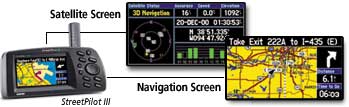
GPS Screens

A GPS receiver must be locked on to the signal of at least three satellites to calculate a 2D position (latitude and longitude) and track movement. With four or more satellites in view, the receiver can determine the user's 3D position (latitude, longitude and altitude). Once the user's position has been determined, the GPS unit can calculate other information, such as speed, bearing, track, trip distance, distance to destination, sunrise and sunset time and more.
 “Cuff” is a Line of GPS-Enabled Jewelry That Double as Safety Devices

Cuff, Cuff personal safety, wearable technology, safety technology, personal safety device, Ecouterre,

If you’re a senior who lives alone, or a woman working second shift, it’s important to be concerned about safety. As anyone who watches the ID channel knows, danger can be lurking in plain sight. This isn’t to say that we should live in fear, but we should definitely be prepared. For those nervous about walking home alone at night, Cuff’s new line of GPS-enabled jewelry provides a stylish yet practical way to ensure that help is only a button-push away. Much more attractive than similar alert button devices, Cuff allows you to build your own inner circle of contacts via an app. 
Cuff, GPS, design for safety, Deepa Sood, safety devices, wearable technology, eco-fashion, sustainable fashion, green fashion, ethical fashion, sustainable style, smart bracelets, smartbands, high-tech bracelets, San Francisco, smartphonesFor those nervous about walking home alone at night, Cuff’s new line of GPS-enabled jewelry can give you some piece of mind and alert friends and family to your exact location. If you run into a dangerous or uncomfortable situation, you merely press your Cuff and a message will be sent to your protective circle so they know where you are in case of emergency. The GSP Cuff chip can be used with a variety of stylish jewelry and accessories like necklaces, bracelets or even key chains, so it won’t even look like you’re wearing a security device. Cuff was created to provide wearers a greater sense of safety, but can also be used to create connections between friends. 

Cuff was started by Deepa Sood, former VP of Product  Development at Restoration Hardware, with help from her mother who encouraged her to launch the brand. Combination  safety device,wearable technology and chic jewelry, the Cuff  line offers a variety of ways to provide security in a stylish way.  Each piece of jewelry or accessory has a spot to slide in the  CuffLinc, which is a GPS-enabled chip that tracks the wearers  location.
 The Cuff wearer sets up her “Cuff circle” or her protective  network via the iPhone app to connect with specific people. If the  wearer is in danger, has an emergency or needs assistance, he or she can press the CuffLinc for three seconds, which will send out an alert to everyone in the Cuff circle. The Cuff app can also be used to send alerts to certain people letting them know you need to contact them. And wearers of Cuff will never miss an alert, because it will vibrate when a notification has been sent out.
Cuff can be used in a variety of scenarios. It can be worn by children and parents so they can always find each other, by people who work or walk in unsafe areas, or even by people who are ill and might need assistance. The Cuff can also be used by groups of friends or family to improve improve their connections and feel closer to one another. Cuff starts out at $50 for a bracelet and goes up to $150 for the more stylish brass bracelets and necklaces.

Market Research Report- GPS Tracking and Navigation Market in India  
The general notion of tracking subjects has resulted in the advent of Global Positioning System (GPS) as a major breakthrough that the world had witnessed. Though the technology has been adopted a lot earlier in the developed countries, India is fast catching up the trend. GPS has surfaced as a ubiquitous concept that looks at bringing the entire world into close proximity by connecting far-off subjects. The report begins with the introduction of concept of GPS along with a brief description of the types of tracking. It then goes on to describe the basic framework of the functioning of GPS through its work model. The different components that get synergized to form the GPS ecosystem are described in the following section. It is followed by market overview which can be segregated into the global and the Indian scenario respectively. The global market overview is elaborated with a general introduction as well as a market size by shipment and values. The global market is slated to increase at the rate of 25-30% and a prediction is stated till 2016. An overview of the Indian GPS market comes next wherein along with the understanding of the sector, the market size as well as a market structure is also presented. This is immediately followed by the differentiation of the GPS market into two primary heads. The focus then shifts towards the Geographic Information System (GIS) wherein a take on the concept of GIS along with the Indian market overview is rendered. The GIS market overview comes with the market size figures and the segments where it operates. The following sections speak about the product categories and the benefits associated with GPS in the country. The report then progresses towards implementation of GPS as a mobile phone technology and also deliberates on the modified version of technology that aims at ameliorating the usage for consumers.

Uses for GPS

  • ·         GPS are used for mapping forests, help farmers harvest their fields and navigate airplanes on the ground or in the air. It can also be used in military applications. The term 'GPS' stands for global positioning system.

  • ·         GPS is used to provide geographical positioning and the time of day of any point on the earth surface. It is made up of a space-based satellite navigation system that can send signals to any place on earth regardless of the prevailing physical environment. The system is maintained by the United States of America.

  • ·         The Global Positioning System or the GPS has several uses. For example, consumers have GPS receivers in their mobile phones that allow 911 dispatchers to determine their location in emergencies, businesses. Companies use GPS to provide routes to drivers, as well as track their progress, whereas law enforcers such as the police use GPS to efficiently get to their destination for emergencies.

  • ·         GP stands for general practitioner. This is a medical practitioner who treats acute illnesses and provides preventive care for people of all ages and sexes. A general practitioner also provides suitable health education to people in order to help them make sound decisions.

  • ·         GPS means global positioning system which is a precise worldwide navigational and surveying facility based on the response of signals from an array of orbiting satellites. It was developed in 1973 and was initially designed to assist soldiers and military vehicles, planes, and ships in correctly determining their locations worldwide.

  • ·         GPS is an abbreviation commonly used to mean Global Positioning System. It describes a global navigation satellite which is based in the space. GPS is specifically used to provide location and time in all weather anywhere near the earth.

  • ·         GP is the acronym for General Practitioner. A General Practitioner is a trained healthcare professional who provides general primary and preventive care. Such a professional treats acute and chronic illnesses and offers health education for all and sundry.

  • ·         GPS stands for Global Positioning System. It is a satellite based navigation system meant to be used by the U.S department of defence. But later in 1980's the U.S government made it available for civilian use. GPS satellites circle the earth two times a day in a very precise orbit and transmit signals data to earth.

  • ·         GPS receivers are able to obtain their location by acquiring a signal from some of the 27 satellites that orbit the globe. The GPS system, originally for use by the US military, is now available to all for location-finding and navigation. With a GPS receiver, road warriors, pilots, ramblers, and nautical folk can find out where they are, plan routes, help get on the wrong track when lost, and generally make travelling a whole lot easier.

  • ·         Global Positioning System refers to a system of satellites and receivers that allow people and devices to pinpoint their precise location on the earth and the heart of the system relies on 24 satellites that orbit the earth twice per day.

Conclusion

Navigating open waterways without a marine GPS navigation system is almost unheard of in the day and age of advanced technology. Nearly a requirement for water voyages of any duration, marine GPS units can be found at numerous local retailers, as well as from online stores and marketplaces. With a little research and foresight, along with the information provided in this guide, shoppers should have no problem identifying the type of GPS unit and functions needed for any boating application. Choosing between a pricey, feature-rich, fixed-mount unit or a simpler, inexpensive handheld device is the first step to finding the right marine navigation system. Shoppers also need to carefully consider the type of boating they engage in, along with any required functions for the GPS. With a certain type of GPS unit in mind, shoppers can begin researching different models. Setting a budget and deciding on the most important features will help narrow the choices to a few top contenders. With a list of desired features and price points in mind, it is a matter of finding the unit that is both functional and easy to operate. Make sure the person who will be using the unit is comfortable operating it before committing to a particular GPS device. Whether taking a leisure trip around a large lake or a fishing trip on the open seas, having the right marine GPS unit will ensure a smooth voyage and safe return.
 For more details:-

http://inhabitat.com/cuff-gps-enabled-jewelry-is-next-gen-life-alert-for-women-with-style/
http://www.ecouterre.com/cuff-is-a-line-of-gps-enabled-jewelry-that-double-as-personal-safety-devices/
     http://www.docstoc.com/docs/101125986/Market-Research-Report-GPS-Tracking-and-          Navigation-Market-in-India


Start a  Business of Ice Cream Parlour


Ice cream is a popular commodity, and one with a significant mark-up. If you’re looking to start an ice cream business, there are a number of different avenues to take, such as going mobile with a van, or opening a fixed location at a beach or on the high-street. Having a solid business plan is essential as ice cream businesses can be heavily affected by seasonal demand.
Ice cream is a very saleable commodity, especially during the summer months. The initial start-up costs are not as high as some other businesses and thus may attract first-time entrepreneurs or those not willing to risk large amounts of capital. Ice-cream businesses are also very scalable; you can expand to multiple vans or locations should you succeed. If you’re looking to start your entrepreneurial path and aren’t sure what company to start, consider an ice-cream business. If you can find the right location, and pair it with a solid business plan, you’ll get a great flavour of running a business and will hopefully enjoy profitability too.


Type of business- 


The nature of your business is likely to affect the level of sales that you make. Things to consider are:
The size of your ice cream parlour. The more room you have, the greater the number of potential customers you will be able to accommodate. Will you have an outdoor seating area. Will you make take-away sales from a separate 'window' or kiosk
·       The location of your parlour. A parlour in a popular tourist location is likely to attract a large amount of customers in the holiday season but may be very quiet for the rest of the year. Locating in a town centre may attract customers throughout the year
·         The appearance of your parlour. An upmarket image may mean that you will be able to charge higher prices for your ice cream products.

  eps:-

  1. Start an Ice Cream Shop Step 1.jpg
    1
    Determine whether you will start a franchised shop or a shop on your own.
    • Know the benefits of franchising your business. You'll have people working with you for guidance in starting it. They will help you in the decor of the shop, the materials and food ingredients used to make the products, and the preparation for employees. However, they can also call for capital loan.
  2. Start an Ice Cream Shop Step 2.jpg
    2
    Get an idea for your business and what it will look like. Do this by looking at other ice cream and frozen dessert shops. For example, an ice cream and frozen yogurt shop may specialize in chocolate, strawberry and vanilla flavors. You want to be as successful as that shop, right?
  3. Start an Ice Cream Shop Step 3.jpg
    3
    Do market research.You can look at websites such as the National Ice Cream Retailers Association for this research.
  4. Start an Ice Cream Shop Step 4.jpg
    4
    Ask for what is needed to start an ice cream business. A pass for starting your business may be necessary. You will also need items such as ice cream makers, and things to prevent animals such as bees from coming. What is called for, for your business, should stay with you at all times.
  5. Start an Ice Cream Shop Step 5.jpg
    5
    Decide what goods (other than ice cream) that you are going to dispose to your customers. This can include ice cream cones, and things to put on top of the ice cream (such as whipped cream and cookie crumbs). Once you have come up with everything you are going to dispose, write it down on paper.
  6. Start an Ice Cream Shop Step 6.jpg
    6
    Determine a setting for your business. This could be somewhere close to malls, parks, or in the center of town, or near other places to buy things/restaurants. You should also keep customers' convenience in mind, as well as the transportation conditions. Another thing you need to do is make sure that you have enough space for all ice creams that you are disposing to your customers.
  7. Start an Ice Cream Shop Step 7.jpg
    7 Come up with a plan for your shop. Be sure to write what you learned in your research, where your shop is going to be, how you plan to attract customers, and how you are going to boost your business. Make sure people in a bank close to you, as well as merchants, see what you wrote.
  8. Compliance and regulation-


  9. Any shop serving food and drink requires high hygiene standards. There are common statutes covering the preparation and sale of food and these must be adhered to at all times.

    The Food Safety Act 1990 is a British piece of legislation that provides the framework for all food legislation in the country, while the General Food Law Regulation is a piece of European legislation on general food safety. The General Food Law Regulation 178/2002 covers general food safety. These are ‘food law’ legislation and separate to food hygiene legislation. 

    With regard to food hygiene, ensure you speak to the Health and Safety Executive (HSE) to make sure your practices and procedures are fully compliant with food hygiene regulations as the law changes regularly.
  10. For more details:-

Start A Business of  Interior Decorator


interior decorator 6 Tips on How to Become an Interior Decorator

If you have a love of decorating and a knack for arranging furniture and choosing decor and color, a career as an interior decorator may be perfect for you. Unlike interior design, training and certification is not required. Anyone with skills and the ability to market themselves can start working as an interior decorator. Since competition is high and there is some work involved with getting started, it's important to learn how to become an interior decorator and market yourself effectively.

  1. Steps

    Become an Interior Decorator Step 1.jpg
    1
    Evaluate your skills, strengths and weaknesses. If people regularly compliment your decorating skills and turn to you for advice, that's a good sign that you have the natural talent to be an interior decorator. However, when working for others, you'll be exposed to a variety of different tastes and styles. You'll have to be able to show an extensive knowledge of space planning, fabrics and materials and you'll also have to be able to work with different personalities. List areas that may be challenging, and start working on them.
  2. Become an Interior Decorator Step 2.jpg
    2
    Get training. You won't have to have a degree to work as an interior decorator, but some classes or certifications can give you credibility. Many community colleges offer associates degrees, and colleges often have certification programs or short courses on interior design. Online programs and classes in home staging or organizing can be helpful, too. Besides all that, you can begin teaching yourself immediately with self study. Learn the fundamentals, types of materials, decorating history and decorating styles.
  3. Become an Interior Decorator Step 3.jpg
    3
    Practice interior decorating as much as you can. Volunteer to help friends and family with decorating projects. Look for volunteer projects with local organizations. Look for service organizations like Habitat for Humanity and local shelters. Even decorating spaces for special events is good experience.
  4. Become an Interior Decorator Step 4.jpg
    4
    Put together a portfolio of your work. Make sure to take photographs of all projects that you complete. Keep hard copies as well as showing off your work online. Groups on Flickr, HGTV and other design sites as well as decorating blogs all offer opportunities to show off your work as well as network with others who share your interest and give you more information about how to become an interior decorator.
  5. Become an Interior Decorator Step 5.jpg
    5
    Find sources for materials and supplies. Without a license, you may not be entitled to designer discounts. However, you can begin to negotiate with suppliers if you are buying in bulk. You can also learn to find inexpensive sources for materials like overstock stores and thrift shops.
  6. Become an Interior Decorator Step 6.jpg
    6
    Look for a job in interior decorating or visual merchandising. Competition is high, so a high paying, professional job may not be easy to find. However, you can get started by working in a furniture store, design center, or local department store. A job that offers a chance to do some decorating and visual merchandising--arranging items that attract buyers' attention and are pleasing to the eye--will add to your experience and portfolio.
  7. Become an Interior Decorator Step 7.jpg
    7
    Start your own business if time and funds allow. Your start up costs can be low, you'll need a business license for your state and town and some office space. If you don't have time to do work in the field, consider a business as a virtual decorator where you can evaluate a client's home through pictures and discussion.


  8. Licensing Requirements
    There are three classifications for interior designers in states that require a license:
    ·         Certified Interior Designer
    ·         Registered Interior Designer
    ·         Licensed Interior Designer

    Your state law will determine which of these you can choose to become, and each require a certain level of work experience, education and passing an exam.
  9. For more details:-
Powered by Blogger.