It is a safety system in automobiles. It prevents the wheels from locking while braking. The purpose of this is to allow the driver to maintain steering control under heavy braking and, in some situations, to shorten braking distances (by allowing the driver to hit the brake fully without skidding or loss of control).
How Do Wheels Lock?
During braking, wheels lock if the brake force applied is more than the friction between the road and tyre. This often happens in a panic braking situation, especially on a slippery road. When the front wheels lock, the vehicle slides in direction of motion. When the rear wheels locks, the vehicle swings around. It is impossible to steer around an obstacle with wheels locked. Locked wheels can thus result in accident. Skidding also reduce tyre life.
What Does ABS Do?
The system detects when the wheel are about to lock and momentarily release the pressure on locking wheel. The brakes are reapplied as soon as the wheels have recovered.
A toothed wheel (pole wheel) is fitted to the rotating wheel hub. A magnetic sensor mounted on each wheel in close in close proximity to the teeth, generates electrical pulses when the pole wheel rotates. The rate at which the pulses are generated (frequency) is a measure of wheel speed. This signal is read by electronic control unit (ECU). When a wheel is lock, the ECU sends an electrical signal to the modulator valve solenoid, which release pressure from the brake chamber. When the wheel recovers sufficiently, the brake pressure is reapplied again by the switch off signal to the modulator valve.
The modulator valve has an addition ‘hold’ state which maintains pressure. In break in the chamber, thus optimizing the braking process. The cycling of modulator valve (5 to 6 times per second) is continued till the vehicle comes to a controlled stop.
With ABS, the vehicle remains completely stable even when the driver continues to press the brake pedal during braking, thus avoiding accidents.

Components:
The anti-lock braking system consists of following components.
Wheel Speed Sensor
The wheel speed sensor consists of a permanent magnet and coil assembly. It generates electrical pulses when the pole wheel rotates. The rate at which the pulses are generated is a measure of wheel speed. The voltage induced increases with the speed of rotation of the wheel and reduces with increasing gap between the pole wheel and the sensor.
Pole Wheel
Pole Wheel is a toothed wheel made of ferrous material. It normally has teeth on the face. In some cases where it is not possible to install the sensor parallel to the axle, the pole wheels are designed with teeth on periphery. The pole wheel fitted on standard 9-20, 10-20 tires has normally 100 evenly spaced teeth. 80 evenly spaced teeth pole wheels are used for the vehicles having the tyre diameter less than 9mm.
Sensor Extension Cable
The sensor extension cable is a two core cable which connects the wheel speed sensor to the Electronic Control Unit. The inner core sheathing is of EPDM rubber and the outer sheathing is polyurethane which provide abrasion resistance to the cable. The cable has a module plug with two pins is connected to the control assembly. The cable has two cores-brown and black in colour.
Electronic Control Unit
The ECU is the core component of the ABS system. Wheel speed sensor signal are the input to the Electronic Control Unit. The ECU computers wheel speeds, wheel deceleration and acceleration. If any wheel tends to lock, the ECU actuates the corresponding Modulator valve to prevent wheel lock. The ECU is normally mounted in driver's cabin.
The ECU consists of 7 major circuits,
> Input circuit
> Master circuit
> Slave circuit
> Driver circuit
> Feedback circuit
> Power supply circuit
> Fail safe circuit
The functions of ECU,
> It receives wheel speed signal from the sensor. The wheel speed signals are processed and appropriate output signals are sent to the modular valves in the event of a wheel lock.
> It continuously monitors the status and operation of ABS components and wiring.
> It alerts the driver in the event of occurrence of any electrical fault in the ABS system by actuating a warning lamp.
> It disconnects the exhaust brakes during ABS operations.
> It enables the service technician to read the faults in the system either through a diagnostic controller or a blink code lamp.
Modulator Valve Cable
The Modulator valve cable has thee cores. There are two solenoid interface lines and a common ground line. The inner core sheathing is of EPDM type and the outer sheathing is polyurethane which provide abrasion resistance to the cable.
The cable has a three pin moulded socket is connected to the modulator valve solenoid at one and an interlock connector with locking feature at the other end. The cores are brown, blue and green.
Modulator Valve
ABS Modulator valve regulate the air pressure to the brake chamber during ABS action. During normal braking it allows air to flow directly from inlet to delivery. Modulator valve cannot automatically apply the brakes, or increase the brake application pressure above the level applied by the driver through the dual brake valve.
There is an inlet port, Delivery port and Exhaust passage.
> The inlet port is connected to the delivery of quick release valve or relay valve.
> The delivery port is connected to the brake chamber.
> The exhaust passage vents air from the brake chambers.
The modulator valve has two solenoids. By energizing the solenoids, the modular valve can be switched to any of the following modes.
> Pressure
> Pressure hold
> Pressure release
Quick Release Valve
Quick release valve are fitted in air braking system to release the air from the brake chamber quickly after release of brake pedal. This prevents delay in brake release due to long piping runs or multiples of brake chamber being exhausted through the brake valve.
Relay Valve
Relay valve provides a means of admitting and releasing air to and from brake chamber quickly, in accordance with the signal pressure from the delivery of the dual brake valve. Air from the reservoir passes through the valve into the brake chamber. The pressure applied to the brake is equal to the signal pressure from the dual brake valve. When the brake pedal is released the signal pressure is released. The pressure in the brake chamber is released directly through the exhaust port of the relay valve.
Warning Lamp
Vehicle are fitted with an ABS warning lamp. It is a LED indicator lamp amber in colour and lights up when the system has detected any electrical fault. ABS warning lamp is located on the instrument panel in form of a driver.
Blink Code Lamp
This lamp is green in colour and is used to indicate the stored faults in the system to the service technician on operating a blink code switch. The nature of fault in the system can be diagnosed by the number of flashes.
Off Highway Switch
This is an optional switch in front of the driver which can be switched ON when the vehicle is operating off highway. In this mode, ABS control will; allow higher wheel slip to achieve shorter stopping distance than with normal ABS control.
Blink Code Switch
A momentary switch that grounds the ABS Indicator Lamp output is used to place the ECU into the diagnostic blink code mode and is typically located on the vehicle's dash panel.

A turbocharger or turbo is a forced induction device used to allow more power to be produced for an engine of a given size. A turbocharged engine can be more powerful and efficient than a naturally aspirated engine because the turbine forces more intake air, proportionately more fuel, into the combustion chamber than if atmospheric pressure alone is used. Turbo are commonly used on truck, car, train, and construction equipment engines. Turbo are popularly used with Otto cycle and Diesel cycle internal combustion engines.
There are two ways of increasing the power of an engine. One of them would be to make the fuel-air mixture richer by adding more fuel. This will increase the power but at the cost of fuel efficiency and increase in pollution levels… prohibitive! The other would be to somehow increase the volume of air entering into the cylinder and increasing the fuel intake proportionately, increasing power and fuel efficiency without hurting the environment or efficiency. This is exactly what Turbochargers do, increasing the volumetric efficiency of an engine.
In a naturally aspirated engine, the downward stroke of the piston creates an area of low pressure in order to draw more air into the cylinder through the intake valves.  Now because of the pressure in the cylinder cannot go below 0 (zero) psi (vacuum) and relatively constant atmospheric pressure (about 15 psi) there will be a limit to the pressure difference across the intake valves and hence the amount of air entering the combustion chamber or the cylinder. The ability to fill the cylinder with air is its volumetric efficiency. Now if we can increase the pressure difference across the intake valves by some way we can make more air enter into the cylinder and hence increasing the volumetric efficiency of the engine.
It increases the pressure at the point where air is entering the cylinder, thereby increasing the pressure difference across the intake valves and thus more air enters into the combustion chamber. The additional air makes it possible to add more fuel, increasing the power and torque output of the engine, particularly at higher engine speeds.
Turbochargers were originally known as Turbo superchargers when all forced induction devices were classified as superchargers; nowadays the term "supercharger" is usually applied to only mechanically-driven forced induction devices. The key difference between a turbocharger and a conventional supercharger is that the latter is mechanically driven from the engine, often from a belt connected to the crankshaft, whereas a turbocharger is driven by the engine's exhaust gas turbine. Compared to a mechanically-driven supercharger, turbochargers tend to be more efficient but less responsive.
HISTORICAL PERSPECTIVE
The turbocharger was invented by Swiss engineer Alfred Büchi. His patent for a turbocharger was applied for use in 1905. Diesel ships and locomotives with turbochargers began appearing in the 1920s.
AVIATION:
During the First World War French engineer AugusteRateau fitted turbochargers to Renault engines powering various French fighters with some success. In1918, General Electric engineer Sanford Moss attached a turbo to a V12 Liberty aircraft engine. The engine was tested at Pikes Peak in Colorado at 4,300 m to demonstrate that it could eliminate the power losses usually experienced in internal combustion engines as a result of reduced air pressure and density at high altitude.
Turbochargers were first used in production aircraft engines in the 1920s, although they were less common than engine-driven centrifugal superchargers. The primary purpose behind most aircraft-based applications was to increase the altitude at which the airplane could fly, by compensating for the lower atmospheric pressure present at high altitude.
PRODUCTION AUTOMOBILES:
The first turbocharged diesel truck was produced by Schweizer Maschinenfabrik Saurer (Swiss Machine Works Saurer) in 1938 .The first production turbocharged automobile engines came from General Motors in 1962. At the Paris auto show in1974, during the height of the oil crisis, Porsche introduced the 911 Turbo – the world’s first production sports car with an exhaust turbocharger and pressure regulator. This was made possible by the introduction of a waste gate to direct excess exhaust gasses away from the exhaust turbine. The world's first production turbo diesel automobiles were the Garrett-turbocharged Mercedes 300SD and the Peugeot 604, both introduced in 1978. Today, most automotive diesels are turbocharged.
1962 Oldsmobile Cutlass Jet fire
1962 Chevrolet Corvair Monza Spyder
1973 BMW 2002 Turbo
1974 Porsche 911 Turbo
1978 Saab 99
1978 Peugeot 604 turbo diesel
1978 Mercedes-Benz 300SD turbo diesel (United States/Canada)
1979 Alfa Romeo Alfetta GTV 2000 Turbodelta
1980 Mitsubishi Lancer GT Turbo
1980 Pontiac Firebird
1980 Renault 5 Turbo
1981 Volvo 240-series Turbo
OPERATING PRINCIPLE
A turbocharger is a small radial fan pump driven by the energy of the exhaust gases of an engine. A turbocharger consists of a turbine and a compressor on a shared shaft. The turbine converts exhaust heat to rotational force, which is in turn used to drive the compressor. The compressor draws in ambient air and pumps it in to the intake manifold at increased pressure resulting in a greater mass of air entering the cylinders on each intake stroke.
The objective of a turbocharger is the same as a supercharger; to improve the engine's volumetric efficiency by solving one of its cardinal limitations. A naturally aspirated automobile engine uses only the downward stroke of a piston to create an area of low pressure in order to draw air into the cylinder through the intake valves. Because the pressure in the atmosphere is no more than 1 atm (approximately 14.7 psi), there ultimately will be a limit to the pressure difference across the intake valves and thus the amount of airflow entering the combustion chamber.
Because the turbocharger increases the pressure at the point where air is entering the cylinder, a greater mass of air (oxygen) will be forced in as the inlet manifold pressure increases. The additional air flow makes it possible to maintain the combustion chamber pressure and fuel/air load even at high engine revolution speeds, increasing the power and torque output of the engine. Because the pressure in the cylinder must not go too high to avoid detonation and physical damage, the intake pressure must be controlled by venting excess gas. The control function is performed by a waste gate, which routes some of the exhaust flow away from the turbine. This regulates air pressure in the intake manifold.
COMPONENTS OF A TURBOCHARGER
The turbocharger has four main components. The turbine (almost always a radial turbine) and impeller/compressor wheels are each contained within their own folded conical housing on opposite sides of the third component, the center housing/hub rotating assembly. The housings fitted around the compressor impeller and turbine collect and direct the gas flow through the wheels as they spin. The size and shape can dictate some performance characteristics of the overall turbocharger. The turbine and impeller wheel sizes dictate the amount of air or exhaust that can be flowed through the system, and the relative efficiency at which they operate. Generally, the larger the turbine wheel and compressor wheel, the larger the flow capacity. The center hub rotating assembly houses the shaft which connects the compressor impeller and turbine. It also must contain a bearing system to suspend the shaft, allowing it to rotate at very high speed with minimal friction. Waste gates for the exhaust flow.
TURBINE WHEEL:
The Turbine Wheel is housed in the turbine casing and is connected to a shaft that in turn rotates the compressor wheel.
COMPRESSOR WHEEL (IMPELLER)
Compressor impellers are produced using a variant of the aluminum investment casting process. A rubber former is made to replicate the impeller around which a casting mould is created. The rubber former can then be extracted from the mould into which the metal is poured. Accurate blade sections and profiles are important in achieving compressor performance. Back face profile machining optimizes impeller stress conditions. Boring to tight tolerance and burnishing assist balancing and fatigue resistance. The impeller is located on the shaft assembly using a threaded nut.
WASTE GATES:
On the exhaust side, a Waste gate provides us a means to control the boost pressure of the engine. Some commercial diesel applications do not use a Waste gate at all. This type of system is called a free-floating turbocharger. However, the vast majority of gasoline performance applications require Waste gates. Waste gates provide a means to bypass exhaust flow from the turbine wheel. Bypassing this energy (e.g. exhaust flow) reduces the power driving the turbine wheel to match the power required for a given boost level.

ADVANTAGES
1. More specific power over naturally aspirated engine. This means a turbocharged engine can achieve more power from same engine volume.
2. Better thermal efficiency over both naturally aspirated and supercharged engine when under full load (i.e. on boost). This is because the excess exhaust heat and pressure, which would normally be wasted, contributes some of the work required to compress the air.
3. Weight/Packaging. Smaller and lighter than alternative forced induction systems and may be more easily fitted in an engine bay.
4. Fuel Economy. Although adding a turbocharger itself does not save fuel, it will allow a vehicle to use a smaller engine while achieving power levels of a much larger engine, while attaining near normal fuel economy while off boost/cruising. This is because without boost, less fuel is used to create a proper air/fuel ratio.
DISADVANTAGES
1. Lack of responsiveness if an incorrectly sized turbocharger is used. If a turbocharger that is too large is used it reduces throttle response as it builds up boost slowly otherwise known as "lag". However, doing this may result in more peak power.
2. Boost threshold- A turbocharger starts producing boost only above a certain rpm due to a lack of exhaust gas volume to overcome inertia of rest of the turbo propeller. This results in a rapid and nonlinear rise in torque, and will reduce the usable power band of the engine. The sudden surge of power could overwhelm the tires and result in loss of grip, which could lead to under steer/over steer, depending on the drive train and suspension setup of the vehicle. Lag can be disadvantageous in racing, if throttle is applied in a turn, power may unexpectedly increase when the turbo spools up, which can cause excessive wheel spin.
3. Cost- Turbocharger parts are costly to add to naturally aspirated engines. Heavily modifying OEM turbocharger systems also require extensive upgrades that in most cases requires most (if not all) of the original components to be replaced.
4. Complexity- Further to cost, turbochargers require numerous additional systems if they are not to damage an engine. Even an engine under only light boost requires a system for properly routing (and sometimes cooling) the lubricating oil, turbo-specific exhaust manifold, application specific downpipe, boosts regulation. In addition inter -cooled turbo engines require additional plumbing, while highly tuned turbocharged engines will require extensive upgrades to their lubrication, cooling, and breathing systems; while reinforcing internal engine and transmission parts.
TURBO LAG AND BOOST
The time required to bring the turbo up to a speed where it can function effectively is called turbo lag. This is noticed as a hesitation in throttle response when coming off idle. This is symptomatic of the time taken for the exhaust system driving the turbine to come to high pressure and for the turbine rotor to overcome its rotational inertia and reach the speed necessary to supply boost pressure. The directly-driven compressor in a supercharger does not suffer from this problem. Conversely on light loads or at low RPM a turbocharger supplies less boost and the engine acts like a naturally aspirated engine. Turbochargers start producing boost only above a certain exhaust mass flow rate (depending on the size of the turbo). Without an appropriate exhaust gas flow, they logically cannot force air into the engine. The point at full throttle in which the mass flow in the exhaust is strong enough to force air into the engine is known as the boost threshold rpm. Engineers have, in some cases, been able to reduce the boost threshold rpm to idle speed to allow for instant response. Both Lag and Threshold characteristics can be acquired through the use of a compressor map and a mathematical equation.
APPLICATIONSGasoline-powered cars
Today, turbocharging is commonly used by many manufacturers of both diesel and gasoline-powered cars. Turbo charging can be used to increase power output for a given capacity or to increase fuel efficiency by allowing a smaller displacement engine to be used. Low pressure turbocharging is the optimum when driving in the city, whereas high pressure turbocharging is more for racing and driving on highways/motorways/freeways.
Diesel-powered cars
Today, many automotive diesels are turbocharged, since the use of turbocharging improved efficiency, driveability and performance of diesel engines, greatly increasing their popularity.
Motorcycles
The first example of a turbocharged bike is the 1978 Kawasaki Z1R TC. Several Japanese companies produced turbocharged high performance motorcycles in the early 1980s. Since then, few turbocharged motorcycles have been produced.
Trucks
The first turbocharged diesel truck was produced by Schweizer Maschinenfabrik Saurer (Swiss Machine Works Saurer) in 1938.
Aircraft
A natural use of the turbocharger is with aircraft engines. As an aircraft climbs to higher altitudes the pressure of the surrounding air quickly falls off. At 5,486 m (18,000 ft), the air is at half the pressure of sea level and the airframe experiences only half the aerodynamic drag. However, since the charge in the cylinders is being pushed in by this air pressure, it means that the engine will normally produce only half-power at full throttle at this altitude. Pilots would like to take advantage of the low drag at high altitudes in order to go faster, but a naturally aspirated engine will not produce enough power at the same altitude to do so.
Here the main aim is to effectively utilize the non renewable energy such as petrol and diesel. Complete combustion of the fuels can be achieved. Power output can be increased. Wind energy can be used for air compression. We conclude that the power as well as the efficiency is increasing 10 to 15 % and pollution can also decrease. From the observation we can conclude that when the full throttle valve is open at that time the engine speed is 4000 rpm and by this the turbocharger generate 1.60 bar pressurized air. Generally the naturally aspirated engine takes atmospheric pressurized air to the carburetor for air fuel mixture but we can add the high density air for the combustion so as the result the power and the complete combustion take place so efficiency is increasing.


CAD: Computer-Aided Design (CAD) can be defined as the creation, modification, analysis and optimization of a new component using a computer.
 CAD involves 3 major elements:-
     1. Hardware
     2. CAD software and
     3. The user
The primary function of CAD involves design, analysis and application to manufacturing. An object drawn with CAD can be analyzed interactively on the CAD screen and the physical information can be extracted from it.
In an engineering sense, Cad also incorporates finite-element analysis, stress analysis, heat transfer analysis, and fluid flow analysis and so on. I.e. which enables a part to be constructed and tested virtually before any physical object is manufactured.
CAM: computer-Aided manufacturing (CAM) can be defined as the application of computers to plan, process, manage and control various operations in a manufacturing organization either with direct or indirect computer interface with the available resources.

Steel is an alloy of iron and carbon, with carbon content upto a maximum of 1.5%. Most of the steel produced now-a-days is plain carbon steel or simply carbon steel. It is divided into the following types depending upon the carbon content:
 
1. Dead mild steel — upto 0.15% Carbon
2. Low carbon or mild steel — 0.15% to 0.45% Carbon
3. Medium carbon steel — 0.45% to 0.8% Carbon
4. High carbon steel — 0.8% to 1.5% Carbon

Our cities stand on the basic foundation of steel, without which they would instantly collapse. How is this outstanding alloy made? Here we discusses the various methods normally employed during the steel manufacturing process.
·         Steel is basically up of an alloy of carbon and iron, where the presence of carbon may vary from 0.25% to 1.5% and hence steel is primarily classified as low carbon steel (around 0.25% carbon), medium carbon steel (between 0.25% to 0.75% carbon) and high carbon steel (0.75% to 1.5% carbon).

Steel may be manufactured through the following principle methods:
·         Cementation Process
·         Crucible Process
·         Bessemer Process
·         Open-hearth Process
·         Electric Process
·         Duplex process
·         L-D Process
Let’s look at these one by one.
Cementation Process:

In this process wrought iron bars are introduced in a furnace in between powdered charcoal layers and are subjected to a very high temperature – about 7000 Celsius for about a week to fortnight depending upon the required quality of the steel. The conditions slowly diffuse carbon into iron and cause the carbon to become dissolved in the iron, raising the carbon percentage. Steel obtained from this process is called “blister steel" due to the blister-like marks formed on the surface due to the evolved gases during the manufacturing process. The carbon amount here is usually around 0.75% to 1.5%.
Crucible Process:
The process involves heating of either blister steel fragments or short lengths of wrought iron bars mixed with charcoal inside fire clay crucibles. The resulting molten steel is allowed to run through iron moulds. Such steel is called “cast iron." Cast steel is extremely hard and perfectly homogenous. These are specifically used for making cutting tools and the finest cutlery items.
Bessemer Process:
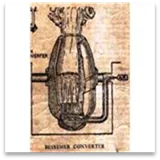
 In this process pig iron is melted in a cupola and poured into Bessemer converter which is pear shaped and has a steel shell lined with refractory material. It’s pivoted on trunnions so as to facilitate tilting, pouring or charging.
Once the above converter is charged with molten pig iron, a strong thrust of air is blasted across the molten mass for about 20 minutes through nozzles provided at the bottom of the vessel. The process oxidizes all traces of the carbon and silicon present, leaving the converter with pure iron.
After this the blasting of air is stopped and the specified amount of ferro-manganese is added to it for the sake of including the recommended content of carbon and manganese to the steel.
The air blasted procedure is again initiated for some time, ensuring perfect mixing of the alloy.
The converter is then tilted so that the molten material can be discharged into the ladles. In the final step the molten alloy is
shifted into rectangular moulds where it’s obtained in the form of solid ingots.

Open Hearth Process:
 The specialty of open-hearth furnaces is the extreme heat that can be obtained from them due to their regenerative process. The charge of pig iron, steel scrap, iron ore, and flux are together kept in a shallow container with a flame burning above it. The process is initiated inside reverbaratory gas-fired regenerative furnaces for greater efficiency.
Regenerators are placed below the furnace and positioned in two pairs. The pairs are heated alternately through the passage of hot gases given out from the furnace in their route to the chimney. This heat is retained by the regenerators and is reversed and given back to the furnace. This heat exchange procedure helps the furnace to maintain high temperatures even with less fuels.
Once the furnace is charged with pig iron, pure oxidizing ores like haematite are added to it from time to time, which helps oxidization and the removal of impurities like silicon, carbon, and manganese in the pig iron. Spiegel is also introduced when the carbon content becomes less than 0.1%, and ferro-manganese after the metal is tapped out into the ladle. Ferro-manganese becomes important for restoring malleability and also for carburizing the iron.
Electric Process:
 In this process electric arc or electric high frequency furnaces are used. In electric arc furnaces which are more common among the two processes, high voltage electric arc struck between carbon electrodes and the charge becomes the source of a very high temperature. The charge is collected directly from an open hearth furnace, the intense arc heat keeps the charge in its molten state, and the impurities are removed in the form of slag.
The high frequency furnace is based on the principle that when high frequency alternating current is applied to steel, eddy currents starts flowing in them. If this induction is made very strong, it can heat up the steel and melt it.
Electric furnaces are more advantageous compared to the other steel manufacturing processes due to the absence of evolving gases, fumes, etc., which normally become a major problem with fuel operated furnaces.
Duplex process.
 The duplex process of steel making is a combination of acidic bessemer process and basic open hearth process. This process is in operation at Tata Iron and Steel works, Jamshedpur (Bihar).
L-D process (Linz-Donawitz process).
It is the latest development in steel making processes and is now adopted at Rourkela steel plant where three converters of 40 tonnes capacity are working.

Note : The bessemer process may be acidic or basic depending upon the lining of furnace. In the acidic bessemer process, the furnace is lined with silica ricks. The slag produced in this process contains large amount of silica. Since phosphorus in a pig iron cannot be removed by this process, therefore acidic bessemer process is unsuitable for producing steel from pig iron containing large quantities of phosphorus.

In basic bessemer process, also known as Thomas process, the furnace is lined with a mixture of tar and burned dolomite. This process is applicable for making steel from pig iron which contains more than 1.5% phosphorus.

Note: The steel contains small amounts of impurities like silicon, sulphur, manganese and phosphorus. The effect of these impurities are as follows:
Silicon in the finished steel usually ranges from 0.05 to 0.30%. It is added in low carbon steels to prevent them from becoming porous. It removes the gases and oxides, prevents blow holes and thereby makes the steel tougher and harder.
Sulphur occurs in steel either as iron sulphide or manganese sulphide. Iron sulphide because of its low melting point produces red shortness whereas manganese sulphide does not effect so much.
Manganese serves as a valuable deoxidising and purifying agent, in steel. When used in ordinary low carbon steels, manganese makes the metal ductile and of good bending qualities. In high speed steels, it is used to tougher the metal and to increase its critical temperature.

Phosphorus  makes the steel brittle, It also produces cold shortness in steel. In low carbon steels, it raises the yield point and improves the resistance to atmospheric corrosion. The sum of carbon and phosphorus usually does not exceed 0.25%.


Three fundamental things can happen: a bad fuel mix, lack of compression or lack of spark. Beyond that, thousands of minor things can create problems, but these are the "big three." Based on the simple engine we have been discussing, here is a quick rundown on how these problems affect your engine:
Bad fuel mix - A bad fuel mix can occur in several ways:
· You are out of gas, so the engine is getting air but no fuel.
· The air intake might be clogged, so there is fuel but not enough air.
· The fuel system might be supplying too much or too little fuel to the mix, meaning that combustion does not occur properly.
· There might be an impurity in the fuel (like water in your gas tank) that makes the fuel not burn.
Lack of compression - If the charge of air and fuel cannot be compressed properly, the combustion process will not work like it should. Lack of compression might occur for these reasons:
· Your piston rings are worn (allowing air/fuel to leak past the piston during compression).
· The intake or exhaust valves are not sealing properly, again allowing a leak during compression.
·  There is a hole in the cylinder.
The most common "hole" in a cylinder occurs where the top of the cylinder (holding the valves and spark plug and also known as the cylinder head) attaches to the cylinder itself. Generally, the cylinder and the cylinder head bolt together with a thin gasket pressed between them to ensure a good seal. If the gasket breaks down, small holes develop between the cylinder and the cylinder head, and these holes cause leaks.
Lack of spark - The spark might be nonexistent or weak for a number of reasons:
· If your spark plug or the wire leading to it is worn out, the spark will be weak.
· If the wire is cut or missing, or if the system that sends a spark down the wire is not working properly, there will be no spark.
· If the spark occurs either too early or too late in the cycle (i.e. if the ignition timing is off), the fuel will not ignite at the right time, and this can cause all sorts of problems.

Many other things can go wrong. For example:
·If the battery is dead, you cannot turn over the engine to start it.
·If the bearings that allow the crankshaft to turn freely are worn out, the crankshaft cannot turn so the engine cannot run.
·If the valves do not open and close at the right time or at all, air cannot get in and exhaust cannot get out, so the engine cannot run.
·If someone sticks a potato up your tailpipe, exhaust cannot exit the cylinder so the engine will not run.
·If you run out of oil, the piston cannot move up and down freely in the cylinder, and the engine will seize.
In a properly running engine, all of these factors are within tolerance.

In the age of the mobile device, we use more batteries than ever before. From our TV remotes and handheld GPS units, to mobile games, we depend on our batteries. While a lot of our devices now incorporate internal, rechargeable batteries, there are still a lot of devices that need their batteries swapped out when they die. If you use a lot of batteries, then you may find yourself trying to decide between replacing with single-use or rechargeable?

Let's take a look at the Advantages of Rechargeable Batteries.

1. Performance – Since rechargeable batteries can be recharged many times over, the cumulative total service life exceeds that of primary batteries by a wide margin.

2. Savings – Recharging rechargeable batteries many hundred times is giving the consumer tremendous savings in the long run.

3. Environmentally friendly – Since the cumulative service is so much longer than primary batteries, only a fraction of the solid waste is generated and a solid waste reduction of 90% and more is possible. If the battery contains no toxins, such as rechargeable alkalines, they can be even disposed of in regular landfills. Other rechargeable, which do contain toxins such as NiMH should be recycled. Most stores nowadays do take old rechargeable back.
Powered by Blogger.