Showing posts with label environment. Show all posts

 Biodiversity, or the variety of life on Earth, is foundational to the health of ecosystems and the planet's overall stability. It encompasses the countless species of plants, animals, fungi, and microorganisms that interact in complex webs of life, from the towering forests to the smallest patches of lichen on rocky cliffs. Understanding and preserving biodiversity is essential because each species, whether significant or seemingly insignificant, contributes to the resilience and balance of ecosystems. The loss of even one species can have cascading effects, disrupting ecological functions that all life depends on. Here, we delve into the many reasons why biodiversity matters and why every species counts in sustaining life as we know it.

Understanding Biodiversity and Its Components

Biodiversity is often discussed in terms of three core components: genetic diversity, species diversity, and ecosystem diversity.

  1. Genetic Diversity refers to the variation of genes within species. This diversity is essential because it enables species to adapt to changing environments and resist diseases. For example, diverse genetic traits among agricultural plants can provide resilience against crop diseases, securing food supplies.

  2. Species Diversity is the variety of species within a given habitat or ecosystem. Each species holds a specific niche, contributing to ecological processes such as nutrient cycling, pollination, and pest control.

  3. Ecosystem Diversity represents the variety of ecosystems, such as forests, wetlands, deserts, and coral reefs. Each ecosystem provides unique services, supporting different communities of species and contributing to the overall health of the planet.

Why Biodiversity Matters

1. Ecological Stability and Resilience

Biodiversity is a vital foundation for ecosystem stability. Complex ecosystems like rainforests and coral reefs consist of species that rely on each other to maintain balance. When biodiversity is rich, ecosystems are more resilient to changes, including natural disasters and human-induced impacts. For instance, forests with diverse plant and animal species are better able to recover from storms, fires, or droughts, ensuring they continue to provide clean air, water, and other ecological services.

2. Biodiversity and Ecosystem Services

Ecosystems provide numerous services essential to human survival. These services are often categorized into four main types:

  • Provisioning Services: Biodiversity is a source of essential goods like food, fresh water, medicinal plants, and raw materials. Many medicines, such as antibiotics, are derived from plant and animal compounds. Forests and oceans are also significant sources of food, sustaining billions of people worldwide.

  • Regulating Services: Biodiversity helps regulate critical natural processes like air and water purification, climate regulation, and disease control. Wetlands, for example, filter pollutants and prevent flooding by absorbing excess rainwater. Forests absorb carbon dioxide, playing a key role in mitigating climate change.

  • Supporting Services: These include services necessary for other ecosystem services to function, like nutrient cycling, soil formation, and photosynthesis. Without these underlying processes, food production and other services would cease to function.

  • Cultural Services: Biodiversity enriches human cultures, traditions, and spiritual values. National parks and wildlife reserves are not only tourist attractions but also inspire art, religion, and education. Natural landscapes and species play a role in the well-being of communities, offering recreational and spiritual experiences.

3. Biodiversity and Food Security

Biodiversity is essential for food security. Agricultural diversity, for instance, ensures a stable food supply by providing various crops that adapt to different climate conditions, resist pests, and improve soil quality. Crop biodiversity reduces dependency on a limited number of species, decreasing vulnerability to disease outbreaks that could threaten entire food supplies. Wild species also contribute to agricultural ecosystems by pollinating crops, enriching soil, and controlling pests, all of which are crucial for sustainable agriculture.

4. Medical Discoveries and Health

Our health is deeply connected to biodiversity. Many modern medicines, such as aspirin, quinine, and penicillin, were discovered through studying plants, fungi, and microorganisms. The diversity of species increases the likelihood of discovering new medicinal compounds that could treat diseases and save lives. Marine biodiversity, in particular, holds potential for future discoveries, with researchers exploring marine organisms to develop treatments for cancer, arthritis, and infections.

5. Climate Regulation

Forests, oceans, and other ecosystems play a significant role in regulating the Earth’s climate. Forests absorb and store carbon dioxide, mitigating the effects of greenhouse gases and reducing global warming. Similarly, oceanic ecosystems, especially mangroves, seagrasses, and coral reefs, act as carbon sinks, storing carbon and preventing its release into the atmosphere. Loss of biodiversity in these ecosystems can accelerate climate change by reducing the planet’s ability to store carbon.

6. Soil Fertility and Agriculture

Biodiversity is critical in maintaining soil fertility and agricultural productivity. Soil organisms, such as bacteria, fungi, and earthworms, break down organic matter, enriching the soil with nutrients. This process supports crop growth and allows for sustainable agriculture. Diverse plant species also help prevent soil erosion, maintain soil structure, and retain moisture. Without biodiversity, soil becomes less fertile, impacting food production and leading to land degradation.

The Economic Value of Biodiversity

The economic benefits of biodiversity are vast yet often overlooked. Biodiversity contributes to industries such as agriculture, pharmaceuticals, and tourism. Ecotourism, for example, generates billions of dollars by attracting visitors to biodiversity-rich areas. Sustainable fishing and agriculture depend on diverse species for long-term productivity. Protecting biodiversity is thus not only an ecological necessity but also an economic one, ensuring resources and opportunities for future generations.

Biodiversity Loss: Causes and Consequences

Human activities are the primary drivers of biodiversity loss. Deforestation, pollution, climate change, and over-exploitation of resources have caused significant declines in species populations worldwide. The impacts of biodiversity loss include:

  • Habitat Destruction: Deforestation and land conversion for agriculture reduce the habitats available for species, leading to population declines and extinctions.

  • Pollution: Chemicals, plastics, and pesticides harm wildlife, disrupt food chains, and contaminate ecosystems. Marine species, in particular, are at risk from plastic pollution and oil spills.

  • Climate Change: Global warming alters habitats and forces species to adapt, migrate, or face extinction. Coral reefs, for instance, are highly sensitive to temperature changes, and rising ocean temperatures have caused coral bleaching events.

  • Overexploitation: Overfishing, poaching, and illegal logging threaten species, disrupting ecosystems and diminishing biodiversity.

The consequences of biodiversity loss are severe, affecting everything from food security to human health and economic stability. Losing species disrupts ecosystems, leading to reduced resilience, fewer ecosystem services, and increased vulnerability to natural disasters.

Protecting and Preserving Biodiversity

Addressing biodiversity loss requires coordinated global action. Conservation efforts focus on protecting habitats, enforcing anti-poaching laws, and supporting sustainable practices in industries like agriculture and fishing. Some critical approaches include:

  • Creating Protected Areas: National parks, wildlife reserves, and marine sanctuaries protect habitats from human interference, allowing ecosystems to flourish.

  • Sustainable Agriculture and Fishing: Promoting organic farming, crop rotation, and sustainable fishing practices helps conserve biodiversity and ensures long-term food security.

  • Restoration Efforts: Reforestation, wetland restoration, and coral reef rehabilitation are vital in rebuilding degraded ecosystems and restoring biodiversity.

  • Education and Awareness: Raising public awareness about the importance of biodiversity encourages responsible behavior and supports conservation initiatives. Schools, organizations, and media campaigns play a significant role in educating communities.

  • International Collaboration: Organizations like the Convention on Biological Diversity (CBD) and the United Nations work with countries to establish policies that protect biodiversity and address environmental challenges.

The Road Ahead: Why Every Species Counts

As we face the interconnected challenges of biodiversity loss and climate change, it becomes clear that preserving biodiversity is essential for a sustainable future. Each species, no matter how small, plays a role in the complex web of life, contributing to ecological balance and resilience. By understanding the importance of biodiversity, supporting conservation efforts, and promoting sustainable practices, we can protect these vital ecosystems and ensure they continue to provide for future generations.

Every species counts because every species has a role, whether in pollination, nutrient cycling, or as part of a larger food web. By valuing and protecting biodiversity, we safeguard the health of our planet and the well-being of all who depend on it.


Earth's atmosphere has a series of layers, each with its own specific traits. Moving upward from ground level, these layers are named the troposphere, stratosphere, mesosphere, thermosphere and exosphere. The exosphere gradually fades away into the realm of interplanetary space.

Troposphere
The troposphere is the lowest layer of our atmosphere. Starting at ground level, it extends upward to about 10 km (6.2 miles or about 33,000 feet) above sea level. We humans live in the troposphere, and nearly all weather occurs in this lowest layer. Most clouds appear here, mainly because 99% of the water vapor in the atmosphere is found in the troposphere. Air pressure drops, and temperatures get colder, as you climb higher in the troposphere.
Stratosphere
The next layer up is called the stratosphere. The stratosphere extends from the top of the troposphere to about 50 km (31 miles) above the ground. The infamous ozone layer is found within the stratosphere. Ozone molecules in this layer absorb high-energy ultraviolet (UV) light from the Sun, converting the UV energy into heat. Unlike the troposphere, the stratosphere actually gets warmer the higher you go! That trend of rising temperatures with altitude means that air in the stratosphere lacks the turbulence and updrafts of the troposphere beneath. Commercial passenger jets fly in the lower stratosphere, partly because this less-turbulent layer provides a smoother ride. The jet stream flows near the border between the troposphere and the stratosphere.
Mesosphere
Above the stratosphere is the mesosphere. It extends upward to a height of about 85 km (53 miles) above our planet. Most meteors burn up in the mesosphere. Unlike the stratosphere, temperatures once again grow colder as you rise up through the mesosphere. The coldest temperatures in Earth's atmosphere, about -90° C (-130° F), are found near the top of this layer. The air in the mesosphere is far too thin to breathe; air pressure at the bottom of the layer is well below 1% of the pressure at sea level, and continues dropping as you go higher.
Thermosphere
The layer of very rare air above the mesosphere is called the thermosphere. High-energy X-rays and UV radiation from the Sun are absorbed in the thermosphere, raising its temperature to hundreds or at times thousands of degrees. However, the air in this layer is so thin that it would feel freezing cold to us! In many ways, the thermosphere is more like outer space than a part of the atmosphere. Many satellites actually orbit Earth within the thermosphere! Variations in the amount of energy coming from the Sun exert a powerful influence on both the height of the top of this layer and the temperature within it. Because of this, the top of the thermosphere can be found anywhere between 500 and 1,000 km (311 to 621 miles) above the ground. Temperatures in the upper thermosphere can range from about 500° C (932° F) to 2,000° C (3,632° F) or higher. The aurora, the Northern Lights and Southern Lights, occur in the thermosphere.
Exosphere
Although some experts consider the thermosphere to be the uppermost layer of our atmosphere, others consider the exosphere to be the actual "final frontier" of Earth's gaseous envelope. As you might imagine, the "air" in the exosphere is very, very, very thin, making this layer even more space-like than the thermosphere. In fact, air in the exosphere is constantly - though very gradually - "leaking" out of Earth's atmosphere into outer space. There is no clear-cut upper boundary where the exosphere finally fades away into space. Different definitions place the top of the exosphere somewhere between 100,000 km (62,000 miles) and 190,000 km (120,000 miles) above the surface of Earth. The latter value is about halfway to the Moon!
Ionosphere
The ionosphere is not a distinct layer like the others mentioned above. Instead, the ionosphere is a series of regions in parts of the mesosphere and thermosphere where high-energy radiation from the Sun has knocked electrons loose from their parent atoms and molecules. The electrically charged atoms and molecules that are formed in this way are called ions, giving the ionosphere its name and endowing this region with some special properties.


It's the largest hot desert in the world: the Sahara, a blistering landscape of sand, heat, and deadly dryness that swallows 10 nations and is growing bigger all the time.
Because of its searing, sunny conditions, numerous energy projects are already seeking to capitalise on the immense solar potential of the Sahara.
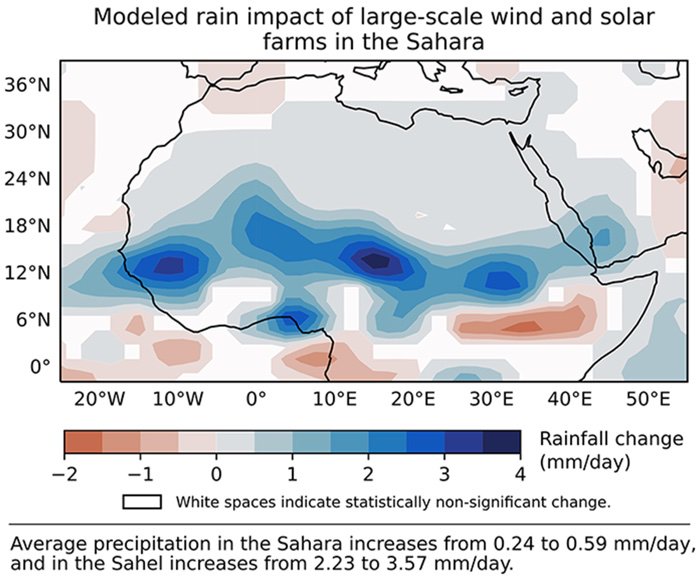
But new research shows an amazing, unprecedented effect of these efforts: solar and wind farms could actually bring rainfall and greenery back to the desert.
"We found that the large-scale installation of solar and wind farms can bring more rainfall and promote vegetation growth in these regions," says one of the researchers, atmospheric scientist Eugenia Kalnay from the University of Maryland.
"The rainfall increase is a consequence of complex land-atmosphere interactions that occur because solar panels and wind turbines create rougher and darker land surfaces."
Scientists already knew that wind and solar farms produced localised effects on things like heat and humidity in the regions they're installed, but nobody knew quite how these effects would play out if you were to build a massive renewable energy complex in the Sahara desert.
The reasons the Sahara is desirable for such a facility are numerous. The desert has a great natural supply of solar and wind energy, it's sparsely populated, and the landscape isn't widely used for other things humans need, like agriculture.
Plus, along with the milder, transitional Sahel region to the desert's south, the Sahara is located close to Europe and the Middle East – which have huge energy demands – and of course to sub-Saharan Africa, whose energy needs are projected to grow in the future.
But if we deployed wind turbines and solar panels across the Sahara and the Sahel, it wouldn't just be a benefit for renewable energy – first-of-its-kind modelling suggests the environment itself would begin to be transformed by the introduction of turbine blades and solar panels.
"Our model results show that large-scale solar and wind farms in the Sahara would more than double the precipitation in the Sahara, and the most substantial increase occurs in the Sahel, where the magnitude of rainfall increase is between ~200 and ~500 mm per year," says first author of the study Yan Li, who began the research at Maryland and is now at the University of Illinois at Urbana-Champaign.
"As a result, vegetation cover fraction increases by about 20 percent."
214 sahara desert rain solar wind green vegetation 1(Eviatar Bach)
These effects arise for a couple of reasons. Firstly, wind turbines enhance vertical mixing of heat in the atmosphere, pushing higher, warmer air down to the surface and increasing land surface friction, and ultimately leading to greater likelihood of precipitation.
"This increase in precipitation, in turn, leads to an increase in vegetation cover, creating a positive feedback loop," Li explains.
At the same time, solar panels, which soak up the Sun's rays, reduce what's called surface albedo – the amount of light reflectance at the surface – which also ends up increasing precipitation.
It wouldn't be easy to build this kind of hypothetical infrastructure, of course – we're talking a solar farm roughly the size of China or the United States, punctuated by giant turbines covering about 20 percent of the Sahara.
But if we could pull such an epic feat off, we wouldn't just be kickstarting a gradual greening of the Sahara desert – we'd also completely kick our addiction to fossil fuels, with the complex delivering about 82 terawatts of electrical power annually, the team calculates.
"In 2017, the global energy demand was only 18 terawatts, so this is obviously much more energy than is currently needed worldwide," Li says.
Given everything we know about what fossil fuels are doing to the planet, the research offers a little glimpse of how alternative energy technologies could reveal surprising environmental advantages we're not yet aware of.
"In addition to avoiding anthropogenic greenhouse gas emissions from fossil fuels and the resulting warming, wind and solar energy could have other unexpected beneficial climate impacts when deployed at a large scale in the Sahara, where conditions are especially favourable for these impacts," the team writes in their paper.
With the power surplus provided by such a facility, the researchers say you could help realise other difficult, large-scale environmental projects, such as desalination of seawater and transporting it to regions that suffer from freshwater scarcity, in turn bolstering health, food production, and even biodiversity.
Of course, this is all just based upon a simulation for now, and a hypothetical vision that would be difficult to realise in reality. But it's the right kind of idea to get this planet back on track – a dream worth thinking about after you wake up.
"The Sahara has been expanding for some decades, and solar and wind farms might help stop the expansion of this arid region," says air quality researcher Russ Dickerson from the University of Maryland, who wasn't involved with the study.

"This looks like a win-win to me."

More than 100,000 years ago, a period of unusually warm sea surface temperatures saw the oceans rise up to 9 metres higher than they are today.

The bad news? We might be looking at the same thing happening again, after researchers discovered that the heat extremes of that ancient, natural phase of global warming were actually similar to the temperature trends we're seeing today.
A new analysis led by researchers from Oregon State University has found that sea surface temperatures (SST) during the last interglacial period (LIG) – also called the Eemian – bear a striking resemblance to the rise in SSTs that have taken place over the last 150 years or so.
The LIG occurred between 129,000 and 116,000 years ago, and was one of the warmest periods of the last 800,000 years.
During the interglaciation, Earth's climate warmed due to a shift in the tilt of the planet, causing sea levels to rise between 6 and 9 metres higher than they are at present.
Now, after analysing marine sediment cores from 83 sites around the world, the researchers have reconstructed global sea surface temperatures during the LIG, and matched it with temperature data sets covering the years 1870–1889 and 1995–2014.
At the outset of the LIG, some 129,000 years ago, the global sea surface temperature was already similar to the average sea surface temperature for the 1870–1889 period.
Temperatures warmed very slowly during the LIG, with the global sea surface temperature increasing by about 0.5°C by 125,000 years ago.
But while that change occurred slowly over 4 millennia during the LIG, the 1995–2014 average shows the sea surface is at the same temperature now – and the rise took less than 150 years this time around.
"The result that present global sea surface temperatures are indistinguishable from those at the last interglacial 125,000 years ago is extremely worrying, since sea levels were 6 to 9 metres higher then compared to present," says climate scientist Richard Allan from the University of Reading in the UK, who was not involved with the study.
Even though the sea surface temperature now is about the same as it was 125,000 years ago, there's still a lot we don't know about how sea levels will rise this time, since the time-scale over which these temperature increases took place – and are still taking place – is so different.
During the LIG, the warming occurred so slowly that sea ice melting would have been a gradual, drawn out process. This time around – with a much faster increase in sea surface temperatures due to human activity – it's unclear how long the effect will take.
"[D]ue to the length of time it takes to heat up the depths of our vast oceans and to melt giant ice sheets it would take thousands of years before sea level could potentially rise to such levels," says Allan.
"[S]o sustained and substantive cuts in greenhouse gas emissions from energy-intensive activities remain vital and beneficial to societies."
While current global efforts are aiming to rein in carbon and keep global warming temperature increases to less than 2 degrees Celsius above pre-industrial levels, it's not great news that – as it stands – human intervention can speed up natural global warming processes to such a worrisome extent.
"It's not just the warming, it's the release of carbon from reservoirs [of fossil fuels] in the planet that have been around for millions of years," lead researcher Jeremy Hoffman told Ian Johnston at The Independent.
"We're talking about something that took millions of years to form and we're removing it in decades. Earth would need to have an eruption like Mount St Helen's happen every 2.5 hours … to keep pace with the emissions we are producing."
Despite the sober outlook the research provides, scientists say we need to use this knowledge and act while we can, to mitigate the impact on generations in many centuries from now.
"Sea level responds directly to global temperatures, but slowly, so that the full extent of sea level rise will only be apparent over thousands of years," researcher Andrew Watson from the University of Exeter in the UK, who wasn't involved with the study, said in a statement.

"The good news is that with luck it will continue to rise slowly, so that we have time to adapt, but the bad news is that eventually all our present coastal city locations will be inundated."

Powered by Blogger.