What is the CNC Machine?
CNC is the short form for Computer Numerical control. The CNC machine comprises of the mini computer or the microcomputer that acts as the controller unit of the machine. While in the NC machine the program is fed into the punch cards, in CNC machines the program of instructions is fed directly into the computer via a small board similar to the traditional keyboard.
In CNC machine the program is stored in the memory of the computer. The programmer can easily write the codes, and edit the programs as per the requirements. These programs can be used for different parts, and they don’t have to be repeated again and again.
Compared to the NC machine, the CNC machine offers greater additional flexibility and computational capability. New systems can be incorporated into the CNC controller simply by reprogramming the unit. Because of its capacity and the flexibility, the CNC machines are called as “soft-wired" NC.
Image result for cnc machine
How the CNC Machine Works?
The CNC machine comprises of the computer in which the program is fed for cutting of the metal of the job as per the requirements. All the cutting processes that are to be carried out and all the final dimensions are fed into the computer via the program. The computer thus knows what exactly is to be done and carries out all the cutting processes. CNC machine works like the Robot, which has to be fed with the program and it follows all your instructions.
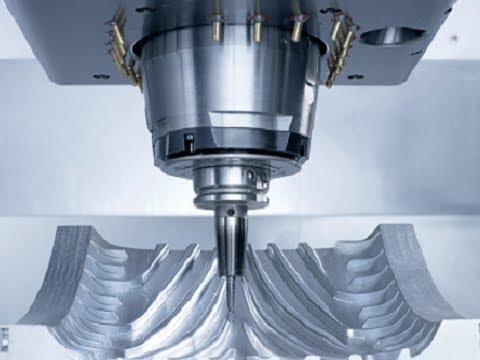
Some of the common machine tools that can run on the CNC are: Lathe, Milling machines, Drilling Machine etc. The main purpose of these machines is to remove some of the metal so as to give it proper shape such as round, rectangular, etc. In the traditional methods these machines are operated by the operators who are experts in the operation of these machines. Most of the jobs need to be machined accurately, and the operator should be expert enough to make the precision jobs. In the CNC machines the role of the operators is minimized. The operator has to merely feed the program of instructions in the computer, load the required tools in the machine, and rest of the work is done by the computer automatically. The computer directs the machine tool to perform various machining operations as per the program of instructions fed by the operator.
You don’t have to worry about the accuracy of the job; all the CNC machines are designed to meet very close accuracies. In fact, these days for most of the precision jobs CNC machine is compulsory. When your job is finished, you don’t even have to remove it, the machine does that for you and it picks up the next job on its own. This way your machine can keep on doing the fabrication works all the 24 hours of the day without the need of much monitoring, of course you will have to feed it with the program initially and supply the required raw material.
Most of the manufacturing companies are now equipped with the CNC machines as the markets have got very competitive; however, getting the expert labours for operating these machines is becoming quite difficult. Even the machine operators of these days prefer to operate the machine by programming instead of operating it manually. In most of the machine tools training institutes the new operators are taught manual machining as well as CNC machining and programming.


Image result for indian railways


The Central Railway has released a recruitment notification for the positions of Junior Engineer. Interested and eligible candidates can apply for the positions before the deadline.
The last date to apply for the Railway Junior Engineer posts is July 19, 2019.
Railway Recruitment 2019 Vacancy Detail

Name of Post: Junior Engineer
No. of Posts: 07 Posts
Selected candidates will be  posted at any station as per requirement  of  administration on Solapur Division [ANG, DD, KWV, SUR, KLBG, PVR, LUR]
The engagement will be offered purely on contract basis for a period of one year from the date  of contract, which can be renewed as a fresh contract on year to year basis or till such time availability of a regularly selected candidate, or up to 19/11/2020 whichever is earlier, the notification read.
Educational Qualification
Candidates should possess the required academic/Technical qualification on or before date of issuing of notification for applying against the post notified vide notification as given below:
Junior Engineer (Works)/ Level-6: Four years  Bachelor’s  degree  in  (a)  Civil  Engineering  or  (b)  a  combination  of  any  sub  stream  of basic streams of Civil Engineering from a recognized University / Institute.
OR (a) three years Diploma in Civil Engineering or B.Sc in Civil Engineering of three years duration (b) a combination of any sub stream of basic streams of Civil Engineering from a recognized University / Institute.
NOTE: The candidate must have secured minimum marks in Bachelor’s Degree /diploma for Junior technical Associates (Works)as mentioned above as given below:
1) General candidates : 60% 2) OBC –Non Creamy Layer : 55% 3) SC/ST Candidates: 50%
Age Limit
Upper age limit for UR, 33 years, while for OBC and SC/ST, it is 36 and 38 years respectively.
Selection Process/Exam Mark Pattern
Total Marks: 100
Qualification-  55 marks
Experience-  30 marks
Personality/Intelligence: 15 marks
 ONLINE APPLICATION 
Candidates are required to apply ONLINE by visiting cr.indianrailways.gov.in > News & Recruitment > Contractual JE Works engagement. Detailed instructions for filling up ONLINE applications are available on the website. 
Candidates are required to log on to the website cr.indianrailways.gov.in >News & Recruitment >Contractual JE Works )engagement for filling ONLINE application for recruitment against contractual appointment and fill up the personal details/Bio-data etc carefully.
For full Notification, click here.


1)      Explain the term BOM?
BOM stands for Bill of Materials; it is a list of item or parts that makeup a product assembly.  For example, a lawn mower requires a handle assembly, metal deck assembly, a control assembly, motor and blade assembly.
2)      Explain what is DCR?
DCR stands for Document Change Request, a change request which addresses about a problem with a document, SOP (standard operating procedure) or specification and propose a change to fix it.
3)      Explain what is Kanban?
Kanban is scheduling system which advises manufacturers about how much to produce, what to produce and when to produce.  In this system, inventory is re-filled only when visual cues like an empty bin or cart is seen.
4)      Explain what is MES?
MES stands for a system that manages and controls the production on the factory floor with the motive of reducing the total time required to produce an order.
5)      Explain what is Six Sigma?
Six sigma is a data-driven methodology and approach for eliminating defects in any process from manufacturing to transactional and from product to service.
6)      What is the difference between lean manufacturing and JIT (Just-in-Time) Manufacturing?
·         Lean Manufacturing:  It takes the concept of JIT and re-examines it from the customer point of view.  Anything that is produced should add something of valuable to the customer’s requirement. For example, if you are making stereo system for a luxury car, you will think from the customer point of view like sound quality, durability, space occupancy, loud or medium sound, etc.
·         JIT (Just-in-Time):  This methodology is designed to ensure that a product or part would arrive just in time to be used. This technique saves the cost behind the unused inventory, and eliminating the need of piling up inventory.

7)      Explain what is QMS?
QMS stands for Quality Management System; it documents all necessary information about company’s design and operational controls, including issue reporting, monitoring, continuous improvement and training, to make sure that company delivers continuous product.
8)      Explain what is batch production?
Batch production is a manufacturing technique, where components or goods are produced in groups and not in a continuous stream. This methodology is mainly used when similar items are produced together.
9)      What is the challenge in manufacturing products?
Main challenge in manufacturing is to develop better production processes, ensure the right material and component supplies at the least cost, decrease production time, eliminate wastage and maintain quality in the final product.
10)   List out the factors that can affect the manufacturing process?
The factors affect the manufacturing process are
·         Supplies: A well-managed supply and inventory is very crucial in order to run manufacturing process smoothly. The manufacturers must brace themselves up and ready to overcome any unexpected delays in supplies due to weather or transportation hindrance.
·         Equipment: Equipment’s are the central unit for any manufacturing plant; regular maintenance are utmost necessary to avoid a breakdown in the middle of production. Identify the means of improving the efficiency of every part of the equipment.
·         Factory Overhead: Without power supply, manufacturing is not possible.  Always keep plan B ready in case of temporary power cut down.
·         Special Parts: Replacing any special spare parts with different specification may slow down your production, so before ordering any special spare parts ensure it fits your demand especially if it is imported from long distance.
·         Work Force:  Human resource is equally important and plays a major role in manufacturing unit.

11)   Define the term “factory overhead”?
During the manufacturing process, whatever the cost is incurred during the process is referred as “factory overhead”, excluding the cost of materials and direct labours.
12)   List out some of the examples of factory overhead?
Following are the overheads a production manufacturing engineer has to consider:
·         Factory rent
·         Utilities used in the unit
·         Costs behind equipment set up
·         Costs behind equipment maintenance
·         Production unit supplies
·         Insurance covered on equipment’s and production facilities
·         Fringe benefits
·         Depreciation
·         QA Salaries
·         Property taxes on manufacturing facilities
·         Material management salaries

13)   Explain how to supervise in a manufacturing unit?
Supervising a manufacturing process includes attending to the individual phases of the production.  Also, manufacturing supervisor should have a close eye on the inventory that going to be used.
·         Step 1:  Keep the records of different phases of manufacturing also analyse whether the amount of product produced by the crew is enough to meet the demand
·         Step 2:  Look for the bottlenecks in the unit and see how you can eliminate it
·         Step 3: Keep the track of inventory and try to reduce the liquid capital used after unused material
·         Step 4: Examine the final goods to determine whether they meet the company’s quality standards.

14)   Explain how can you calculate manufacturing work in progress?
Manufacturing work in progress is when manufacturing firm transforms material into the work in process which includes raw material, labour and factory overhead.  You can calculate all the below factors to know the costing for the manufacturing work in progress.
·         labour costs
·         Raw material inventory costs
·         Production cost
·         Cost of ending work in process for the accounting period

15)   Explain what is product report?
A product report is a general term used to represent design, manufacturing, quality, sales and repair information about a product.
16)   Explain what is RMA?
RMA stands for Return Material Authorization; it is a financial and work order tracking used to determine a returned item’s origination. It is often used in a transaction where a customer returns goods to the manufacturer for replacement or repair purpose.
17)   Explain what is SCAR (Supplier Corrective Action Request)?
Manufacturers are highly dependent on their raw material suppliers, to communicate with them effectively SCAR is used.  It is a change request that mentions the issues with the process or material from a supplier and ask for a resolution. It sometimes also includes the details about how the complaint should be addressed.
18)   What are the softwares which can be useful in manufacturing unit?
In manufacturing unit, software that can be useful are Manufacturing ERP and Material Management. Some of the companies that provide the manufacturing software solution are SAP, Oracle ERP system, etc.

19)   Explain what is GMP?
GMP is a good manufacturing practice and is recognized worldwide for the control and management of manufacturing and quality control testing of foods, medical devices and pharmaceutical products.
20)   Explain what are the approach used in manufacturing for QA?
For QA in manufacturing techniques used are
·         Acceptance sampling:  In this testing, a random sample is picked from the batch rather than testing the whole batch.
·         Statistical process control:  Through the use of control charts and data collected for the samples at the various stages of production a manufacturing product can be monitored


·         Troubleshooting studies: At the end of the line product, a trouble-shooting study can be carried out to see whether the changes in the inputs are associated with the output variables.


“Injection moulding is a manufacturing process for producing parts by injecting material into a mould. Injection moulding can be performed with a host of materials, including metals, glasses, elastomers, confections, and most commonly thermoplastic and thermosetting polymers. Material for the part is fed into a heated barrel, mixed, and forced into a mould cavity where it cools and hardens to the configuration of the cavity. After a product is designed, usually by an industrial designer or an engineer, moulds are made by a mould-maker (or toolmaker) from metal, usually either steel or aluminium, and precision-machined to form the features of the desired part. Injection moulding is widely used for manufacturing a variety of parts, from the smallest components to entire body panels of cars.”
Plastic housing is one of the most common finished products of injection moulding, used to produce thin-walled plastic parts. Plastic housing is a thin-walled enclosure, many a time demanding many ribs and bosses on the inside. These houses are used in an array of products including household appliances, consumer electronics, power tools, and as automotive dashboards. Injection moulding is also used to manufacture valves and syringes that are used in the medical industry.
The moulding procedure is complex. Hence, parts to be injection moulded needs to be designed with enough care keeping into account, the substance used for the part, the desired shape and features of the part, mould material and the various properties of the moulding machine.
An interesting variety of injection moulding is Compression Injection Moulding.
Compression Injection Moulding (CIM) aims “to combine the high productivity of Conventional injection moulding with the Stress-Free moulding obtained by Compression Moulding. It is well suited for articles with a high Flow path/wall thickness ratio. It is possible to mould articles on a lower Clamp tonnage than conventional Injection moulding.”
If we investigate the past, compression moulding would come out to be the initial grounds on which moulding of plastics began to develop itself from. Most Thermosets are compression moulded till date, though most thermoplastics are indeed injection moulded. They are melt-processible, making it ideal for injection moulding.
The plastics industry, especially injection moulding companies have witnessed an aggressive change in the economics. With the automotive and electronics business eyeing the east and a continual necessity to keep costs at check, it becomes imperative to better operations within the industry. A possibility could be building a new profile of potent customers in a new feasible market environment.
Let us talk about moulding in the medical industry.
And why not? If one would like to explore such avenues CEOs and CFOs must be ready to be able to make those crucial decisions.
Medical Injection Moulding (MIM) is a process that is much more than the field of just plastics. It has a process that involves more than just a machine, mould or any other material. Quality control capacities and operation-controls – these are aspects that just cannot be compromised. An ISO system of checking or standardizing quality is being followed and mostly that is at an ISO-13485 mark. This means that for standing out to medical devices buyers, one would need such quality control system compliant output.
Raw materials are significant too- a thorough review of the material used that includes colourants, processing aids, stabilizers, etc is mandatory. Maintaining records and bringing in a lot control is another requirement. Cleanliness and hygiene again are crucial in the medical industry. There are separate standards for these as well that need to be maintained in production units. Design of the final output – can either be a contribution chance or an impediment!
When it comes to technology, one would want to look at hygiene, process control and automation, data retention/control and other equipment that would contribute largely to the total moulding, process.
In a nutshell, injection moulding can well be “moulded” according to needs of the market and demand.


1. NASA
National Aeronautics and Space Administration is one of the top 10 mechanical companies in USA. They provide ample of opportunities to mechanical engineers and securing a position in NASA is like a dream come true. They need skilled engineers with good knowledge of the respective field.
2. GOOGLE
Google is one of the most advanced computational companies in the world. They require some of the most advanced computer hardware. The recruitment of mechanical companies is in progress for this purpose. It is one of the top 10 mechanical companies in USA.
3. BOEING COMPANY
The Boeing Company is an American Multi National Company. They manufacture aircraft, rockets and satellites.  It is the largest manufacturer of aircraft and world’s second-largest defense contractor. It is one of the top 10 mechanical companies in USA.
4. LOCKHEED MARTIN CORPORATION
Lockheed Martin has their business with the U.S Department of Defense and US federal government agencies. They manufacture military aircraft, autonomous underwater vehicles, radar system, laser weapon and various combat systems.  They provide job opportunities to mechanical engineers.
5. GE AVIATION
GE Aviation is one of the largest corporations. It is one of the top aircraft engine suppliers and subsidiary of General Electric. It is one of the top 10 mechanical companies in USA. They win the loyalty of the customers by their good quality products.
6. FORD MOTOR COMPANY
The Ford motor company was founded by Henry Ford. The revenue of the company is US$156.776 billion. It is one of the top 10 mechanical companies in USA. The net income of the company is US$7.602 billion. The company manufactures automobiles and vehicles under Ford brand. They win the loyalty of their customers and secure a leading position in the market.
7. UNITED STATE DEPARTMENT OF ENERGY
The United States Department of Energy is responsible for energy conservation, domestic energy production and nuclear weapon program. They provide many opportunities to skilled mechanical engineers.
8. HALLIBURTON
Halliburton is one of the largest oilfield service companies.  They have revenue of US$20.620 billion. It is one of the top 10 mechanical companies in USA. The net income of the company is US$ -463 million.
9. GENERAL MOTORS
General motors advances in vehicle electrification to automation.  It is one of the top 10 mechanical companies in USA. They provide cars, trucks and crossovers to their customers. They provide their best service and follows their ethics strictly.
10. CAMERON INTERNATIONAL CORPORATION
Cameron International is a global provider of pressure control, processing, flow control and compression systems. It is one of the top 10 mechanical companies in USA. They have revenue of US $9.8 billion.

Powered by Blogger.