Showing posts with label astronomy. Show all posts


In an incredible world first, astrophysicists detected multiple planets in another galaxy earlier this year, ranging from masses as small as the Moon to ones as great as Jupiter.
The technique, first predicted by Einstein's theory of general relativity, has been used to find exoplanets within Milky Way, and it's the only known way of finding the smallest and most distant planets, thousands of light-years from Earth.
As a planet orbits a star, the gravitational field of the system can bend the light of a distant star behind it.
We know what this looks like when it's just two stars, so when a planet enters the mix, it creates a further disturbance in the light that reaches us - a recognisable signature for the planet.
So far, 53 exoplanets within the Milky Way have been detected using this method. To find planets farther afield, though, something a little bit more powerful than a single star was required.
Oklahoma University astronomers Xinyu Dai and Eduardo Guerras studied a quasar 6 billion light-years away called RX J1131-1231, one of the best gravitationally lensed quasars in the sky.
Using data from NASA's Chandra X-ray observatory, the researchers found that there were peculiar line energy shifts in the quasar's light that could only be explained by planets in the galaxy lensing the quasar.
It turned out to be around 2,000 unbound planets with masses ranging between the Moon and Jupiter, between the galaxy's stars.
"We are very excited about this discovery. This is the first time anyone has discovered planets outside our galaxy," Dai said.
Of course, we haven't seen the planets directly, and are unlikely to in the lifetime of anyone alive today. But being able to detect them at all is an incredible testament to the power of microlensing, not to mention being evidence that there are planets in other galaxies.
Of course, common sense would dictate that planets are out there - but evidence is always nice.
"This galaxy is located 3.8 billion light years away, and there is not the slightest chance of observing these planets directly, not even with the best telescope one can imagine in a science fiction scenario. 
"However, we are able to study them, unveil their presence and even have an idea of their masses. This is very cool science."
The research was published in The Astrophysical Journal.


4 TIMES LARGER THAN EARTH
Given the abundance of moons in our own Solar System, you'd think there are heaps orbiting exoplanets, too. Such exomoons have been elusive until now - but it looks like that has finally changed.
Last year, astronomers Alex Teachey and David Kipping of Columbia University announced they'd spotted the very first exomoon candidate in data from the Kepler telescope.
Now they've conducted follow-up observations with the powerful Hubble Space Telescope. Those observations point even more strongly to the discovery of the very first exomoon.
"This would be the first case of detecting a moon outside our Solar System," Kipping said.
"If confirmed by follow-up Hubble observations, the finding could provide vital clues about the development of planetary systems and may cause experts to revisit theories of how moons form around planets."
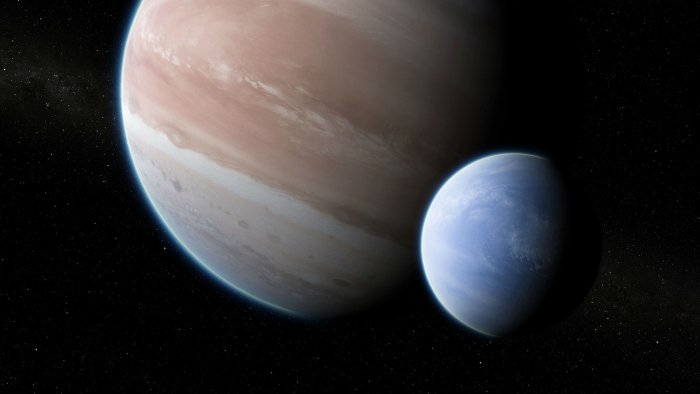
Kepler-1625b-i, as the candidate exomoon has been named, orbits an exoplanet called Kepler-1625b, which in turn orbits a yellow, Sun-like star called Kepler-1625. The entire system is located around 8,000 light-years away, a distance recently revised with the aid of Gaia data.
The planet, Kepler-1625-b, is a Jupiter-sized gas giant, just over 11 times the radius of Earth, but with considerably more mass than Jupiter.
The candidate moon is also a whopper - according to the astronomers' calculations, it's roughly the size of Neptune, and therefore also a gas body, orbiting its planet at a distance of about 3 million kilometres.
The astronomers first got a hint of Kepler-1625b-i when they studied Kepler data on 284 exoplanets in search of an exomoon - what they describe as "little deviations and wobbles" beyond the normal transit dips in the light curve coming from the star as the planet moves across it. But it wasn't enough information.
"Kepler recorded just three transits of the planet in front of her star, and that's largely because the planet takes almost a year to complete an orbit. Three transits was tantalising, but not conclusive. Because Kepler can no longer observe the same field, we asked for some follow up observations with Hubble. Our analysis of the new light curve reveals two substantial anomalies," Kipping explained during a press briefing.
"The first is that the planet appears to transit one and a quarter hours too early; that's indicative of something gravitationally tugging on the planet. The second anomaly is an additional decrease in the star's brightness after the planetary transit has completed."
Sadly, Hubble's time is in high demand, which means the time Teachey and Kipping had with the telescope was limited to 40 hours. This time ran out before the moon's complete transit could be measured.
While these observations mount further evidence for the existence of Kepler-1625b-i, they are not, as yet, conclusive.
Other explanations for the signals observed by Teachey and Kipping could include a second planet orbiting Kepler-1625 - although, they note, so far Kepler has found no evidence of a second planet.
Another potential explanation is that one or more of the signals they observed were noise from the star itself. However, the star itself, as the team have ascertained from Kepler data, is so quiet they can't even detect its rotation. So stellar noise is possible, but Teachey and Kipping found no evidence for it.
It's reasonable to start getting excited about the possibility of a brand new discovery - a first of its kind that hopefully heralds many more in the future.
"If validated, the planet moon system, a Jupiter with a Neptune-sized moon, would be a remarkable system with unanticipated properties, in many ways echoing the unexpected discovery of hot Jupiters in the early days of planet hunting," Kipping said.
exmoon artist impression
An artist's impression of exoplanet Kepelr-1625b and its moon. (Dan Durda)
It will certainly raise some questions about moon formation.
Kepler-1625b-i is about 1.5 percent of the mass of the planet, similar to the mass-ratio of Earth and the Moon. But because both bodies are gaseous (which means neither are habitable as we understand it, in case you were wondering), and because of the moon's size, that raises questions about how it got there.
Our Moon may have formed as the result of a collision with Earth, but a collision with a gas planet like Kepler-1625b might not result in enough material to form a Neptune-sized moon.
Jupiter's moons are believed to have formed from a ring of material; but again, none of Jupiter's moons are the size of Neptune. Or it could have been an object that was captured by the planet's gravity from elsewhere.
For now, we can't get any answers to those questions, but we can at least hope the moon discovery will be confirmed, hopefully by future Hubble and James Webb Space Telescope Observations.
"We're looking forward to the scrutiny of the scientific community on this work and we hope we'll have an opportunity to observe the target again before too long," Teachey said.

Well, this sure is one parade that's getting rained out of existence. A spectacular astronomical event that had been predicted for 2022 now isn't going to happen after all.

Early in 2017, scientists forecast the collision of two stars in the constellation Cygnus – something that would result in a rare and wonderful phenomenon visible to the naked eye. And the news spread like wildfire.

The two stars, located a mere 1,800 light-years from Earth, are currently locked in a spiralling death dance. According to the researchers, in the year 2022 – just a few short years away – they were going to collide.

And it wasn't just going to be a small blip in the night sky. When binary star system KIC 9832227 finally merged, it was going to produce a luminous red nova - increasing in brightness 10,000-fold, which would be visible from Earth for some time.

Now, though, that prediction has been nixed.

*Sad trombone*

A team of researchers led by astronomer Quentin Socia at San Diego State University has meticulously pored over the mathematics, and come up with a different result.

And the original researcher - astronomer Larry Molnar from Calvin College - has agreed with this new finding.

"Good science makes testable predictions," Molnar said.

"There have been a few other papers that have tried to poke at our project, and we've been able to poke back - criticisms that just don't fly.  But this one does fly, and I think they have a good point. This illustrates how science can be self-correcting."

The problem was found to be with the data Molnar and his team used to make the prediction.

KIC 9832227 is a fascinating system. The two stars are locked in with each other so tightly that they take just 11 hours to perform one full orbit. And they're so close that they actually share parts of their atmospheres, what is known as a contact binary.

They're also an eclipsing binary, oriented in just the right way that, as they orbit, they eclipse each other from our point of view here on Earth.

The prediction was based on the timings of minimum light – that is, the point at mid-eclipse in which the light from the binary system is at its lowest – from all available sources.

Molnar and his team used Calvin Observatory data between 2013 and 2016. Between 2007 and 2013, they used data from other observatories. There was a long gap in the data before 2007, but in 1999, one observation had been taken as part of the Northern Sky Variability Survey.

Socia and his team got their hands on previously unpublished archival data from 2003, taken as part of the NASA Ames Vulcan Project. And they found that the eclipses were occurring half an hour later than predicted by Molnar's merger hypothesis.

They re-ran the numbers, and the timings after 2007 checked out. But that one 1999 datapoint was awry - a full hour later than it was supposed to be.

The culprit? A typo.

Yep. In the paper that originally described the 1999 data, published in 2004, a typo resulted in the misrepresentation of the timing of the eclipse by 12 hours. This error was carried into Molnar's team's calculations.

Interestingly, the typo didn't occur in the article's preprint (it's the mjd, or Modified Julian Date, value in Table 6).

The eclipse absolutely couldn't have occurred at the time the published paper stated, either. Socia calculated where KIC 9832227 would have been at that specific time. It would have been below the horizon. The telescope would not have been been able to see it.

This isn't to say that, at some point in the future, KIC 9832227 isn't going to go kaboom; but that point isn't going to be in 2022.

And yes, we're a bit deflated about it; but ultimately, while science can giveth, its ability to taketh away is equally important.

"This is arguably the most important part of the scientific process. Knowledge advances the most when bold predictions are made, and people question and test those predictions," Socia said.

"Often the most exciting discoveries happen when our expectations are not met. This is a good example of how scientists from different parts of the world can work together to better understand how our universe works, bringing with them new pieces to the puzzle."

So it's not going to be KIC 9832227. But eventually a binary star is going to collide, and there are now a lot of eyes out there looking for it.

"The authors of the manuscript don't question our fundamental premise, which is to say 'this is something that you should be looking for, this is something that can be found,'" Molnar said.

"It's actually because they agree with that fundamental premise that they dug deeper. And so the search for an impending stellar merger continues."

The research has been published in The Astrophysical Journal Letters.


The prophecy was written 70 years ago.. and it’s absolutely mind-blowing!

Peter Konstantinov Deunov, also known as Beinsa Douno, born in 1886 and who later passed away in 1944, left a prophecy that he had obtained through a trance based state. The prophecy was therefore dated as 1944, a few days before his death in December that year. The prophecy Beinsa Douno left fits right into the times we are going through right now, in relation to the shift in consciousness, the earth changes and our golden age. Back then, Douno was aware and taught that we were moving into the age of Aquarius, as per the astrological age system.

The Prophecy


“During the passage of time, the consciousness of man traversed a very long period of obscurity. This phase which the Hindus call ‘Kali Yuga’, is on the verge of ending. We find ourselves today at the frontier between two epochs: that of Kali Yuga and that of the New Era that we are entering.

A gradual improvement is already occurring in the thoughts, sentiments and acts of humans, but everybody will soon be subjugated to divine Fire, that will purify and prepare them in regards to the New Era. Thus man will raise himself to a superior degree of consciousness, indispensable to his entrance to the New Life. That is what one understands by ‘Ascension’.

Some decades will pass before this Fire will come, that will transform the world by bringing it a new moral. This immense wave comes from cosmic space and will inundate the entire earth. All those that attempt to oppose it will be carried off and transferred elsewhere.

Although the inhabitants of this planet do not all find themselves at the same degree of evolution, the new wave will be felt by each one of us. And this transformation will not only touch the Earth, but the ensemble of the entire Cosmos.

The best and only thing that man can do now is to turn towards God and improve himself consciously, to elevate his vibratory level, so as to find himself in harmony with the powerful wave that will soon submerge him.

The Fire of which I speak, that accompanies the new conditions offered to our planet, will rejuvenate, purify, reconstruct everything: the matter will be refined, your hearts will be liberated from anguish, troubles, incertitude, and they will become luminous; everything will be improved, elevated; the thoughts, sentiments and negative acts will be consumed and destroyed.

Your present life is a slavery, a heavy prison. Understand your situation and liberate yourself from it. I tell you this: exit from your prison! It is really sorry to see so much misleading, so much suffering, so much incapacity to understand where one’s true happiness lies.

Everything that is around you will soon collapse and disappear. Nothing will be left of this civilization nor its perversity; the entire earth will be shaken and no trace will be left of this erroneous culture that maintains men under the yoke of ignorance. Earthquakes are not only mechanical phenomena, their goal is also to awaken the intellect and the heart of humans, so that they liberate themselves from their errors and their follies and that they understand that they are not the only ones in the universe.

Our solar system is now traversing a region of the Cosmos where a constellation that was destroyed left its mark, its dust. This crossing of a contaminated space is a source of poisoning, not only for the inhabitants of the earth, but for all the inhabitants of the other planets of our galaxy. Only the suns are not affected by the influence of this hostile environment. This region is called “the thirteenth zone”; one also calls it “the zone of contradictions”. Our planet was enclosed in this region for thousands of years, but finally we are approaching the exit of this space of darkness and we are on the point of attaining a more spiritual region, where more evolved beings live.

The earth is now following an ascending movement and everyone should force themselves to harmonize with the currents of the ascension. Those who refuse to subjugate themselves to this orientation will lose the advantage of good conditions that are offered in the future to elevate themselves. They will remain behind in evolution and must wait tens of millions of years for the coming of a new ascending wave.

The earth, the solar system, the universe, all are being put in a new direction under the impulsion of Love. Most of you still consider Love as a derisory force, but in reality, it is the greatest of all forces! Money and power continue to be venerated as if the course of your life depended upon it. In the future, all will be subjugated to Love and all will serve it. But it is through suffering and difficulties that the consciousness of man will be awakened.

The terrible predictions of the prophet Daniel written in the bible relate to the epoch that is opening. There will be floods, hurricanes, gigantic fires and earthquakes that will sweep away everything. Blood will flow in abundance. There will be revolutions; terrible explosions will resound in numerous regions of the earth. There where there is earth, water will come, and there where there is water, earth will come. God is Love; yet we are dealing here with a chastisement, a reply by Nature against the crimes perpetrated by man since the night of time against his Mother; the Earth.

After these sufferings, those that will be saved, the elite, will know the Golden Age, harmony and unlimited beauty. Thus keep your peace and your faith when the time comes for suffering and terror, because it is written that not a hair will fall from the head of the just. Don’t be discouraged, simply follow your work of personal perfection.

You have no idea of the grandiose future that awaits you. A New Earth will soon see day. In a few decades the work will be less exacting, and each one will have the time to consecrate spiritual, intellectual and artistic activities. The question of rapport between man and woman will be finally resolved in harmony; each one having the possibility of following their aspirations. The relations of couples will be founded on reciprocal respect and esteem. Humans will voyage through the different planes of space and breakthrough intergalactic space. They will study their functioning and will rapidly be able to know the Divine World, to fusion with the Head of the Universe.

The New Era is that of the sixth race. Your predestination is to prepare yourself for it, to welcome it and to live it. The sixth race will build itself around the idea of Fraternity. There will be no more conflicts of personal interests; the single aspiration of each one will be to conform himself to the Law of Love. The sixth race will be that of Love. A new continent will be formed for it. It will emerge from the Pacific, so that the Most High can finally establish His place on this planet.

The founders of this new civilization, I call them ‘Brothers of Humanity’ or also ‘Children of Love’. They will be unshakeable for the good and they will represent a new type of men. Men will form a family, as a large body, and each people will represent an organ in this body. In the new race, Love will manifest in such a perfect manner, that today’s man can only have a very vague idea.

The earth will remain a terrain favourable to struggle, but the forces of darkness will retreat and the earth will be liberated from them. Humans seeing that there is no other path will engage themselves to the path of the New Life, that of salvation. In their senseless pride, some will, to the end hope to continue on earth a life that the Divine Order condemns, but each one will finish by understanding that the direction of the world doesn’t belong to them.

A new culture will see the light of day, it will rest on three principal foundations: the elevation of woman, the elevation of the meek and humble, and the protection of the rights of man.

The light, the good, and justice will triumph; it is just a question of time. The religions should be purified. Each contains a particle of the Teaching of the Masters of Light, but obscured by the incessant supply of human deviation. All the believers will have to unite and to put themselves in agreement with one principal, that of placing Love as the base of all belief, whatever it may be. Love and Fraternity that is the common base! The earth will soon be swept by extraordinary rapid waves of Cosmic Electricity. A few decades from now beings who are bad and lead others astray will not be able to support their intensity. They will thus be absorbed by Cosmic Fire that will consume the bad that they possess. Then they will repent because it is written that “each flesh shall glorify God”.

Our mother, the earth, will get rid of men that don’t accept the New Life. She will reject them like damaged fruit. They will soon not be able to reincarnate on this planet; criminals included. Only those that possess Love in them will remain.

There is not any place on earth that is not dirtied with human or animal blood; she must therefore submit to a purification. And it is for this that certain continents will be immersed while others will surface. Men do not suspect to what dangers they are menaced by. They continue to pursue futile objectives and to seek pleasure. On the contrary those of the sixth race will be conscious of the dignity of their role and respectful of each one’s liberty. They will nourish themselves exclusively from products of the vegetal realm. Their ideas will have the power to circulate freely as the air and light of our days.

The words “If you are not born again” apply to the sixth race. Read Chapter 60 of Isaiah it relates to the coming of the sixth race, the Race of Love.

After the Tribulations, men will cease to sin and will find again the path of virtue. The climate of our planet will be moderated everywhere and brutal variations will no longer exist. The air will once again become pure, the same for water. The parasites will disappear. Men will remember their previous incarnations and they will feel the pleasure of noticing that they are finally liberated from their previous condition.

In the same manner that one gets rid of the parasites and dead leaves on the vine, so act the evolved Beings to prepare men to serve the God of Love. They give to them good conditions to grow and to develop themselves, and to those that want to listen to them, they say: “Do not be afraid! Still a little more time and everything will be all right; you are on the good path. May he that wants to enter in the New Culture study, consciously work and prepare.”

Thanks to the idea of Fraternity, the earth will become a blessed place, and that will not wait. But before, great sufferings will be sent to awaken the consciousness. Sins accumulated for thousands of years must be redeemed. The ardent wave emanating from On High will contribute in liquidating the karma of peoples. The liberation can no longer be postponed. Humanity must prepare itself for great trials that are inescapable and are coming to bring an end to egoism.

Under the earth, something extraordinary is preparing itself. A revolution that is grandiose and completely inconceivable will manifest itself soon in nature. God has decided to redress the earth, and He will do it! It is the end of an epoch; a new order will substitute the old, an order in which Love will reign on earth.”

Astronomers studying pulsars may have finally unravelled why these mysterious pulsating objects appear to send different kinds of signals into space – by tracking the immense cloud trails of their nebulae.

Thanks to images taken by NASA's Chandra X-ray Observatory, a new analysis of two very contrasting pulsars shows that pulsars' energy emissions may only be visible to Earth from certain angles – which could explain a mystery that's puzzled scientists up until now.

Pulsars are a kind of neutron star – an extremely dense core of matter left over once a massive star has exploded in a supernova.

What sets pulsars apart from other neutron stars are their pulsating radio waveemissions – a tightly focused beam of electromagnetic radiation that rapidly rotates around the pulsar much like the light shone from a lighthouse.

While pulsars were long categorised by the emission of these radio waves, more recently researchers have found that some pulsars also generate a different kind of energy signal – gamma rays – and the distinction has puzzled astronomers for almost a decade.

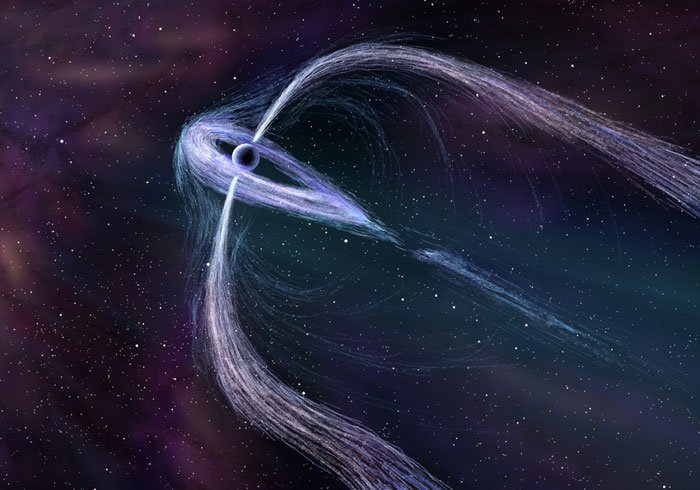
34898-ataleoftwopu-1Geminga, artist's impression. Credit: Nahks Tr'Ehnl

"It's not fully understood why there are variations between different pulsars," says researcher Bettina Posselt from Pennsylvania State University.

"One of the main ideas here is that pulse differences have a lot to do with geometry – and it also depends on how the pulsar's spin and magnetic axes are oriented with respect to line of sight whether you see certain pulsars or not, as well as how you see them."

One of the ways scientists can study pulsars is by tracking what's called pulsar wind nebulae – clouds of energetic particles that form doughnut-shaped rings called tori, which stretch out into tail-like structures as they spin off from the rapidly rotating pulsar.

Thanks to the Chandra X-ray Observatory, scientists can now study these nebulae, which helps us understand the different kinds of magnetic activity that pulsars exhibit – and also why we only pick up certain emissions from them.

"This is one of the nicest results of our larger study of pulsar wind nebulae," says one of the team, physicist Roger W. Romani from Stanford University.

"By making the 3D structure of these winds visible, we have shown how one can trace back to the plasma injected by the pulsar at the centre."

Two very divergent kinds of pulsar wind nebulae can be seen in the pulsars Geminga – which is approximately 800 light-years from Earth – and BO355+54, which is about 3,300 light years away.

In the case of Geminga (shown above), you can see the pulsar has three distinct tails making up its nebulae. Of these, the two long tails are called lateral tails, and are thought to spin off from Geminga's magnetic poles.

These lateral tails stretch out for more than half a light-year from Geminga, while a third, shorter tail also emanates from the pulsar.

The researchers think the positioning of Geminga's poles is why we can only pick up gamma rays from the pulsar on Earth – but not radio emissions.

"The tails seem to tell us why that is," says Posselt. "For Geminga, we view the bright gamma ray pulses and the edge of the pulsar wind nebula torus, but the radio beams near the jets point off to the sides and remain unseen."

34898-ataleoftwopu-2

Top Left X-ray: NASA/CXC/PSU/B.Posselt et al; Infrared: NASA/JPL-Caltech. Top Right X-ray: NASA/CXC/GWU/N.Klinger et al; Infrared: NASA/JPL-Caltech. Illustrations by Nahks Tr'Ehnl.

By contrast, B0355+54 (pictured above alongside Geminga) has its radio waves angled at Earth, which is how we're able to detect it – even though we can't pick up its gamma rays.

"For B0355+54, a jet points nearly at us so we detect the bright radio pulses while most of the gamma-ray emission is directed in the plane of the sky and misses the Earth," says one of the team, Oleg Kargaltsev from George Washington University.

"This implies that the pulsar's spin axis direction is close to our line-of-sight direction and that the pulsar is moving nearly perpendicularly to its spin axis."


While there's still a lot to learn about pulsars, the new discoveries help explain why we've only picked up distinct emissions from these kinds of cosmic objects before – and lets researchers study particle physics in ways that would be impossible to replicate in a lab on Earth.


Over the past 15 years, robotics and automation specialist TRACLabs has used its 3T robot intelligence software to perform inspection tasks for the International Space Station (ISS). Robots programmed with the latest software are able to search for, find and recognise people, hunt for underwater mines and carry out repair and replacement tasks on earth or in space. Impressive so far, but wait, there's more.
Layered intelligence can now be utilised by any computer-controlled machine, even stationary ones. TRACLabs has also been busy developing intelligent control for advanced life support systems such as biological water processors, oxygen generation and CO2 recovery systems. The results of several of these efforts were used in human-related tests, including one with four people living and working in a NASA biosphere for three months. With a little more work, industrial automation might have the power to keep us alive in the most unfriendly environments imaginable.
In terms of the types of technology industrial automation is contributing to keeping the ISS up and running, we've not even scratched the surface. Supplier of industrial networking technology, Hirschmann is also in on the action, providing the ISS with industry-proven managed OCTOPUS switches, used in data communication.
On the ISS, the OCTOPUS switches are subjected to electromagnetic radiation that is around 100 times higher than on Earth, mostly caused by high energy protons. To ensure they were up to the job, the switches underwent extensive testing prior to being implemented. Luckily, the radiation-sensitive integrated switch circuits proved their suitability for their trip into space.
After proving their worth in the communication system of the Russian segment of the ISS, the OCTOPUS switches have also been in use since 2011 in the American segment. This part of the ISS is the home of the Cupola, the observatory module used to conduct experiments, dockings and observations of Earth. In addition, the OCTOPUS switches transport data from the space station's joint Local Area Network (LAN). In the future, videos in HD quality are to be transmitted from the Cupola to ground control.
Across the pond, leader in power and automation technologies ABB is in the midst of developing a new industrial sensor that will be used to study planetary rocks from a Mars or Moon Rover. The new design is around half the size of its predecessor with better performance and lower service requirements. It includes a solid-state laser designed to operate in space, without any servicing for more than 20 years. To compare, its predecessor needed servicing every three years.
With the help of the new sensor, ABB hopes to advance understanding of issues such as global warming, ozone depletion and the impact of pollution on air quality, as well as weather prediction and climatology.
Apart from the latest generations of robots and industrial automation technologies, the ISS also relies on more traditional industrial automation components like motors and drives. The critical process of cooling, for example, is heavily dependent on liquid ammonia pumps.

It’s fair to say that industrial automation plays a key part in humankind’s exploration of outer space. And it’s helping us go further and further every day. So there you have it, you can officially say that your industry is making its mark in space.

Powered by Blogger.