Showing posts with label moon. Show all posts

ELON MUSK SAYS SPACEX WILL “PROBABLY” LAND HUMANS ON THE MOON BY 2024,


BUT THEY WILL HAVE TO OVERCOME A FEW HURDLES FIRST.

NASA

Rather than later, sooner is preferable.

Elon Musk, the founder of SpaceX, has hinted that Starship will be ready to land astronauts on the Moon before the estimated launch date of 2024.

Musk was responding to a tweet from a Tesla CEO on Saturday asking if the super heavy-lift launch vehicle will be ready to transport astronauts to the lunar surface by 2024, to which he replied, "Probably sooner."

Is he correct?

Of course, this may just be more of the typical Elon bravado we've all grown to despise and adore — especially given SpaceX's track record of missing mission and launch dates.

There's also the reality that Artemis will be a particularly difficult mission, requiring anywhere from eight to sixteen launches to prepare for a single voyage to the Moon. A lunar landing in 2024, according to NASA's own inspector general, is "not viable" due to delays in spacesuit development.

However, there are evidence that things are heading in the right direction. For one thing, SpaceX recently affixed Starship to the Super Heavy launcher, making it the world's largest rocket. They're simply waiting for the FAA to complete an environmental evaluation before attempting their first orbital test launch. As a result, there's a strong probability Starship will enter orbit in the fall.

In addition, according to Fox Business, NASA just made a $300 million payment to SpaceX for the planned $3 billion project. So, at the very least, the EPA is still confident in Musk's company's ability to complete the task.

In any case, it's best to treat planned launch dates for large, complex missions like Artemis with caution. The objective will be completed eventually — and even if you want to dunk on Blue Origin, it's best not to rush things (looking at you, Elon).


This article is originally published in - futurism


4 TIMES LARGER THAN EARTH
Given the abundance of moons in our own Solar System, you'd think there are heaps orbiting exoplanets, too. Such exomoons have been elusive until now - but it looks like that has finally changed.
Last year, astronomers Alex Teachey and David Kipping of Columbia University announced they'd spotted the very first exomoon candidate in data from the Kepler telescope.
Now they've conducted follow-up observations with the powerful Hubble Space Telescope. Those observations point even more strongly to the discovery of the very first exomoon.
"This would be the first case of detecting a moon outside our Solar System," Kipping said.
"If confirmed by follow-up Hubble observations, the finding could provide vital clues about the development of planetary systems and may cause experts to revisit theories of how moons form around planets."
Kepler-1625b-i, as the candidate exomoon has been named, orbits an exoplanet called Kepler-1625b, which in turn orbits a yellow, Sun-like star called Kepler-1625. The entire system is located around 8,000 light-years away, a distance recently revised with the aid of Gaia data.
The planet, Kepler-1625-b, is a Jupiter-sized gas giant, just over 11 times the radius of Earth, but with considerably more mass than Jupiter.
The candidate moon is also a whopper - according to the astronomers' calculations, it's roughly the size of Neptune, and therefore also a gas body, orbiting its planet at a distance of about 3 million kilometres.
The astronomers first got a hint of Kepler-1625b-i when they studied Kepler data on 284 exoplanets in search of an exomoon - what they describe as "little deviations and wobbles" beyond the normal transit dips in the light curve coming from the star as the planet moves across it. But it wasn't enough information.
"Kepler recorded just three transits of the planet in front of her star, and that's largely because the planet takes almost a year to complete an orbit. Three transits was tantalising, but not conclusive. Because Kepler can no longer observe the same field, we asked for some follow up observations with Hubble. Our analysis of the new light curve reveals two substantial anomalies," Kipping explained during a press briefing.
"The first is that the planet appears to transit one and a quarter hours too early; that's indicative of something gravitationally tugging on the planet. The second anomaly is an additional decrease in the star's brightness after the planetary transit has completed."
Sadly, Hubble's time is in high demand, which means the time Teachey and Kipping had with the telescope was limited to 40 hours. This time ran out before the moon's complete transit could be measured.
While these observations mount further evidence for the existence of Kepler-1625b-i, they are not, as yet, conclusive.
Other explanations for the signals observed by Teachey and Kipping could include a second planet orbiting Kepler-1625 - although, they note, so far Kepler has found no evidence of a second planet.
Another potential explanation is that one or more of the signals they observed were noise from the star itself. However, the star itself, as the team have ascertained from Kepler data, is so quiet they can't even detect its rotation. So stellar noise is possible, but Teachey and Kipping found no evidence for it.
It's reasonable to start getting excited about the possibility of a brand new discovery - a first of its kind that hopefully heralds many more in the future.
"If validated, the planet moon system, a Jupiter with a Neptune-sized moon, would be a remarkable system with unanticipated properties, in many ways echoing the unexpected discovery of hot Jupiters in the early days of planet hunting," Kipping said.
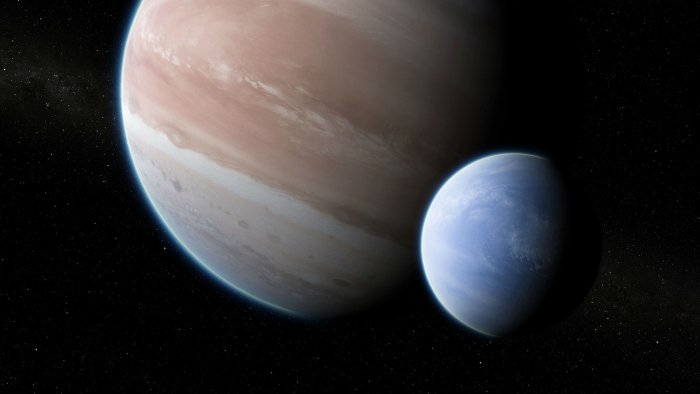
exmoon artist impression
An artist's impression of exoplanet Kepelr-1625b and its moon. (Dan Durda)
It will certainly raise some questions about moon formation.
Kepler-1625b-i is about 1.5 percent of the mass of the planet, similar to the mass-ratio of Earth and the Moon. But because both bodies are gaseous (which means neither are habitable as we understand it, in case you were wondering), and because of the moon's size, that raises questions about how it got there.
Our Moon may have formed as the result of a collision with Earth, but a collision with a gas planet like Kepler-1625b might not result in enough material to form a Neptune-sized moon.
Jupiter's moons are believed to have formed from a ring of material; but again, none of Jupiter's moons are the size of Neptune. Or it could have been an object that was captured by the planet's gravity from elsewhere.
For now, we can't get any answers to those questions, but we can at least hope the moon discovery will be confirmed, hopefully by future Hubble and James Webb Space Telescope Observations.
"We're looking forward to the scrutiny of the scientific community on this work and we hope we'll have an opportunity to observe the target again before too long," Teachey said.

NASA -camera -shows-moon- crossing -Earth
A camera on the Deep Space Climate Observatory (DSCOVR) satellite shot an arresting view of the moon crossing in front of the Earth. The image clearly shows the moon's far side lit up by the sun -- though even in full sunlight, the Earth is far brighter.
"It is surprising how much brighter Earth is than the moon," DSCOVR project scientist Adam Szabo said in a news release. "Our planet is a truly brilliant object in dark space compared to the lunar surface."

DSCOVR, which is a partnership between NASA, the National Oceanic and Atmospheric Administration and the U.S. Air Force, is equipped with NASA's Earth Polychromatic Imaging Camera, a 4-megapixel CCD camera and telescope. It's orbiting between the Earth and the sun at a distance of 1 million miles.
Though the moon's so-called dark side isn't visible from Earth -- thanks to the "tidally locked" moon always presenting the same side to its terrestrial neighbour -- It's far from the first time we've seen it.
NASA photographed the moon crossing in front of the Earth in 2008, but the moon was only partially illuminated. Moreover, those images were taken from 31 million miles away.
DSCOVR's primary role is to monitor the solar wind for NOAA, which is "critical to the accuracy and lead time of space weather alerts and forecasts," says NASA.

Conjunctions are exciting to check out in a distinct night time sky especially when the Jupiter is just 6 degrees in the sky. You just have to get outside the house and watch west and there will be Venus and Jupiter visible clearly in the night sky.
On July 18 and 19, the crescent moon will be given company by Venus and Jupiter making it a celestial extravaganza.
The three celestial objects will be seen in a row as if they are in a divine meeting.
These three astronomical bodies, Moon, Venus and Jupiter are the second, third and fourth brightest objects respectively in our solar system after the Sun.
In fact, Venus, the second planet from the Sun, is 77 million km from Earth, and Jupiter, the fifth planet from the Sun and the solar system’s largest, is 909 million km away.
They have been gradually coming closer to each other in excess of the previous few weeks.
All the three bodies were in a triangle on Friday night and it was visible with the naked eyes. However, the phenomenon can also be watched in the daytime as well but it will vary depending on the location and time zone. They will make an appearance at 6:45 am IST on Sunday, July 19.
The moon will actually pass in front of the Venus on Monday, July 20 at 6:30 am IST, favoring the South Pacific though the rest of the world will see a stunningly close pass.

An image showing an alien walking on the moon is simply "dust NASA

New York: An image showing an alien walking on the moon is simply "dust, an eyelash or scratch on the negative" of the film that took the image, NASA has said.The video showing the alien on the moon was posted by YouTube user Wowforreel and viewed more than two million times in less than a month.

He figured out an irregularly shaped dark spot on Google Moon.According to NASA scientists, the image was taken by either the Apollo 15 or 17 manned missions to the moon in 1971 and 1972, respectively. "My best guess, is that something (dust, an eyelash, scratch on the negative) was on the film," Pix11 quoted a scientist as saying.

"Remember, this was in the pre-digital days when all sorts of nasty things could happen to film," he added. Why the video went viral can be explained by a psychological phenomenon called Pareidolia.This is the brain's response to seeing faces and other significant objects in random stimulus, media reports said.IANS

via -firstpost
Powered by Blogger.