What is Octane Number? How rating of SI Engines (Spark ignition engines) is done using an octane number?

The hydrocarbon fuels used in spark ignition (S.I.) engine have a tendency to cause engine knock when the engine operating conditions become severe. The knocking tendency of a fuel in S. I. engines is generally expressed by its octane number. The percentage, by volume, of iso-octane in a mixture of iso-octane and normal heptane, which exactly matches the knocking intensity of a given fuel, in a standard engine, under given standard operating conditions, is termed as the octane number rating of that fuel. Thus, if a mixture of 50 percent iso-octane and 50 percent normal heptane matches the fuel under test, then this fuel is assigned an octane number rating of 50. If a fuel matches in knocking intensity a mixture of 75 percent iso-octane and 25 percent normal heptane, then this fuel would be assigned an octane number rating of 75. This octane number rating is an expression which indicates the ability of a fuel to resist knock in a spark ignition engine.

Since iso-octane is a very good anti-knock fuel, therefore it is assigned a rating of 100 octane number. On the other hand, normal heptane has a very poor anti-knock qualities, therefore, it is given a rating of zero octane number. These two fuels, i.e., iso-octane and normal heptane are known as primary reference fuels. It may be noted that higher the octane number rating of a fuel, the greater will be its resistance to knock and higher will be the compression ratio. Since the power output and specific fuel consumption are functions of compression ratio, therefore we may say that these are also functions of octane number rating. This fact indicates the extreme importance of the octane number rating in fuels for S. I. engines.

Note: The octane number of petrol, generally available, is 80 to 100.


As we know that inverters are finding their extensive uses now a days. Previously they were only used in some main applications, which would be large scale and expensive. But now a days, inverters are like a small compulsory electronic device, on which many of our other main electronic equipment depend.They are extensively used, not only because of their universal function of converting DC power to AC power, but also because of their high efficiency, reduced power costs and versatile applications.

These days, they are being used extensively in applications where there is a frequent power cut off, because in case of power failures, inverters are a very good and efficient power remedies. For every classification, we form some basis first, depending upon which we can further categorize our results for easier understanding and a better approach. This is done in order to promote better understanding and a more extensive classification of different things.In the same way, we primarily classify inverters on the basis of their output characteristics. So there are three different types of outputs we get from inverters, and hence we classify inverters into three primary classes, which are:
  • The Square Wave inverter.
  • The Modified Sine wave inverter or quasi sine wave inverter.
  • A Pure sine wave inverter


The Square Wave inverter

A square wave inverter is one of the simplest inverter types, which convert a straight DC signal to a phase shifting AC signal. But the output is not pure AC, i.e. in the form of a pure sine wave, but it is a square wave.At the same time they are cheaper as well. The simplest construction of a square wave inverter can be achieved by using an on-off switch, before a typical voltage amplifying circuitry like that of a transformer. The output of this type of a circuit is a square wave.

The modified Sine wave inverter 

The construction of this type of inverter is a bit more complex than a simple square wave inverter, but still it is a lot simpler than a pure sine wave inverter.A Modified sine wave shows some pauses before the phase shifting of the wave, i.e. unlike a square it does not shift its phase abruptly from positive to negative, or unlike a sine wave, does not make a smooth transition from positive to negative, but takes brief pauses and then shifts its phase.It is also called as  quasi sine wave inverter.


A Pure Sine Wave Inverter

The electrical circuit of a pure sine wave inverter is far more complex than a square wave or modified sine wave inverter. Another way to obtain a sine output is to obtain a square wave output from a square wave inverter and then modify this output to achieve a pure sine wave. A pure sine wave inverter has several advantages over its previous two forms:
  • More efficiency, hence consumes less power.
  • They can be adjusted according to your personal power requirements, since several types are available with different power outputs.
  • The output of a pure sine wave inverter is very reliable, but at the same time, there is a tradeoff between the price and reliability.
  • Due to this reason they are the best option for sensitive equipment.


Most failures in equipment—whether electrical, mechanical, process, or electronic—are signaled by a significant rise in operating temperature long before failure occurs. Infrared thermography can detect heat patterns in the infrared wave-length spectrum that are not visible to the unaided eye. These heat patterns can help identify deteriorating components before they fail.
Infrared thermography is the science of detecting infrared energy emitted from an object, converting it to apparent temperature, and displaying the result as an infrared image. Literally, infrared thermography means "beyond red" (infrared) "temperature picture" (thermography).

How an infrared camera works

With an infrared camera you can capture thermal images without making direct contact with equipment. That means you can capture thermal information from operating equipment at a safe distance and have a better chance of seeing temperature anomalies under normal operating conditions. Most popular infrared cameras (also known as thermal imagers) capture radiometric thermal images that contain apparent temperature measurements for each pixel within the image. With that capability, you can identify an anomaly and then drill down to calculate the apparent temperatures of the points in question.

When to use infrared thermography

The non-contact nature of infrared thermography makes it ideal for a wide range of applications where components are moving, very hot, dangerous to contact, difficult to reach, impossible to shut off, or could be contaminated or damaged through contact. Infrared cameras are also very helpful in detecting energy or moisture-related problems in a building envelope. Learn more about thermal imaging.

The benefit of today’s technology

Unlike early thermal cameras that were large, very expensive, difficult to use, slow to acquire data, and offered poor image resolution, the technology has evolved to produce compact, ergonomic cameras that are easy and fast to use, are much more affordable and provide high resolution images. With the proper infrared camera and lens, you can scan details from targets as small as 25 microns to targets several hundred feet tall. The speed and convenience of today’s infrared cameras enable you to conduct inspections faster and find problems in areas that you might have otherwise overlooked.

We know that one of the core uses of Radar is to send and receive valuable information in the form of waves. RADAR is helpful in detecting incoming signals during a war and also used by geologist for earthquake detection. Archeologists use this technology for detection of buried artifacts. It is also used to understand the environment and climatic changes.

Applications and uses of Radar are given below:
  • Military
  • Law Enforcements
  • Space
  • Remote Sensing of Environment
  • Aircraft navigation
  • Ship Navigation
  • Air Traffic Controller

RADAR are used in Military

Radars have a wide range of usage in military operations. They are used in Naval, Ground as well as Air defense purposes. They are used for detection, tracking and surveillance purposes also. Weapon control and missile guidance often use various types of RADARs.

These are used in Law Enforcements

Law enforcements especially highway police has an extensive uses of RADARs during a pursuit in order to measure the speed of a vehicle. Due to bad weather conditions, when satellite is unable to get a clear image of traffic and barricades, then RADARs is used to get the desired results.

This technology is used in Space

RADARs are used to track and detect satellites and spacecrafts. They are also used for safely landing and docking of spacecrafts. RADARs in satellites are used for remote sensing.

RADAR is used for Remote Sensing of Environment

Just like various type of waves are received by an antenna. This technology are also used to detect weather condition of atmosphere and are also used for tracking motions of planets, asteroids and other celestial bodies in the solar system.

It is used in Aircraft Navigation

Ground mapping RADARs and weather avoidance RADARs are used in aircraft to navigate it properly. This technology enables an aircraft to ensure the location of obstacles which can be a threat to the flight plan.

Uses of RADAR in Navigating Ships

Ships are guided through high resolutions RADARs situated on the shores. Because of poor visibility in bad weather conditions, RADARs provides safety by warning threats. These ships often use this technology to measure the proximity of other ships and their speed on the water.

RADARs is used in Air Traffic Controller

RADARs are used for safely controlling the traffic in air. It is used to guide aircrafts for proper landing and take-off during bad weather conditions. These type of RADARs also detect the proximity and the altitude of the aircrafts.
These were some applications and uses of RADAR


1. R Madhavan

R Madhavan had been excellent in academics during his student life and also had won a scholarship to visit Canada for a programme. He owns a degree in Bachelors in Technology in Mechanical Engineering from IIT- Madras.
2. Sushant Singh Rajput
Sushant is also a well-educated mechanical engineer from Delhi Technological University. He has successfully established himself in the industry with various hits like ‘Kai Po Che’,’ MS Dhoni’, ’Shudh Desi Romance’. He secured a 7th rank in All India Engineering Entrance Exams (AIEEE) but acting was always his first love and preference, that later brought him so much fame.
3. Sonu Sood
Sonu Sood, an actor, model, and producer made his debut with Tamil film Kallazhagar. He has done his engineering in electronics from Yeshwantrao Chavan College of Engineering, Nagpur. He has done Bollywood films like ‘Singh is King’, ’Ek Vivah Aisa Bhi’, ‘Buddah Hoga Tera Baap’ and much more.
4. Vicky Kaushal
Vicky made his debut with ‘Masaan’ which was a well-appreciated film. He has also appeared in ‘Raman Raghav,’ ‘ Raazi,’ ‘Sanju,’ ‘Manmarziyaan,’ and others. He has done engineering in electronics and telecommunications.
5. Kartik Aaryan
This 25-year-old actor who has appeared in hit movies like ‘Pyar Ka Punchnama’ ‘Pyar Ka Punchnama 2,’ ‘Sonu ke Titu ki Sweety,’ etc is born and brought up in Gwalior. He has pursued his Engineering in Biotechnology from Mumbai.
6. Riteish Deshmukh
He is the son of a politician and has a bachelor’s degree in architect engineering. He has studied from Kamla Raheja College of Architecture, Mumbai. He has appeared in several movies like ‘Banjo,’ ’Housefull 3,’’Ek Villian,’ ’ Great Grand Masti,’and others.
7. Amol Parashar
Amol Parashar is a mechanical engineer who has done his B.Tech from IIT Delhi. He has endorsed many brands like Mc Dowell’s no. 1 soda, Cadbury, Metlife, Virgin Mobile, Mentos, Tanishq, and also done movies like ‘Rocket Singh- Salesman of the year’.
8. Kriti Sanon
Kriti Sanon is also an engineer; she has done her Engineering from Jaypee, Noida in Electronics and Communications. She made her debut on screen with the film ‘Heropanti’ opposite Tiger Shroff. After that, she has appeared in various movies.
9. Taapsee Pannu
TaapseePannu who stunned everybody with her acting in ‘Pink’ holds a degree in Computer Science Engineering. She made her debut with ‘Chasme Badoor’. We have seen such enormous growth in her acting skills, and she has set an example that education does not matter to reap success but we can follow our heart always and change our profession reach great heights.
10. Ameesha Patel
Ameesha Patel, the Gujarati girl, is also an engineer and holds a degree in Bio-genetic engineering. She has done post-graduation in economics from Tufts University, Massachusetts. She was a gold medalist then. She has done movies like ‘Thoda Pyaar Thoda Magic’, ‘Humraaz’, ‘Border’.


Dehumidifiers can help prevent and, in some cases, repair damage to your home.
If you live close to the equator or near a coastal region, you probably hear your local weatherman say the word "humidity" all too often. But no matter where you are, you've surely experienced it -- that muggy, heavy feeling that fills the air, often when it's rainy, foggy or hot outside. It can make your hair frizzy and may seem to dampen everything, including your mood.
When people complain about humidity, for the most part they're talking about relative humidity. Depending on temperature, air can hold a fixed amount of water vapor; relative humidity is the ratio of actual vapor in the air to this fixed amount. For example, at a temperature of 68 degrees Fahrenheit (20 degrees Celsius), one cubic meter (35 cubic feet) of air can hold about 18 grams (.6 ounces) of water. This would be a state of saturation, otherwise known as 100 percent relative humidity.
That's a lot of jargon to describe a level of humidity that, for many people, can feel extremely uncomfortable. When this humidity seeps into your home, it can make rooms feel stuffy and perhaps even smell musty. Beyond these superficial discomforts, too much humidity can have some more serious disadvantages, too. An overly humid home can lose its structural integrity, attract pests like silverfish and centipedes, and even make you sick.
In an average home in which the temperature is 68 degrees Fahrenheit, the relative humidity should ideally be between 30 and 50 percent. If you're struggling to reach that range, a dehumidifier may come in handy. Dehumidifiers remove excess moisture from the air, improving the comfort and health of your home.
Dehumidifier Basics
Imagine enjoying a soda during a particularly warm day. When you pick up the can, you might notice that it's wet -- there's moisture on the outside. Why is that? As air loses heat, it also begins to lose its ability to retain moisture; the colder surface pulls and collects water from the warmer air, creating condensation. Your dehumidifier does pretty much the same thing. Most dehumidifiers can be broken down into five component parts:
·         Fan Compressor -- This compresses and expands a refrigerant gas like freon to cool the dehumidifier's coils.
·         Reheater -- This captures and collects heat that the cooling process generates.
·         Compressor cooling coils
·         Reservoir
How do all these parts fit together to pull moisture from the air? It's fairly simple, but very effective:
1.      A fan collects air from the surrounding area and pulls it into the dehumidifier.
2.      As the air passes through, it comes into contact with the dehumidifier's cooled coils. These coils use condensation to pull moisture from the air. The collected moisture remains on the coils and drips into the dehumidifier's reservoir.
3.      The dehumidifier reheats the air and exhausts it back into the room.
A dehumidifier usually has a removable plastic bucket for a reservoir; most buckets also have a place where you can hook up a hose so the collected water can drain straight into a floor drain or pump. This frees you from having to remember to dump out the water. But don't worry too much about the reservoir overflowing -- most dehumidifiers also have an automatic shut-off. If you're using a dehumidifier in extremely moist conditions, however, or if you need to keep your dehumidifier on all the time, you should look into a unit with a built-in condensate pump, which regularly pumps water out of the unit's reservoir rather than simply relying on gravity to empty it as a hose does.
Many dehumidifiers also have a humidistat, which allows you to set your desired level of relative humidity. A humidistat has two parts: a sensing element and a relay amplifier. The sensing element includes two alternate metal conductors, and changes in relative humidity will cause electrical resistance between those conductors. The relay amplifier measures this resistance and sends a signal to turn the dehumidifier on or off. These basic components add up to a device that may make your home feel a whole lot better.
WHAT'S THE DIFFERENCE?
Could your air conditioner help reduce humidity in your home, too? If you have an A/C, it functions similarly to a dehumidifier, pulling warm air in and letting it cycle over cold coils. The difference is that it does not reheat the air before exhausting it -- that's how it keeps your space cool. Also, your A/C does not have a humidistat and thus cannot detect relative humidity -- just temperature. Once it succeeds in cooling your home to your ideal temperature, it may stop running. This might allow the humidity to climb again, making your house feel like it's hotter than it actually is.


It's easy to see that the sky is blue.
Have you ever wondered why?

A lot of other smart people have, too. And it took a long time to figure it out!
blue sky and clouds illustration

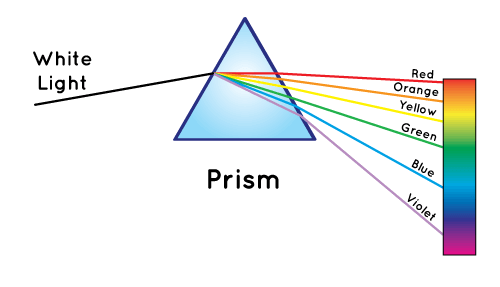
The light from the sun looks white. But it is really made up of all the colors of the rainbow.
A prism separates white light into the colors of the rainbow.
When white light shines through a prism, the light is separated into all its colors. A prism is a specially shaped crystal.
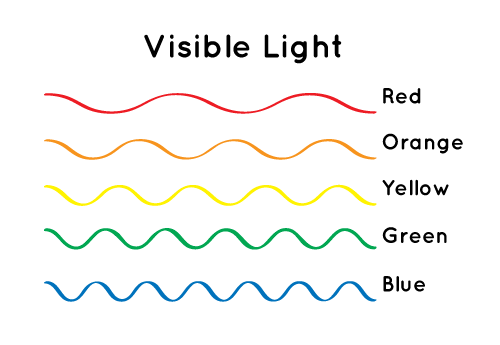
Like energy passing through the ocean, light energy travels in waves, too. Some light travels in short, "choppy" waves. Other light travels in long, lazy waves. Blue light waves are shorter than red light waves.
Different colors of light have different wavelengths.
All light travels in a straight line unless something gets in the way and does one of these things:—
  • reflect it (like a mirror)
  • bend it (like a prism)
  • or scatter it (like molecules of the gases in the atmosphere)

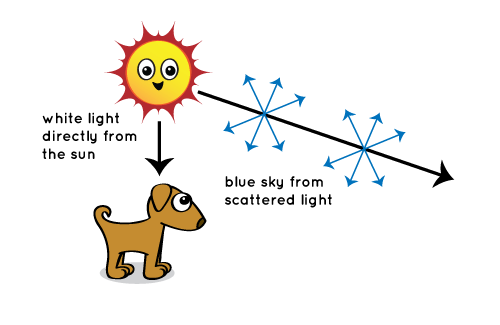
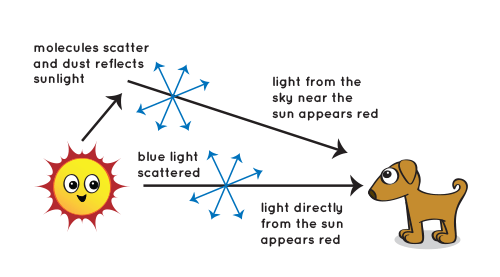
Sunlight reaches Earth's atmosphere and is scattered in all directions by all the gases and particles in the air. Blue light is scattered in all directions by the tiny molecules of air in Earth's atmosphere. Blue is scattered more than other colors because it travels as shorter, smaller waves. This is why we see a blue sky most of the time.


Atmosphere scatters blue light more than other colors.
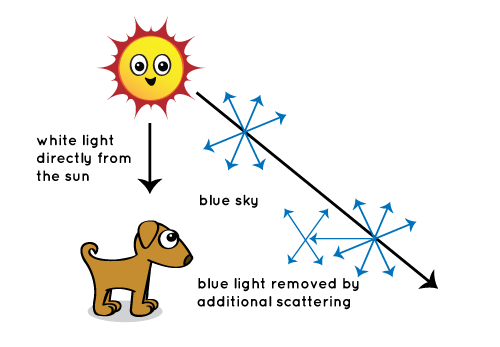
Closer to the horizon, the sky fades to a lighter blue or white. The sunlight reaching us from low in the sky has passed through even more air than the sunlight reaching us from overhead. As the sunlight has passed through all this air, the air molecules have scattered and rescattered the blue light many times in many directions.
Atmosphere scatters blue light more than other colors
Also, the surface of Earth has reflected and scattered the light. All this scattering mixes the colors together again so we see more white and less blue.


What makes a red sunset?

As the sun gets lower in the sky, its light is passing through more of the atmosphere to reach you. Even more of the blue light is scattered, allowing the reds and yellows to pass straight through to your eyes.
Red sky at sunset
Red sun at sunset.
Sometimes the whole western sky seems to glow. The sky appears red because small particles of dust, pollution, or other aerosols also scatter blue light, leaving more purely red and yellow light to go through the atmosphere.

Is the sky blue on other planets, too?

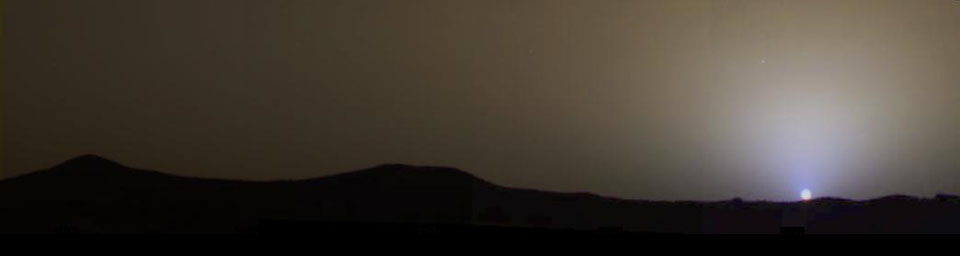
It all depends on what’s in the atmosphere! For example, Mars has a very thin atmosphere made mostly of carbon dioxide and filled with fine dust particles. These fine particles scatter light differently than the gases and particles in Earth’s atmosphere.
Photos from NASA’s rovers and landers on Mars have shown us that at sunset there is actually the opposite of what you’d experience on Earth. During the daytime, the Martian sky takes on an orange or reddish color. But as the Sun sets, the sky around the Sun begins to take on a blue-gray tone.
The orange-colored Martian sky during the daytime. The blue-tinted Martian sky at sunset.
The top image shows the orange-colored Martian sky during the daytime and the bottom image shows the blue-tinted sky at sunset. Both images were captured by NASA’s Mars Pathfinder Lander. Credit: NASA/JPL

Powered by Blogger.