Bam! Bam! Order! Order in Wonderopolis! Bam! Order in Wonderopolis! Bam! Bam!
Don’t worry, we’re just kidding—everyone knows Wonderopolis is anything but orderly. But if that opening sounded familiar, you may be picturing ajudge rapping a tiny hammer on a piece of wood and yelling, “Order in the court!”
That tiny hammer is called a gavel. It’s typically made of wood andpaired with a base on which it can be hit. Why dojudges use gavels? Tomaintain order in the courtroom, of course! After all, emotions can run high during a trial. If the gavel comes out, it’s because the judge is asking for things to quiet down.
However, movies and courtroomdramas have given many people the wrongimpression.Contrary to popular belief, judges don’t use gavels all that often. They’re more likely to use their
In fact, outside of the U.S., gavels are nearlyabsent altogether. They’re not even that common in U.S. courtrooms. Many judges do receive gavels as gifts for special occasions or torecognize accomplishments, but few actually use them.
However, there are a few other places in which those tiny hammers are put to use. One example is in clubs and organizations. Many of these use a gavel tosignal the beginning or end of a group meeting.
The U.S. Senate and House of Representatives also use gavels. Each Speaker of the House chooses their own gavel. In The Senate, though, the same one is used by everyVice President.
The Senate gavel is unique—it’s made of ivory and has no handle. Instead, it’s an hourglass shape that’s held in thepresiding officer’s hand. Theoriginal gavel was broken in 1954 during adebate. The nation of India gifted The Senate a new one that same year.
Are you WONDERing about the history of gavels? It’s a bit mysterious. Some believe their use goes all the way back toMedieval England, but no one can say for sure. Still, they were certainly in use by 1789 when John Adams opened the first session of the very first U.S. Senate.
Do you dream of using a gavel to quiet a courtroom? Maybe you’ll be the one to bring them back into fashion. Or perhaps these tiny hammers are truly things of the past. We’ll let you be the JUDGE of that!
When you think of a typical controlled fire, such as a campfire or bonfire, many of the adjectives that come to mind probably concern heat and temperature: Hot. Roaring. Roasting. On the other hand, you may have a number of visual impressions, too: Sparkling. Shimmering. Dancing.
Just as colors appear in a variety of hues, intensities and on physical media such as painting and clothing, they can also present the same apparent range of visual "flavors" when the medium is what you know as fire. This makes sense, since fire is just . . . really hot light. Or is it?
As it happens, the colors you see in fire do correlate with the temperature in fire, so that you can expect to see certain colors more often in hotter flames and others when things are just getting cooking or dying out. But the situation is more complicated than that because exactly what is burning in a given fire also influences the display of colors in the flaming mix.
How Are the Visible Colors Produced?
What you see as light is actually electromagnetic radiation (EM), visible light being one of a number of types of EM and occupying only a small fraction of the entire EM spectrum. EM waves are characterized by a wavelength, the distance between corresponding points along a graphed EM wave, and a frequency, the number of wavelengths per second passing a fixed point.
The product of wavelength (λ) and frequency (ν) of an EM wave is always the speed of light c (3 × 10⁸ m/s) no matter the EM wave type.
The range of wavelengths below about 440 nanometers ( 4.4 × 10⁷ m) includes radio waves at the low end, then microwaves. Above about 7 × 10⁷ m, X-rays and gamma rays appear; these have high frequencies and are associated with higher energy as a result. This has implications for the colors seen glowing in flames.
The visible light spectrum itself (4.4 × 10⁷ to 7 × 10⁷ m) includes radiation perceived by the human eye as, in order, red, orange, yellow, green, blue, indigo and violet (the famous "Roy G. Biv" of elementary-school science classes). As you'll see, this order carries over into fire, albeit with incomplete fidelity.
What Is Heat in Physics?
The reason most fires you're likely to see on Earth burn is that some kind of material is undergoing combustion, and this requires the presence of oxygen gas (O2).
Various factors can influence how hot the flame burns, including the nature of the material (obviously, gasoline burns very well; water, not so much) and whether it is being "fueled" with more material and oxygen as the fire grows.
Heat has units of energy and can be conceived as a quantity that moves from regions of higher density to regions of lower density, as with the simple diffusion of molecules. Light and heat are both (generally desirable!) products of fires, and as noted above, light waves are associated with energy in proportion to their frequency. These faster oscillations result in a greater liberation of heat, and this in turn is associated with higher temperatures within and near the flame.
Types of Flame
Many materials produce characteristic colors when burned. For example, the element sodium, which combines with chlorine to form ordinary salt (NaCl), produces a bright orange color when burned. Sodium is found in most kinds of wood, so it would be unusual to assemble a fire from the usual branches and sticks and have it not display at least some orange or dark yellow color.
The blue often seen in wood flames comes from the elements carbon and hydrogen, which emit light in the upper end of the visible light spectrum, and thus create blue and violet hues. The metal copper is known to turn green if exposed to the air for long enough; copper compounds create green or blue colors when burned. The metal lithium, to effectively round out the whole rainbow spectrum within this one section, burns red.
At the center of a very hot fire, you may see a dull orange glow or even curious dark space. This is known as blackbody radiation, and is characteristic of very high temperatures (for example, it's a feature of stars). Metals that can heat up even more progress through other colors of this type of radiation (that is, toward the violet end of the visible spectrum).
What Is The Temperature of Fire?
Now, you're cooking! So, before getting a look at just what colors to expect of fires burning at a given temperature, it's helpful to know the range of temperatures produced in the sorts of fires you're apt to encounter and scan for colors. After all, this isn't information most people keep inside their heads or someplace handy on their smartphones.
The flame of a typical candle has an outer core that burns at close to 1,400 °C (about 2,500 °F) while the core of the flame burns at 800 °C (1,450 °F). These are extraordinary temperatures for such a small flame! The walls of a household oven, meanwhile, can reach temperatures of around 500 °C (900 °F); that means the baking or broiling temperature only reaches about half of that in the metal in the walls.
If you have a fireplace in your home that you like to warm your hands over at a discreet distance, the flames providing the heat are roaring away at about 600 °C (1,100 °F). A bonfire stoked with charcoal and wood can get up to 1,100 °C (2,000 °F), as can a laboratory Bunsen burner. Of course, the sun's inner temperature of 2,000,000 °C (3,600,000 °F) makes all of these values seem rather trivial.
Are Temperature and Flame Color Directly Related?
As you have learned, both the type of material being burned in a fire and the temperature of a fire influence the colors you see produced. Also, as the example of the two vastly different candle temperatures illustrates, any one fire is almost certain to have a range of temperatures within it (explaining a large amount of the color variation sometimes observed).
When something is heated, it first turns to gas (something you typically cannot observe). These gas molecules then react with the oxygen if they are in fact combustible molecules. It would be typical to see a fire consisting of a uniform material and heated in a controlled way show reddish, then orange and finally bright yellow flames, demonstrating increasing energy and heat released.
If you light and closely study a candle, you will probably note that a sizable portion of the outer core is blue, something not usually seen much in, say, fireplaces. Considering the differences in temperatures given for these fires, this isn't surprising at all.
Flame Color Temperature Chart
While sources vary somewhat, it is possible to construct a reliable enough chart showing the relationship between flame temperature and flame color across the visible light spectrum.
Dark red (first visible glow): 500 to 600 °C (900 to 1,100 °F) * Dull red: 600 to 800 °C (1,100 to 1,650 °F) * Bright cherry red: 800 to 1,000 °C (1,650 to 1,800 °F) * Orange: 1,000 to 1,200 °C (1,800 to 2,100 °F) * Bright yellow: 1,200 to 1,400 °C (2,100 to 2,500 °F) * White: 1,400 to 1,600 °C (2,500 to 2,900 °F)
Temperatures high enough to produce blue flames are unusual in campfires, which is why they are more often seen when metals are used, as in welding,
According to Android Central, Google has discreetly added a battery-saving function for Pixel smartphones. The function, dubbed "Optimizing for battery health," is said to prevent Pixel phones from charging above 80% in two scenarios: "continuous charge under high battery drain conditions, such as gameplay" and "continuous charge for four days or more." According to the source, the function would be available on Pixel 3 and subsequent smartphones, and it was first observed on qualifying Pixel models in April and May.
According to Google, when the battery-saving feature is activated, a "Optimizing for battery health" notice will appear on the phone's Always-on display as well as in the Settings app under "Battery."
Battery Care was a similar feature on Sony Xperia phones that limited charging to 90 percent and featured a toggle to switch it on or off. Google does not provide a toggle option, but the two conditions must be met for the feature to turn on, so users can rest certain that the feature will not run in the background all of the time, but only when one of the aforementioned circumstances is met. “When the phone no longer meets the conditions stated, the temporary feature shuts off automatically.
If you wish to disable battery optimization on your Pixel phone, Google recommends unplugging it from the charger or removing it from the wireless charging Pixel Stand. After that, you can either restart your smartphone or wait for the function to become dormant, which should take roughly 10 minutes. When the message vanishes and your Pixel can charge to 100% again, you'll know the feature has been switched off.
Even as awareness around plastic pollution grows, very little is being done to solve the problem. At this rate, by 2050, some experts predict the world's oceans will contain more plastic than fish.
A think piece from the United Nations, commissioned by the G20, has now detailed everything the world should do to stop that from becoming our reality because we're not doing enough.
Meanwhile, promises and policies from governments and companies will only reduce plastic litter in the marine environment by 7 percent.
That's nowhere near what will be needed to achieve the G20's Osaka Blue Ocean Vision, which seeks to stop any new plastic pollution from entering the oceans by 2050.
To get there, researchers at the UN argue the world needs a "wholesale change in the plastics economy". We need the plastics industry to go from a "linear and wasteful system" to a circular and renewable one in just a few decades.
According to the report, that's a lofty goal, but it's the only way to achieve the Osaka Blue Ocean Vision. If the G20 is really serious about its commitments, then leading nations need to make plastic pollution a bigger priority going forward.
The report is largely reliant upon a model published in 2020. It shows that if the world does decide to take ambitious and urgent action on plastic pollution, we can reduce the litter destined for our oceans by 82 percent come 2040 using known technology and approaches.
That will, of course, require nations from all around the world to act in unison, something we haven't been great at so far. But if we can figure out the best route to get there, we could create a road map for all to follow.
"It's time to stop isolated changes where you have country after country doing random things that on the face of it are good but actually don't make any difference at all," says Steve Fletcher from the University of Portsmouth.
"Intentions are good but don't recognize that changing one part of the system in isolation doesn't magically change everything else."
Recycling alone won't be enough. The 2020 model found at least half a million people will need to be connected to waste collection services every day for that to work as a strategy.
"Given this is unlikely, reducing the amount of plastic in the system should be a top priority for policymakers because waste management systems cannot scale quickly enough," the report argues.
"The use of plastic can be reduced, minimized, or avoided entirely in many circumstances through intentional design changes to a product."
Global packaging, the authors point out, is valued between $80-120 billion USD per year, yet 95 percent of that money is lost as plastic waste. Not only could changing the design save companies money, but there are also economic benefits that come from developing new products which rely less on plastic and more on renewable materials.
But preventing further leakage should be our number one priority, researchers say. Cleaning up plastic in the ocean comes with a lot of challenges, requires advanced technology, and costs a lot of money.
As such, ocean clean-ups should only be considered a "useful transitional effort" on our way to a circular plastics economy. Otherwise, we'll just keep giving ourselves more and more garbage to chip away at.
In a time of global economic recovery, when COVID-19 stimulus packages emphasize green growth like never before, the world has an opportunity to address the plastics economy like never before.
If these stimulus packages can include measures to reduce marine plastic and create greener sectors from nation to nation, we might just make the Osaka Blue Ocean Vision come true after all.
The UN International Resource Panel report is available here.
Rocks aren't all created equal. Some of them are heavy, while others are light. Others are black, while others are nearly white. Even igneous rocks generated from magma in the Earth's mantle can have a wide range of appearances.
Igneous rocks
Igneous, sedimentary, and metamorphic rocks are the three main types of rocks. Magma in the Earth's mantle creates igneous rocks. They normally don't include fossils, don't react with acids, don't have visible strata, can be comprised of a variety of minerals, have holes or bubbles, and can appear glassy. Volcanologists search for these igneous rocks in order to understand more about their origins and whether they were generated during a volcanic eruption.
Geologists use the visual appearance of the rock as an initial clue to its composition but will then verify their ideas using specialised techniques. For example, scientists at The University of Auckland use an electron microprobe to measure the exact quantities of silica, iron, magnesium and many other chemicals that are in rock samples they collect. This information helps them to classify the rock and may give them direct clues about the volcano and the eruption that formed the rock.
Nature of science
Classification helps scientists organise things into groups. In rock classification, such grouping can help geologists see patterns and perhaps explain the reasons for rocks looking similar.
Lava solidifies to rock
New Zealand has three main types of volcanoes, and each has been formed from a different type of magma. Once the lava has erupted, it cools and solidifies into rock:
Basalt magma often forms shield volcanoes.
Andesite magma often forms cone volcanoes.
Rhyolite magma often forms calderas. Depending on how much gas the magma contains, it can also form cone volcanoes.
Basalt
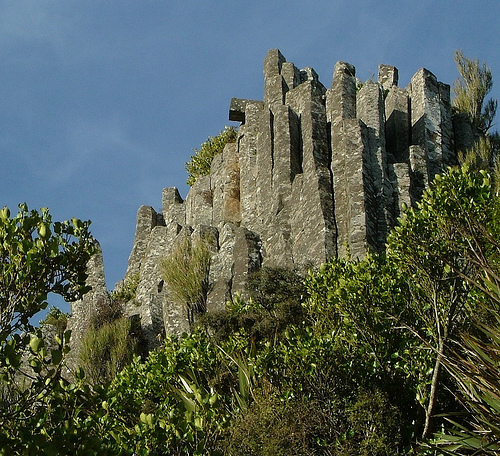
The Earth’s crust is mainly basalt rock. It is a heavy, dark, grainy rock. Basalt is associated with great rock columns that are found in many places around the Earth, for example, the Organ Pipes in Dunedin or the Giant’s Causeway in Ireland.
Rights: Peter MacMurchy
Columnar basalt
Basalt is associated with great rock columns that are found in many places around the Earth, such as the Organ Pipes near Mt Cargill, Dunedin.
Basalt magma is formed at high temperatures (around 1,200ºC). When it comes out of the volcano, it is hot and liquid. It contains very little silica (less than 50%) and a lot of magnesium and iron, which makes the rock look dark.
The Auckland volcanic field has erupted this type of hot, runny iron-rich lava, and the landscape is dotted with mountains made from basalt and scoria (a red-coloured rock that contains large amounts of iron-rich minerals). Both rock types are excavated for building materials and landscaping.
Andesite
Andesites are lighter coloured than basalt because they contain less iron and more silica (50–60%). Some scoria rocks fall within the andesite classification because of their chemical composition.
Rights: The University of Waikato
Andesite
This andesite rock is from the central North Island of New Zealand.
Magma that contains andesite is generally around 800–1,000ºC and forms steep-sided cone volcanoes (stratovolcanoes). Mount Ngāuruhoe is an example of an andesite volcano.
Rhyolite
Rhyolite is light-coloured or white – this is a clue that the rock contains a lot of silica (more than 70%) and not much iron or magnesium.
Rights: Hannes GrobeCreative Commons 2.5
Pumice
Pumice, a rhyolite, is very common in the central North Island. It may still have evidence of the bubbles of gas trapped as the rock solidified.
Rhyolitic magmas are associated with low temperatures (750–850ºC) and are often thick, which means gases can’t escape. Some rhyolitic rocks are quite light, for example, pumice, which may still have evidence of the bubbles of gas trapped as the rock solidified.
When children draw pictures of the Sun, they often show rays radiating outwards – similar to the image below.
The Sun
At this stage of our Sun’s life cycle, hydrogen atoms are fused to form helium atoms. This nuclear reaction produces very large amounts of energy.
These light rays travel in a straight line at nearly 300,000 kilometres per second. Sunlight that travels towards the Earth takes just over 8 minutes to reach us. When the rays reach Earth, they hit whatever is in their path. If the object they hit is opaque, the light cannot pass through, and a shadow forms.
Simply speaking, a shadow is an absence of light. If light cannot get through an object, the surface on the other side of that object (for example, the ground or a wall) will have less light reaching it.
A shadow is not a reflection, even though it is often the same shape as the object.
Light sources and shadows
There are many sources of light – stars like our Sun, candle flames, light bulbs, glow-worms and computer screens produce light. All of this light travels in a straight line until it hits something. Sometimes, it travels a short distance – like when we switch on the lamp. Other times, light travels thousands of years – like the light from stars we see in the Milky Way.
It is easy to see our shadows when we are outdoors in the sunshine on a clear, bright sunny day, but do shadows form when an object blocks light from other sources? The answer is yes, but they may be difficult to see if the light source is not very bright (has a low light intensity). Shadows are also more definite (sharper) where there is contrast between the shadow and the lit surface, for example, a shadow on a white wall will be more easily seen.
The size of the light source can sharpen or blur the shadow. A small spotlight like a cellphone torch forms a more distinct shadow than an overhead room light, but the sharpness of the shadow changes when the torch moves away from the object.
Long penguin shadow
The Sun is low on the horizon so the penguin’s shadow is long. An object is always between a light source and the surface on which its shadow forms.
Changing shapes and sizes
A shape of an object always determines the shape of its shadow. However, the size and shape of the shadow can change. These changes are caused by the position of the light source.
When we are outside on a sunny day, we can see how our shadows change throughout the day. The Sun’s position in the sky affects the length of the shadow. When the Sun is low on the horizon, the shadows are long. When the Sun is high in the sky, the shadows are much shorter. We can create the same effects indoors by changing the position of a torch as it shines on an object.
Although the shadow effects are the same, the reasons for the moving light source are very different. When we use a torch to make long and short shadows indoors, it is the light source that moves. When the Sun makes long and short shadows outdoors, it is the Earth, not the light source (Sun), that moves.
The Sun appearing in the east
As the Earth’s axial rotation spins our planet towards the light of the Sun, we see the Sun appear in the east. Due to the Earth’s rotation, our view of the Sun changes throughout the day.
The spinning Earth
From our vantage point on Earth, it appears that the Sun moves across the sky during the day. We see the Sun appear to rise in the east and set in the west. Actually, the Earth is spinning (rotating on its axis) so it is our view of the Sun in the sky that changes during each 24-hour cycle of light and dark.
We see the sunrise when our location on Earth spins towards the light of the Sun. As the Earth continues to spin, we see the Sun higher in the sky. As the Earth spins away from the light, we see the sunset. The Earth continues to spin until we are in a shadow – our place on Earth is dark because the Sun’s light is blocked by the magnitude of our planet! We have several hours of night with our side of the Earth in darkness, and then as the Earth spins towards the Sun’s light, we see a sunrise. When New Zealand is in darkness during the night, the opposite side of the world is in sunlight.
Shadows change with the seasons
The tilt of the Earth’s axis affects the length of our shadows. During the summer, our location is tilted towards the Sun, so our midday shadows are very short. During the winter, our location is tilted away from the Sun, so our midday shadows are longer.
Meissner effect, the expulsion of a magnetic field from the interior of a material that is in the process of becoming a superconductor, that is, losing its resistance to the flow of electrical currents when cooled below a certain temperature, called the transition temperature, usually close to absolute zero. The Meissner effect, a property of all superconductors, was discovered by the German physicists W. Meissner and R. Ochsenfeld in 1933.
As a superconductor in a magnetic field is cooled to the temperature at which it abruptly loses electrical resistance, all or part of the magnetic field within the material is expelled. Relatively weak magnetic fields are entirely repulsed from the interior of all superconductors except for a surface layer about one-millionth of an inch thick. The external magnetic field may be made so strong, however, that it prevents a transition to the superconducting state, and the Meissner effect does not occur.
Generally, ranges of intermediate magnetic-field strengths, which are present during cooling, produce a partial Meissner effect as the original field is reduced within the material but not wholly expelled. Some superconductors, called type I (tin and mercury, for example), can be made to exhibit a complete Meissner effect by eliminating various chemical impurities and physical imperfections and by choosing proper geometrical shape and size. Other superconductors, called type II (vanadium and niobium, for example), exhibit only a partial Meissner effect at intermediate magnetic-field strengths no matter what their geometrical shape or size. Type II superconductors show decreasing expulsion of the magnetic field as its strength increases until they abruptly cease being superconductors in relatively strong magnetic fields.
Well, this could be very useful, for example, in extremely high-speed trains. If you can levitate a train above its rails, then you can make it go much faster with no friction against the rails, and there are demonstrations of this type of train already in existence.