Showing posts with label cars. Show all posts

 Electric vehicles (EVs) are revolutionizing the automotive industry. With increasing pressure to combat climate change, reduce air pollution, and decrease reliance on fossil fuels, electric vehicles are becoming more than a trend—they are the future. As technology advances rapidly, EVs are evolving from niche alternatives to a primary choice for consumers worldwide. This article explores the most innovative trends and advancements shaping the future of electric vehicles.

1. Growth in Battery Technology

Lithium-Ion Batteries: Higher Capacity and Lower Costs

The heart of any electric vehicle is its battery. Over the past decade, lithium-ion battery technology has led to substantial improvements in EV performance, offering longer driving ranges and faster charging times. The cost of lithium-ion batteries has dropped by approximately 85% since 2010, making EVs increasingly affordable for the average consumer. Moving forward, lithium-iron-phosphate (LFP) and nickel-manganese-cobalt (NMC) batteries will continue to evolve, delivering higher energy density, better safety features, and greater affordability.

Solid-State Batteries: The Next Frontier

One of the most anticipated breakthroughs in EV battery technology is solid-state batteries. Unlike traditional lithium-ion batteries, solid-state batteries use a solid electrolyte, resulting in higher energy density and enhanced safety. Major automotive companies, including Toyota and Volkswagen, are investing heavily in this technology, with predictions that solid-state batteries could extend EV range by 50-100% and significantly reduce charging times. Although still in the developmental phase, solid-state batteries are projected to become mainstream by 2030, promising a major leap in EV performance.

2. Expanding Charging Infrastructure

Ultra-Fast Charging Networks

Charging infrastructure is crucial for widespread EV adoption. Today, ultra-fast charging stations are being installed globally, enabling EVs to recharge up to 80% in under 30 minutes. Leading companies, including Tesla, Electrify America, and IONITY, are investing in ultra-fast charging networks to alleviate range anxiety. With advancements in charging technology, the goal is to make EV charging as convenient and quick as refueling at a gas station.

Wireless Charging Systems

Wireless charging is set to transform EV convenience further. By embedding wireless charging pads in roads or parking spots, EVs can charge automatically when parked or even while driving. This technology, pioneered by companies like Qualcomm and WiTricity, is still in its early stages but could play a crucial role in creating a seamless charging experience in the future.

Vehicle-to-Grid (V2G) Technology

Another exciting development in charging infrastructure is vehicle-to-grid (V2G) technology, which allows EVs to send excess power back to the grid. This innovation turns EVs into mobile energy storage units that can stabilize the electrical grid during peak demand. Several automakers are exploring V2G, and as adoption grows, V2G could reduce energy costs, incentivize EV ownership, and enhance grid resilience.

3. Advancements in Autonomous Driving

Autonomous Electric Vehicles

The future of electric vehicles is not limited to electrification alone. Autonomous driving technologies are advancing at a rapid pace, with companies like Tesla, Waymo, and General Motors leading the charge. As EVs become increasingly automated, fully autonomous EVs could drastically reduce traffic accidents, improve fuel efficiency, and transform transportation models.

Integration with AI and Machine Learning

AI and machine learning are essential to the development of autonomous electric vehicles. Through continuous learning from real-world driving data, these systems can make safer, more efficient driving decisions. As AI technology progresses, we can expect autonomous EVs that are not only environmentally friendly but also capable of operating with minimal human input.

4. Enhanced Sustainability and Recycling Efforts

Battery Recycling and Repurposing

As the demand for electric vehicles rises, so does the need for sustainable battery recycling methods. Companies are investing in innovative recycling techniques to reclaim precious metals from EV batteries, such as lithium, cobalt, and nickel, reducing the need for mining. Additionally, used EV batteries can be repurposed for energy storage applications, supporting renewable energy initiatives.

Green Manufacturing Practices

EV manufacturers are also committed to greener production methods. By reducing waste, lowering emissions, and using more sustainable materials, automakers are addressing the environmental impact of EV production. Leading brands like Tesla, Ford, and Nissan are setting industry standards by incorporating renewable energy sources in their manufacturing processes, ensuring that EV production aligns with broader sustainability goals.

5. Integration with Renewable Energy Sources

Synergy with Solar and Wind Energy

Electric vehicles can serve as an extension of renewable energy initiatives. With solar panels and wind turbines producing excess power, EVs can act as mobile storage solutions for renewable energy. Many EV owners install solar panels at home to charge their vehicles sustainably. This synergy between renewable energy and EVs is essential for achieving a zero-emissions future.

Bidirectional Charging and Home Power Backup

In addition to storing energy from renewables, EVs equipped with bidirectional charging can power homes during outages, essentially functioning as a backup power source. Known as vehicle-to-home (V2H) technology, this innovation allows EVs to become integral to household energy management, especially in areas prone to natural disasters.

6. The Rise of Electric Commercial Vehicles

Electric Trucks and Delivery Vans

Commercial EVs are gaining momentum as companies look to reduce their carbon footprint. Electric trucks and delivery vans are already being rolled out by companies like Rivian, Tesla, and BYD. These vehicles are expected to play a significant role in reducing emissions from freight and logistics. With the rise of e-commerce, electric delivery vehicles are set to become a crucial part of the supply chain, promoting sustainability in transportation.

Electric Public Transportation

Electric public transportation, including electric buses and trains, is also expanding worldwide. Cities are investing in electric public transit systems to combat urban pollution and improve air quality. Electric buses, for instance, are quieter, emit no tailpipe emissions, and reduce the overall carbon footprint. This shift toward electric public transit is a pivotal step toward achieving sustainable urban mobility.

7. Cutting-Edge Innovations in Design and Materials

Lightweight Materials and Aerodynamics

The future of EV design includes the use of lightweight materials such as carbon fiber and aluminum to improve efficiency. Lightweight materials reduce vehicle weight, which in turn extends range and reduces energy consumption. Automakers are also investing in aerodynamic designs to minimize drag, enabling EVs to travel further on a single charge.

Smart and Modular Designs

As the demand for EVs diversifies, manufacturers are exploring modular vehicle designs that allow for customizable features. By implementing smart interior designs, EVs can provide more storage space, comfort, and safety. Additionally, many EVs will incorporate advanced infotainment systems that integrate seamlessly with smartphones and IoT devices, enhancing the user experience.

8. Government Incentives and Policies Supporting EV Adoption

Tax Breaks and Subsidies

Governments worldwide are promoting EV adoption through tax breaks, rebates, and incentives. These policies significantly reduce the cost of EV ownership, making them more accessible to a broader audience. As governments pledge to reduce greenhouse gas emissions, we can expect continued support for EV purchases, infrastructure, and research.

Bans on Internal Combustion Engines (ICEs)

Several countries have announced plans to ban the sale of internal combustion engine (ICE) vehicles in the coming decades. Norway, for example, aims to phase out ICE vehicles by 2025, while the UK and France are targeting 2040. These bans create a sense of urgency for automakers to accelerate EV development and contribute to a future dominated by zero-emission vehicles.

Conclusion: A Bright Future for Electric Vehicles

The electric vehicle industry is undergoing a transformative period characterized by technological advancements, sustainable practices, and supportive policies. Battery innovations, expanding charging infrastructure, autonomous capabilities, and government incentives are all propelling EVs into the mainstream. As these trends continue to evolve, electric vehicles are set to reshape the automotive landscape, providing a cleaner, more efficient, and sustainable transportation solution for the world.

The future of electric vehicles is more than promising—it is inevitable. With continued innovation and global commitment, EVs will become the cornerstone of a green, sustainable future, revolutionizing how we travel and interact with our environment.


  1. The automobile is the most recycled consumer product in the world.
  1. The best selling car of all-time is the Toyota Corolla.

  1. The average consumer spends $400 a year on diagnostics, scheduled maintenance, and tune-ups.
  1. Traffic congestion wastes three billion gallons of gas each year.

  1. White is the most popular car color.
  1. The invention of the first vehicle was by Ferdinand Verbiest in 1672.

  1. The first cars did not have steering wheels. They were operated by a lever.

  1. It takes half an ounce of gas to start a car.
  1. 60 million cars are produced every year
  1. 1 billion cars are currently in use around the world
  1. The average car contains over 30,000 unique parts
  1. The largest speeding fine ever produced was €1,000,000(This was levelled at a man in Sweden, who was clocked doing 180mph.)

  1. The world record for removing and replacing a car engine is 42 seconds(This record was set by mechanics working on a Ford Escort on 21 November, 1985.)
  1. Boston University Bridge in Boston, Massachusetts.(This is one place in the world where a boat can sail underneath a train, while the train is driving underneath a car that is driving underneath an airplane.)


When the first hybrid cars hit showrooms roughly two decades ago, they were dismissed as science projects. But now, hybrid powertrains can be found in everything from high-end supercars, to humble taxis, and even in commercial vehicles.

Hybrids will become even more common over the next decade or so as automakers go to significant lengths to comply with strict emissions regulations. If you’re unsure as to what exactly a hybrid is and how it works, look below to find out the answer.

What is a hybrid car?

The most pertinent question of them all. Quite simply, a hybrid in the context of the automobile means that it’s powered by both an electric motor and an internal combustion engine. The two systems work directly with each other to spin the wheels.
The most obvious example of a hybrid vehicle is the Toyota Prius, which was the first modern, mass-produced hybrid car when it made its debut on the Japanese market in 1997. The Prius is now well into its fourth generation, and it’s the poster child of the segment.
Better fuel economy is the primary motivation behind hybridization. But, more recently, automakers are noticing that hybridization also benefits performance. We’ll get to that in a second.
In essence, a hybrid’s electric motor gets its juice from an on-board battery pack that usually sits in in the trunk behind the rear seats or in the floor pan to lower the center of gravity for improved handling.
When certain driving conditions favor the use of only the electric motor, such as driving below a certain speed or sitting at idle, the engine remains off and thus burns zero gasoline. When the battery level gets to a certain depletion level or if heavy throttle loads are required, the gasoline motor automatically kicks in to assist both in recharging the battery and propelling the drive wheels.

How do hybrids work?

In a conceptual nutshell, hybrid automobiles might all seem like they’re the same: they’re cars powered by both gasoline and electric power and geared toward saving fuel. That may be their main identifier, but there are variations in the designs and layouts of certain hybrids, depending on the type of vehicle and model. There are also different types of hybrid vehicles out there, though we’re focusing mainly on common consumer and commercial vehicle applications.
In a traditional hybrid, like a Toyota Prius, or even a larger Toyota Highlander Hybrid, to the likes of the Honda Accord Hybrid, Chevrolet Volt and Malibu Hybrid, and the Ford Fusion Hybrid — the gasoline engine is still the primary source of overall power for the vehicle. The electric motor also produces electricity by converting kinetic energy with regenerative braking. However, without the gas engine, the hybrid’s battery pack cannot recharge to supply the electric motor and some of the vehicle’s main functions. Thus, the car would basically become terribly short-range and under-powered electric vehicle.
Supplementing the gasoline engine is an electric motor often integrated into the transmission. It serves as the primary source of propulsion, whereas the gas engine is secondary. In the case of Toyota’s ubiquitous Hybrid Synergy Drive, a CVT (Continuously Variable Transmission) takes the place of the traditional gearbox and the electric motor is sort of sandwiched inside, consisting of a planetary gear set, a ring gear, pinion gears, a sun gear, and a planetary carrier.
The electric motor then drives the wheels by sending power through the transmission whenever the throttle is depressed. In hybrids like the Prius or in a Chevrolet Volt, the electric motor acts solely to accelerate the car from a standstill. Once it goes over a certain speed or the gas pedal is pressed down to a certain degree, the gas engine then kicks in to assist the electric motor by sending more power through the CVT, ultimately utilizing both to drive the wheels.
Controlling it all is a series of computers that automatically detect certain driving conditions and various parameters. Though with fuel economy as the primary goal, the computers prioritize the use of the electric motor over the gas engine for motivation.
More recently, manufacturers also began realizing that hybrids also benefit performance and thus, they have engineered various different types of hybrid vehicles. That’s because electric motors deliver instant power, whereas internal combustion engines by contrast have to spool up before hitting their power peaks.
Examples include the supercar trifecta, the Porsche 918, the McLaren P1, and the LaFerrari. All three rely on a combination of an electric motor and gasoline engine for propulsion and power. However, they’re all built and designed rather differently, especially when compared to the traditional hybrid system found in a mass-market vehicle.
The Porsche 918 has twin-turbo V8 that sits in the middle of the chassis driving the rear wheels, but its electric motors are mounted at the front axle, providing the 918 with simulated all-wheel drive. The McLaren P1’s electric motor is integrated to the gas engine and mated to a dual-clutch transmission, while the LaFerrari’s hybrid capabilities involve a system initially developed for Formula 1 racing, also known as KERS, or kinetic energy recovery system.
But ultimately, they all rely on electricity and gasoline for propulsion, thus giving them their hybrid status.
More recently, another term also began surfacing, adding itself to the list as a variant: the mild-hybrid. The term was coined to describe one of the industry’s latest innovations: the 48-volt electrical system. It’s an additional electric supply that supplements the already standard 12-volt electrical supply used on vehicles. It also powers a new electric motor/generator combination module, or EMG, mounted outboard of an internal combustion engine and connected directly to the crankshaft pulley via a heavy-duty belt.

Why would you want a hybrid?

Odds are that if you’re interested in acquiring a hybrid vehicle, you want to save money on gasoline. Who doesn’t love paying as little at the pump as possible and going as far as possible between fill ups?
As with any car purchase, you need to consider your budget and needs and find a vehicle that fits them. Thanks to their popularity, there are many hybrid models of all shapes and sizes to choose from. Those wanting a regular car-based hybrid can spring for the Toyota Prius, the Hyundai Ioniq, and hybrid versions of various other models are available, too. If standard cars don’t entice you, there are hybrid crossover SUV options as well.
Some luxury automakers such as Lexus also produce hybrids. Other manufacturers of hybrid vehicles include Hyundai, Kia, Ford, Chevrolet, Honda, Audi, Mini, BMW, and many more.

Conclusion

A hybrid car can be a great way to save money on gas, provided you pick the right one and have a good idea of how it will be used before you buy. With so many hybrids on the market, and with more coming in the next few years, there is certainly no shortage of options.

A car is considered to be "high performance" if it has a lot of power relative to the weight of the car. This makes sense -- the more weight you have, the more power it takes to accelerate it. For a given amount of power you want to minimize the weight in order to maximize the acceleration.

The following table shows you the horsepower and weight for several high-performance cars (and one low-performance car for comparison). In the chart you can see the peak horsepower, the weight of the car, the power-to-weight ratio (horsepower divided by the weight), the number of seconds the car takes to accelerate from zero to 60 mph, and the price.

You can see a very definite correlation between the power-to-weight ratio and the 0-to-60 time -- in most cases, a higher ratio indicates a quicker car. Interestingly, there is less of a correlation between speed and price. The Viper actually looks like a pretty good value on this particular table!

If you want a fast car, you want a good power-to-weight ratio. You want lots of power and minimal weight. So the first place to start is by cleaning out your trunk.

From cars and trucks to planes and trains, brakes work in a similar way on most different vehicles. There are even brakes in wind turbines! Here's a quick comparison of some common brake systems.
Bicycle
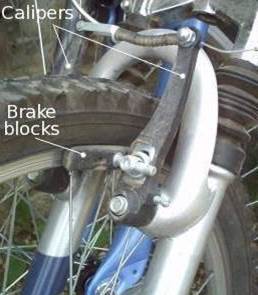
If you ride a bicycle, you know all about brakes. If you want to stop suddenly, you squeeze the brake levers on the handlebars. Thin metal cables running to the back and front wheels pull on small calipers, forcing thick rubber blocks to press against the wheels. As they do so, friction between the blocks and the metal wheel rims generates heat, reducing your kinetic energy, and bringing you safely to a stop.
Although most bicycles still use caliper brakes, some use disc or drum brakes instead (described below).
A closeup of bicycle brake blocks
Motorcycle
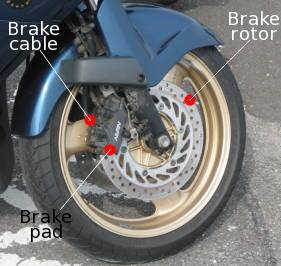
Motorcycles typically have disc brakes comprising a rotor and a brake pad. The rotor is a disc with holes (or slots) in it mounted on the side of the wheel. A brake pad, operated by a hydraulic cable, jams against the rotor to slow it down by friction. The holes in the rotor help to dissipate the heat generated.
Motorcycle brake rotor, brake block, and cable
Steam locomotive
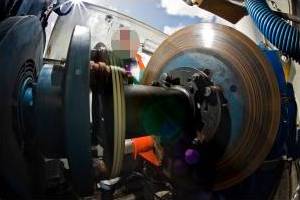
The brakes on a steam locomotive work the same way as a car's and are even more obvious. You can see the brake just behind the wheel in this photo. It clamps against the locomotive's driving wheels to slow them down. Since there are no tires on the wheels, the friction that stops the train comes from the immense weight of the locomotive pressing the metal wheels down onto the track.
A closeup of a steam engine wheel with the brake shoe
Airplane
Airplanes have brakes inside their wheels to help bring them to a stop on the runway, but they can also use air brakes to increase drag (air resistance) and slow themselves down—a bit like parachutes. Jet fighters often have a speed brake, which is a large metal plate just behind the cockpit that can be hydraulically raised to increase drag and braking.
An F-15E Strike Eagle jet fighter airplane raises its aerodynamic speed brake to slow down as it comes into land.
Wind turbine
Wind turbines have brakes to stop their rotors (propellers) turning too quickly. The brake is mounted inside the nacelle (the square-shaped casing behind the propeller that contains the gearbox and generator). Most turbines have an anemometer on them to measure the wind-speed. If it rises above a safe level, the brakes come on automatically and bring the rotors to a standstill. It's a shame, because higher wind speeds mean more energy could be produced. But safety always comes first!
Wind turbine brake
A closer look at car brakes
Most cars have two or three different types of braking systems.
Disc brakes
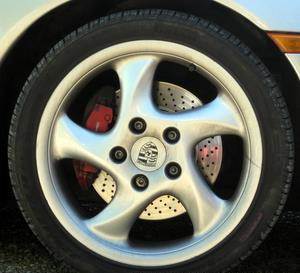
Peer through the hubcap of a car's front wheels and you can usually see a shiny metal disc just inside. This is called a disc brake. When the driver steps on the brake pedal, a pad of hard-wearing material clamps onto the brake disc and rubs it to make it slow down—in a similar way to bicycle brakes.
A closeup of a Porsche sports car front wheel showing the brake disk behind
Drum brakes
Some cars have disc brakes on all four wheels, but many have drum brakes on the back wheels, which work in a slightly different way. Instead of the disc and brake block, they have shoes inside the hollow wheel hub that press outwards. As the shoes push into the wheel, friction slows you down.
Simple animation showing how drum brakes work.
Handbrake
A car's handbrake applies the two rear brakes (disc or drum) in a slower, less forceful way through a lever that's typically located between the front seats. When you pull on the brake, a system of levers tugs on a pair of sturdy cables that apply the brakes to the back wheels. The handbrake system is completely mechanical and, unlike the conventional pedal brakes, doesn't use hydraulic fluid. That means it can be used (with very great care!) as an emergency braking system if the normal brakes fail.

Image result for brake system
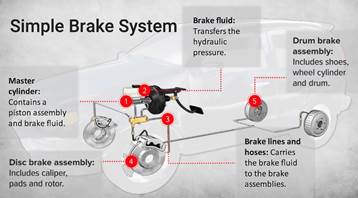
We all know that pushing down on the brake pedal slows a car to a stop. But how does this happen? How does your car transmit the force from your leg to its wheels? How does it multiply the force so that it is enough to stop something as big as a car?
The layout of a typical brake system
When you depress your brake pedal, your car transmits the force from your foot to its brakes through a fluid. Since the actual brakes require a much greater force than you could apply with your leg, your car must also multiply the force of your foot. It does this in two ways:
·         Mechanical advantage (leverage)
·         Hydraulic force multiplication
The brakes transmit the force to the tires using friction, and the tires transmit that force to the road using friction as well.
Before we begin our discussion on the components of the brake system, we'll cover these three principles:
·         Leverage
·         Hydraulics
·         Friction

Leverage and Hydraulics
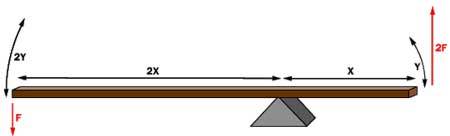
The pedal is designed in such a way that it can multiply the force from your leg several times before any force is even transmitted to the brake fluid.
In the fi­gure above, a force F is being applied to the left end of the lever. The left end of the lever is twice as long (2X) as the right end (X). Therefore, on the right end of the lever a force of 2F is available, but it acts through half of the distance (Y) that the left end moves (2Y). Changing the relative lengths of the left and right ends of the lever changes the multipliers.
The basic idea behind any hydraulic system is very simple: Force applied at one point is transmitted to another point using an incompressible fluid, almost always an oil of some sort. Most brake systems also multiply the force in the process.

Simple hydraulic system

In the figure above, two pistons (shown in red) are fit into two glass cylinders filled with oil (shown in light blue) and connected to one another with an oil-filled pipe. If you apply a downward force to one piston (the left one, in this drawing), then the force is transmitted to the second piston through the oil in the pipe. Since oil is incompressible, the efficiency is very good -- almost all of the applied force appears at the second piston. The great thing about hydraulic systems is that the pipe connecting the two cylinders can be any length and shape, allowing it to snake through all sorts of things separating the two pistons. The pipe can also fork, so that one master cylinder can drive more than one slave cylinder if desired.

Master cylinder with two slaves

The other neat thing about a hydraulic system is that it makes force multiplication (or division) fairly easy. In a hydraulic system, all you have to do is change the size of one piston and cylinder relative to the other.

Hydraulic multiplication

To determine the multiplication factor in the figure above, start by looking at the size of the pistons. Assume that the piston on the left is 2 inches (5.08 cm) in diameter (1-inch / 2.54 cm radius), while the piston on the right is 6 inches (15.24 cm) in diameter (3-inch / 7.62 cm radius). The area of the two pistons is Pi * r2. The area of the left piston is therefore 3.14, while the area of the piston on the right is 28.26. The piston on the right is nine times larger than the piston on the left. This means that any force applied to the left-hand piston will come out nine times greater on the right-hand piston. So, if you apply a 100-pound downward force to the left piston, a 900-pound upward force will appear on the right. The only catch is that you will have to depress the left piston 9 inches (22.86 cm) to raise the right piston 1 inch (2.54 cm).
Friction
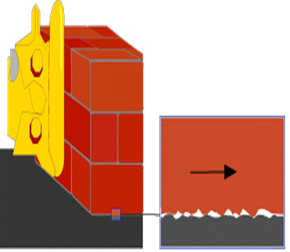
Friction is a measure of how hard it is to slide one object over another. Take a look at the figure below. Both of the blocks are made from the same material, but one is heavier. I think we all know which one will be harder for the bulldozer to push.
To understand why this is, let's take a close look at one of the blocks and the table:

Friction force versus weight

https://cdn.hswstatic.com/gif/brake-friction2.gif
Because friction exists at the microscopic level, the amount of force it takes to move a given block is proportional to that block's weight.
Even though the blocks look smooth to the naked eye, they are actually quite rough at the microscopic level. When you set the block down on the table, the little peaks and valleys get squished together, and some of them may actually weld together. The weight of the heavier block causes it to squish together more, so it is even harder to slide.
Different materials have different microscopic structures; for instance, it is harder to slide rubber against rubber than it is to slide steel against steel. The type of material determines the coefficient of friction, the ratio of the force required to slide the block to the block's weight. If the coefficient were 1.0 in our example, then it would take 100 pounds of force to slide the 100-pound (45 kg) block, or 400 pounds (180 kg) of force to slide the 400-pound block. If the coefficient were 0.1, then it would take 10 pounds of force to slide to the 100-pound block or 40 pounds of force to slide the 400-pound block.
So the amount of force it takes to move a given block is proportional to that block's weight. The more weight, the more force required. This concept applies for devices like brakes and clutches, where a pad is pressed against a spinning disc. The more force that presses on the pad, the greater the stopping force.

Powered by Blogger.