Showing posts with label vehicles. Show all posts


Rocket aerodynamics is the study of how air flows over a rocket and how this affects drag and stability.

The nose cone and fins of a rocket are designed to minimise drag (air resistance) and to provide stability and control (keep it pointing in the right direction without wobbling).

Nose cone and rocket diameter affect drag

The amount of air resistance that opposes a rocket’s motion depends mainly on the shape of the nose cone, the diameter of the rocket and the speed of the rocket.

The first point that meets the air is the nose cone at the front end of the rocket. If the speed of a rocket is less than the speed of sound (1,200 km/h in air at sea level), the best shape of a nose cone is a rounded curve. At supersonic speeds (faster than the speed of sound), the best shape is a narrower and sharper point.

Rockets with a larger diameter have more drag because there is more air being pushed out of the way. Drag depends on the cross-sectional area of the object pushing through the air. Making a rocket as narrow as possible is the best way to reduce drag.

The speed of a rocket through the air similarly increases drag. As speed doubles, drag increases four times as much.

https://youtu.be/oAh4_bDFHls

Fins control direction and stability

The stability of a rocket is its ability to keep flying through the air pointing in the right direction without wobbling or tumbling.

Fins are used on smaller rockets to provide this stability and control direction. It works in the same way as placing feathers at the tail of an arrow. The greater drag on the feathers keeps the tail of the arrow at the back so that the point of the arrow travels straight into the wind.

To understand how to place fins and how large to make them, it is important to understand about centre of mass and centre of pressure.

Centre of mass

The centre of mass of an object is the point at which all of the mass of an object can be thought to be concentrated.

To find the centre of mass of a rigid object such as a water bottle rocket, balance the rocket on your finger so that the rocket is horizontal. The centre of mass is a point directly above your finger.

The centre of mass can be moved closer to the nose cone end of a rocket by adding some mass near the nose cone. This will increase stability.

Centre of pressure

The single point at which all of the aerodynamic forces are concentrated is called the centre of pressure.

To find the approximate position of the centre of pressure, draw an outline of the rocket on a piece of paper. The centre of the area of the outline shape is approximately the centre of pressure.

Centre of pressure

This stable model rocket shows the centre of gravity (cg) (also known as the centre of mass) closer to the front end of the rocket than the centre of pressure (cp).

For a rocket to be stable, the centre of pressure needs to be closer to the tail end than the centre of mass. If the centre of pressure is at the same position as the centre of mass, the rocket will tumble. Stability increases as the distance between the centre of mass and the centre of pressure increases.

https://youtu.be/oAh4_bDFHls

Placing fins at the tail end of a rocket moves the centre of pressure closer towards the tail end and increases stability. However, this also increases drag, so there is an optimal size for fins so that the rocket has enough stability without having too much drag.
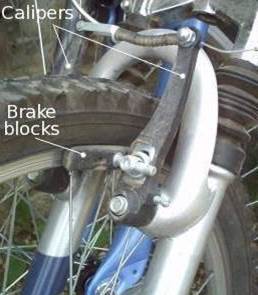
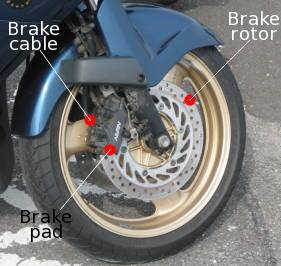
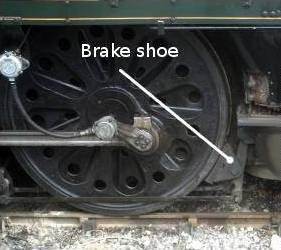
From cars and trucks to planes and trains, brakes work in a similar way on most different vehicles. There are even brakes in wind turbines! Here's a quick comparison of some common brake systems.
Bicycle
If you ride a bicycle, you know all about brakes. If you want to stop suddenly, you squeeze the brake levers on the handlebars. Thin metal cables running to the back and front wheels pull on small calipers, forcing thick rubber blocks to press against the wheels. As they do so, friction between the blocks and the metal wheel rims generates heat, reducing your kinetic energy, and bringing you safely to a stop.
Although most bicycles still use caliper brakes, some use disc or drum brakes instead (described below).
A closeup of bicycle brake blocks
Motorcycle
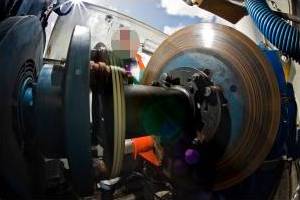
Motorcycles typically have disc brakes comprising a rotor and a brake pad. The rotor is a disc with holes (or slots) in it mounted on the side of the wheel. A brake pad, operated by a hydraulic cable, jams against the rotor to slow it down by friction. The holes in the rotor help to dissipate the heat generated.
Motorcycle brake rotor, brake block, and cable
Steam locomotive
The brakes on a steam locomotive work the same way as a car's and are even more obvious. You can see the brake just behind the wheel in this photo. It clamps against the locomotive's driving wheels to slow them down. Since there are no tires on the wheels, the friction that stops the train comes from the immense weight of the locomotive pressing the metal wheels down onto the track.
A closeup of a steam engine wheel with the brake shoe
Airplane
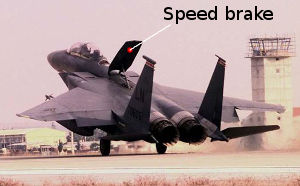
Airplanes have brakes inside their wheels to help bring them to a stop on the runway, but they can also use air brakes to increase drag (air resistance) and slow themselves down—a bit like parachutes. Jet fighters often have a speed brake, which is a large metal plate just behind the cockpit that can be hydraulically raised to increase drag and braking.
An F-15E Strike Eagle jet fighter airplane raises its aerodynamic speed brake to slow down as it comes into land.
Wind turbine
Wind turbines have brakes to stop their rotors (propellers) turning too quickly. The brake is mounted inside the nacelle (the square-shaped casing behind the propeller that contains the gearbox and generator). Most turbines have an anemometer on them to measure the wind-speed. If it rises above a safe level, the brakes come on automatically and bring the rotors to a standstill. It's a shame, because higher wind speeds mean more energy could be produced. But safety always comes first!
Wind turbine brake
A closer look at car brakes
Most cars have two or three different types of braking systems.
Disc brakes
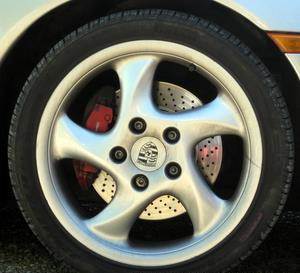
Peer through the hubcap of a car's front wheels and you can usually see a shiny metal disc just inside. This is called a disc brake. When the driver steps on the brake pedal, a pad of hard-wearing material clamps onto the brake disc and rubs it to make it slow down—in a similar way to bicycle brakes.
A closeup of a Porsche sports car front wheel showing the brake disk behind
Drum brakes
Some cars have disc brakes on all four wheels, but many have drum brakes on the back wheels, which work in a slightly different way. Instead of the disc and brake block, they have shoes inside the hollow wheel hub that press outwards. As the shoes push into the wheel, friction slows you down.
Simple animation showing how drum brakes work.
Handbrake
A car's handbrake applies the two rear brakes (disc or drum) in a slower, less forceful way through a lever that's typically located between the front seats. When you pull on the brake, a system of levers tugs on a pair of sturdy cables that apply the brakes to the back wheels. The handbrake system is completely mechanical and, unlike the conventional pedal brakes, doesn't use hydraulic fluid. That means it can be used (with very great care!) as an emergency braking system if the normal brakes fail.

Powered by Blogger.