
HOW DOES THE RO WATER PURIFIER WORK?

If you’ve ever taken a sip from a glass of water that came from the home of someone with a reverse osmosis system, you know how pure and refreshing it tastes.
Or, perhaps you have concerns about water quality and want to make sure your family is drinking healthy water that reduces contaminants as much as possible.
Reverse osmosis (R.O.) drinking water truly is the purest choice for any home. It’s water the way nature intended us to drink it.
But how exactly do these systems work, and what do they do to your home’s water?
What is Reverse Osmosis?

Osmosis is defined as the process of molecules passing through a semi-permeable membrane from a less-concentrated solution into a more-concentrated solution.
An example or osmosis from nature is the roots of plants drawing water from the soil.
Reverse osmosis is simply the opposite of that process.
The Reverse Osmosis Process

Molecules are forced through a semi-permeable membrane to form a less concentrated solution. Essentially, the membrane acts like a type of filter as it has extremely tiny pores that help remove microscopic contaminants from the water you drink by straining them out.
In the case of reverse osmosis drinking water systems, the semi-permeable membrane only lets water molecules through while other contaminants are collected and flushed away.
How Reverse Osmosis Filtration Works
There’s a bit more to the process when using a reverse osmosis system to purify drinking water.
If you’ve ever seen an R.O. system, you’ve likely noticed the three cylindrical canisters on a manifold. One of these is the membrane and the other two are carbon filters. Let’s take a closer look at what each of these cartridges do.

Step 1: Pre-filtration
The first step in purifying water with reverse osmosis is meant to protect the membrane. It removes larger sediment, including some dissolved solids, and helps reduce chlorine.
This first cartridge is referred to as the sediment filter or carbon block filter. It helps conserve the membrane, which can get clogged by excess sediment or damaged by exposure to too much chlorine, which you’ll find in municipal water.
Reverse osmosis works best when you start with good water and then make it great. That’s why you should never use a reverse osmosis system with hard water unless it is under 10 grains per gallon.
Step 2: The Reverse Osmosis Membrane
Following the initial filtration comes the real magic of an R.O. system.
Your water is forced through the semi-permeable membrane under pressure. The membrane is a synthetic plastic material that allows the passage of water molecules. However, sodium, chlorine, and calcium as well as larger molecules like glucose, urea, bacteria and viruses cannot pass.
Following Substances can be removed from the Water Completely;
- lead
- arsenic
- copper
- nitrates and nitrites
- chromium (hexavalent & trivalent)
- selenium
- fluoride
- radium
- barium
- cadmium
- cyst (cryptosporidium)
- total dissolved solids (TDS)Steps 3 & 4: Post Filtration and Final PolishBefore your home’s water is ready to drink, it goes through a second carbon filter (or post filter), which removes any remaining contaminants in the unlikely case they slipped past the membrane.Then the water fills up a storage tank where it waits until you’re ready to use it.Finally, there’s the in-line activated carbon filter, which gives your water one last polish as it comes out your faucet. This is used to remove any remaining odors or flavors that may come from the system hoses or the holding tank.The polish is a “just in case” step to make sure the water you drink tastes incredibly fresh!Is Reverse Osmosis Drinking Water Right for Your Home?Soft water is excellent for cleaning, showering, and laundry. However, some people would rather not drink it. Depending on how hard your water is to start with, it could still have high total dissolved solids (TDS), which can negatively affect the taste. That’s because the hard minerals are replaced by sodium, and there may be other contaminants in your water that a softener will not remove.A reverse osmosis system can remove that sodium along with other contaminants and dissolved solids, which makes a water softener and an R.O. system an ideal combination for most homes.When you install a reverse osmosis system, you’ll enjoy better-tasting coffee and tea, clearer ice cubes, and pure, healthy water right from your kitchen sink. If you’re still using bottled water for drinking, you’ll be making a smart investment that saves you money in the long run and is better for the environment.
List of Sensors Found in Your Smartphones

Smartphones today come with a wealth of sensors to facilitate a better user experience, provide apps with enhanced information about the world around the phone and provide robust and increased battery life.
Proximity Sensor

Detects when an object is near to the phone. Most commonly used to sense when a phone is held up to the users ear to turn off the display. This saves both battery life and prevents accidental screen touches.
Accelerometer and gyroscope

Accelerometers in mobile phones are used to detect the orientation of the phone. The gyroscope, or gyro for short, adds an additional dimension to the information supplied by the accelerometer by tracking rotation or twist.
An accelerometer measures linear acceleration of movement, while a gyro on the other hand measures the angular rotational velocity. Both sensors measure rate of change; they just measure the rate of change for different things.

In practice, that means that an accelerometer will measure the directional movement of a device but will not be able to resolve its lateral orientation or tilt during that movement accurately unless a gyro is there to fill in that info.
With an accelerometer you can either get a really “noisy” info output that is responsive, or you can get a “clean” output that’s sluggish. But when you combine the 3-axis accelerometer with a 3-axis gyro, you get an output that is both clean and responsive in the same time.”
Accelerometers are also used to provide ‘steps’ information for a vendors ‘health’ application.
Digital compass

The digital compass that’s usually based on a sensor called the magnetometer and provides mobile phones with a simple orientation in relation to the Earth’s magnetic field. As a result, your phone always knows which way is North so it can auto rotate your digital maps depending on your physical orientation.
GPS

Global Positioning System (GPS) units in smartphone communicate with the satellites to determine our precise location on Earth. The GPS technology doesn’t actually use internet data this is why we can find our location on maps even after losing the signals, but the map itself is blurry as it requires internet to load the details — this is how offline map works. GPS is used in all location-based apps like Uber and Google Maps.
The accelerometer, gyroscope, magnetometer, and GPS work together to create the perfect navigation system in your smartphone.
Ambient Light Sensor
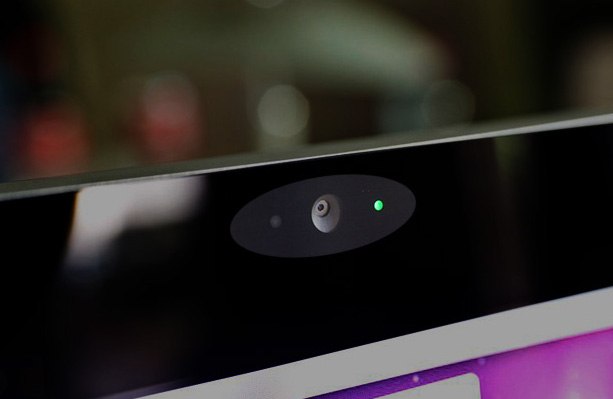
The light sensor detects the lighting levels in the vicinity to adjust the display brightness accordingly. It is used in Automatic Brightness Adjuster to decrease or increase the brightness of the smartphone screen based on the availability of light.
Microphone
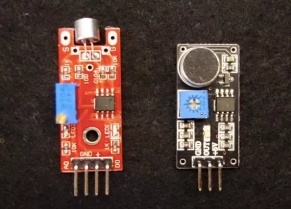
The microphone is basically a sound sensor that detects and measures the loudness of sound. While there are different types of microphone sensors available, smartphones generally use micro-sized electret microphones.
Apart from making and receiving calls, it is used for voice search and voice commands for digital assistant apps like Google Assistant, Siri, Cortana, etc.
Touchscreen Sensors
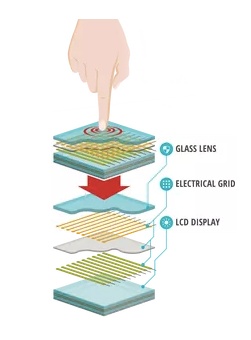
The smartphone sensors in a touchscreen have an electrical current passing through them at all times and touching the screen causes a change in the signals. This change acts as input for the device. Before Apple introduced the capacitive touchscreen, resistive screens were used in the display. But nowadays, the capacitive screen is used in almost all smartphones.
Fingerprint Sensor

Gone are the days of memorizing passwords and patterns to unlock your phone as many users prefer using the fingerprint scanner these days. Fingerprint sensor enables biometric verification to secure many smartphones today. It is a capacitive scanner that records your fingerprint electrically.
When you put your finger on its surface, the ridges in your fingerprints touch the surface whereas the hollows between the ridges have a slight separation. In short, it measures the varying distances and pattern between the ridges on the surface of your finger. This smartphone sensor is quite useful in apps that require authentication such as mobile payment apps.
Pedometer
The pedometer is used for counting steps, and fitness tracker makes use of this sensor to count the number of steps you take. Pedometers generally use the values generated by the accelerometer to monitor your movements like running or walking.
Barcode/QR Code sensors
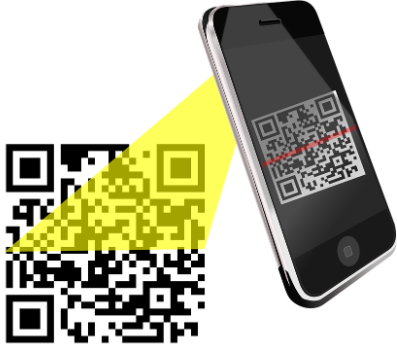
Most of the smartphones have barcode sensors that can read a barcode by detecting the reflected light from the code. It generates an analog signal with varying voltage that represents the barcode. This analog signal is then converted to a digital one and finally decoded to reveal the information in it. Barcode sensors are useful in scanning the barcodes products or QR codes.
Barometer
There are many high-end Android phones like Pixel and iPhones that include a barometer in their hardware. The barometer measures the air pressure, so it is quite useful in detecting weather changes and in calculating the altitude you’re at.
Heart Rate Sensor

Next up is the heart rate sensor that measures heartbeat with the help of LED and optical sensors. The LED emits light towards the skin, and this smartphone sensor looks for the light waves reflected by it.
There is a difference in the light intensity when there is a pulse. The heartbeat is measured by counting the changes in light intensity between the minute pulsations of the blood vessels. Many fitness and health apps use this method to calculate the heart rate.
Thermometer
Every smartphone comes with an inbuilt thermometer for monitoring the temperature inside the device and battery. In case a component starts overheating, the system shuts down itself to prevent any damage.
However, some handsets come with additional thermometers to measure ambient temperature. If you can recall, the Samsung Galaxy S4 bragged of thermometer that can measure temperature. Such thermometer sensors can be used by apps to detect your room temperature.
Air Humidity Sensor
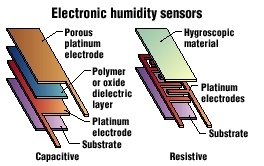
Now that we are talking about Galaxy S4 let’s discuss the Air Humidity sensor as well. S4 was the first smartphone to incorporate an air humidity sensor. It could measure the humidity in the air, and the data collected by it would tell the user whether the given air temperature and humidity are optimum or not. But again, this type of sensor is used by selected handsets only.
Geiger Counter
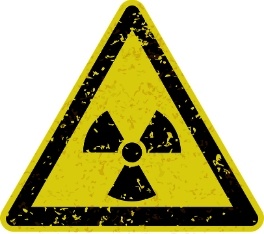
Now, this is one smartphone sensor that you should not expect to find in common devices. In fact, there is only one phone that supports it – the Sharp Pantone 5. This handset has been released in Japan only. The Geiger Counter in it can measure the current radiation level in the area.
Final Words
There is so much of technology packed into our phones that we often take them for granted. But these are some of the most important smartphone sensors that you should know of. Given that smartphones are getting smarter day by day and sensors play a major role in it, this list is will definitely grow longer and I will keep adding more to it. In case there is a smartphone sensor I forgot to mention in this article, do let us know in the comment section below!
What is Centripetal Force?

Centripetal force is defined as,
The component of force acting on an object in curvilinear motion which is directed toward the axis of rotation or center of curvature.
The unit of centripetal force is Newton. The centripetal force is always directed perpendicular to the direction of the displacement of the object.
If an object accelerates according to the changes of velocity, then it can change either its speed or direction of motion. In simple terms, if any moving object in a circular path is constantly changing its direction means it is constantly accelerating. Using Newton’s second law of motion, if an object is travelling in a circular path, it is found that the centripetal force of an object moving in a circular path always acts towards the centre of the circle.
How is the Centripetal Force Calculated?
The Centripetal Force Formula is given as the product of mass (in kg) and tangential velocity (in meters per second) squared, divided by the radius (in meters). Which implies that on doubling the tangential velocity, the centripetal force will be quadrupled. Mathematically it is written as:

Where,
- F is the Centripetal force.
- ac is the Centripetal acceleration.
- m is the mass of the object.
- v is the speed or velocity of the object.
- r is the radius.
Centripetal Force Examples
The force that pulls or pushes an object toward the centre of a circle as it travels, causing angular or circular motion is called a Centripetal Force. Some examples of Centripetal Force is given below.

A few examples of Centripetal Force
- Spinning a ball on a string or twirling a lasso: Here the centripetal force is provided by the force of tension on the rope pulls the object in toward the centre.
- Turning a car: Here the centripetal force is provided by the frictional force between the ground and the wheels.
- Going through a loop on a roller coaster: The force is provided by the Normal Force as the seat or wall pushes you toward the centre.
- Planets orbiting around the Sun: Centripetal Force is provided by Gravity.
What is Energy? and Types of energy:

What is Energy?
Energy is the ability to do work. It is what makes matter move or change.
Energy helps you walk across the street, throw a ball into the air, vacuum your house, watch television and ride the bus to school. Some of the above are possible because we have figured out how to convert energy from one form into another and use it to do our work.

Types of energy
There are many types of energy, but they can be categorized into 2 types:
- Potential energy
- Kinetic energy
Potential Energy has 4 forms:
- Chemical energy – the energy stored in the bonds between atoms that holds molecules together
- Nuclear energy – the energy stored in the nucleus of the atom that holds the nucleus together
- Gravitational energy – the energy an object has because of its position or height
- Elastic energy – or stored mechanical energy, is energy stored in an object by the application of force
Kinetic Energy has 5 forms:
- Mechanical energy – or motion, is the movement of objects or substances from one place to another
- Electrical energy – the energy from flow of electric charge (movement of electrons in one direction)
- Thermal energy – or heat energy, the internal energy of a substance due to the vibration of atoms and molecules making up the substance
- Radiant energy – or light energy, or electromagnetic energy that travels in transverse waves
- Sound energy – the movement of energy through substances in the form of compression waves
What Is Quantum Mechanics?
Quantum mechanics is the branch of physics relating to the very small.
It results in what may appear to be some very strange conclusions about the physical world. At the scale of atoms and electrons, many of the equations of classical mechanics, which describe how things move at everyday sizes and speeds, cease to be useful. In classical mechanics, objects exist in a specific place at a specific time. However, in quantum mechanics, objects instead exist in a haze of probability; they have a certain chance of being at point A, another chance of being at point B and so on.

Three revolutionary principles
Quantum mechanics (QM) developed over many decades, beginning as a set of controversial mathematical explanations of experiments that the math of classical mechanics could not explain. It began at the turn of the 20th century, around the same time that Albert Einstein published his theory of relativity, a separate mathematical revolution in physics that describes the motion of things at high speeds. Unlike relativity, however, the origins of QM cannot be attributed to any one scientist. Rather, multiple scientists contributed to a foundation of three revolutionary principles that gradually gained acceptance and experimental verification between 1900 and 1930. They are:
Quantized properties: Certain properties, such as position, speed and color, can sometimes only occur in specific, set amounts, much like a dial that "clicks" from number to number. This challenged a fundamental assumption of classical mechanics, which said that such properties should exist on a smooth, continuous spectrum. To describe the idea that some properties "clicked" like a dial with specific settings, scientists coined the word "quantized."
Particles of light: Light can sometimes behave as a particle. This was initially met with harsh criticism, as it ran contrary to 200 years of experiments showing that light behaved as a wave; much like ripples on the surface of a calm lake. Light behaves similarly in that it bounces off walls and bends around corners, and that the crests and troughs of the wave can add up or cancel out. Added wave crests result in brighter light, while waves that cancel out produce darkness. A light source can be thought of as a ball on a stick being rhythmically dipped in the center of a lake. The color emitted corresponds to the distance between the crests, which is determined by the speed of the ball's rhythm.
Waves of matter: Matter can also behave as a wave. This ran counter to the roughly 30 years of experiments showing that matter (such as electrons) exists as particles.
Factors affecting Properties of a Material:

Heat treatment:
Heat treatment is used to control heating and cooling of the metals to change the properties and also to improve the performance or to enable processing.

For example:
Heat treatment is the method of hardening of a piece of hydrocarbon steel rod. After heating the rod when it turns to red heat, and later rushed into the cold water it undergoes the process rapidly. Later, it becomes hard and brittle. The material is again heated to dull red, but it allows the rod to cold very slowly, which then becomes very softer and less brittle. This process is known as the annealed. After the heat treatment done to the material, it is considered to be in its best condition for flow forming process. During the time of flow forming the grains are deformed, which results in most metals flattering work hardened if flow formed at room temperature. This is to remove the stress from the forming operations and prepare the material for machining process, and then material is made to normalize.
Processing:
Hot and cold working process is applied to the metals. The shape of the metal is obtained based upon the cold working process or hot working process. The temperature is not easy to explain. Hot works are done at the room temperatures and can be compressed into difficult shapes. The steel is not made to do hot work until it is red hot. When the metal is tested under the microscope then it contains very small grains. When the metals are worked or bend at the room temperature, at that instance the grains deform, later the metal becomes very hard and brittle. Hot process is applied to the metals at that instance crystals are also distorted. They reform is done instantly into the standard crystals, because the developed temperature is directly above the temperature of recrystallization for the metal being used. The cold working process is the flow forming of metals below the temperature where the recrystallization, on the other hand the hot working process is the flow forming metals above the temperature of recrystallization.
Environmental reactions:
The properties of the materials can also be affected by reaction with surroundings in which they are used.
Some examples are:
Resting of steel
Dezincification
Degradation of plastic
General properties of engineering materials:
Properties of materials play a key role. The properties are classified into several types they are:
Physical properties of materials:
The physical properties of the materials deals with some of the properties like temperature, melting, electrical conductivity, density, thermal conductivity, magnetic properties, corrosion resistance etc.
In the following properties some of them are considered to be more important, they are:
Density:
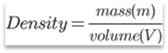
- For material density is known as mass per unit volume.
- At
 the density of the material compared with the density of water is known as relative density.
and
Electrical Conductivity:
Copper wire must be selected for the electrode or core of the cable; this is because the Copper acts as a very good electrical conductivity. The wire conductor material is provided by the insulation, for which a plastic material like polymerized has been chosen. This material has been select as it is a bad conductor of electricity; very few electrons can pass through it. Insulators are very bad conductors of electricity. When pure metals compare with alloys they are stronger. At room temperatures the pure metals have better conductivity than alloys. The temperature fall is improved with the conductivity of metals and metal alloys. Equally non – metallic materials used for insulators, as they offer a lower resistance to pass the electrons, and become poor insulators, as the temperature rises. For example glass is an excellent insulator.
Melting temperature of material:
The recrystallization temperature and melting temperature have a great effect on the materials and the properties of the alloy material.
Semi-Conductors:
Semi-conductor materials lie between the conductors and isolators materials. Depending upon the temperature, Semi-conductors are classified as good conductors are bad conductors. If there is increase in the temperature in small level, then one can observe the rapidly increase of conductivity of semiconductor materials. The electronic thermometer and the semi-conductors are used as temperature sensors. Semi-conductors have the capabilities, for which during the process of manufacturing the conductor’s properties are to be changed. Silicon and germanium are the examples of semi – conductors. In electronic industry, the conductors are extensively used in the manufacturing of solid devices such as integrated circuits, transistors, diodes and thermistors.
Thermal conductivity:
Thermal conductivity is the ability of the material to transmit heat energy by conduction.
For example tie up a soldering rod to the tip, which is attached to a wooden base.

The tip is made up of copper, as it is a good conductor of heat. It allows storing the heat energy and easily moves down to the tip, and to the work piece being soldered. Due to the low thermal conductivity the wooden handle remains cool and resists the flow of the heat energy.
Fusibility:
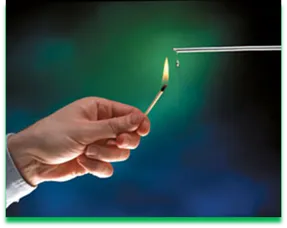
By applying the fusibility the metals are melted. In the figure it shows that by applying the heat the metals are melted automatically, and it has high fusibility. The materials that melt at high temperature are called as refractory materials. Polystyrene must acts as a thermal insulator and they considered to have low melting point.
Reluctance:
Some materials are good or bad conductors of electricity, and some materials are good or bad conductors of magnetism. The resistance offered by the magnetic circuit is known as the reluctance. The conductors which have good magnetic nature are low reluctance. Ferromagnetic materials are made up of steel and iron, which are also associated with the alloying elements like nickel and cobalt. The remaining materials are non – magnetic, as they offer a high reluctance to the magnetic flux field.
Temperature Stability:
Temperature change scan results in a high amount and it shows the effects on the structure and the properties of the material. If there is a change in the temperature then several can take place such as creep. Creep is defined as the gradual extension of a material over a long period of time while the applied load is kept constant. When we consider the plastic materials creep, which is an important factor, and they are considered when the metals works continuously at high temperatures. In gas turbine blades if the creep rate increases then automatically the temperature is to be increased and is vice versa as the temperature lowers.
Subscribe to:
Posts (Atom)