The Grashof number is a dimensionless number, named after  Franz Grashof. The Grashof number is defined as the ratio of the buoyant to viscous force acting on a fluid in the velocity boundary layer. Its role in natural convection is much the same as that of the Reynolds number in forced convection.

Natural convection is used if this motion and mixing is caused by density variations resulting from temperature differences within the fluid. Usually the density decreases due to an increase in temperature and causes the fluid to rise. This motion is caused by the buoyant force. The major force that resists the motion is the viscous force. The Grashof number is a way to quantify the opposing forces.
The Grashof number is defined as:

where:
g is acceleration due to Earth’s gravity
β is the coefficient of thermal expansion
Twall is the wall temperature
T is the bulk temperature
L is the vertical length
ν is the kinematic viscosity.
For gases β = 1/T where the temperature is in K. For liquids β can be calculated if variation of density with temperature at constant pressure is known. For a vertical flat plate, the flow turns turbulent for value of Gr.Pr > 109. As in forced convection the microspic nature of flow and convection correlations are distinctly different in the laminar and turbulent regions.
The Grashof number is closely related to Rayleigh number, which is defined as the product of the Grashof number, which describes the relationship between buoyancy and viscosity within a fluid, and the Prandtl number, which describes the relationship between momentum diffusivity and thermal diffusivity.

Example: Grashof Number

A vertical plate is maintained at 50°C in 20°C air. Determine the height at which the boundary layer will turn turbulent if turbulence sets in at Gr.Pr = 109.
Solution:
The property values required for this example are:
ν = 1.48 x 10⁻⁵ m2/s
ρ = 1.17 kg/m3
Pr = 0.700
β = 1/ (273 + 20) = 1/293
We know the natural circulation becomes turbulent at Gr.Pr > 109, which is fulfilled at the following height:


A VPN, or Virtual Private Network, allows you to create a secure connection to another network over the Internet. VPNs can be used to access region-restricted websites, shield your browsing activity from prying eyes on public Wi-Fi, and more.

These days VPNs are really popular, but not for the reasons they were originally created. They originally were just a way to connect business networks together securely over the internet or allow you to access a business network from home.
VPNs essentially forward all your network traffic to the network, which is where the benefits – like accessing local network resources remotely and bypassing Internet censorship – all come from. Most operating systems have integrated VPN support.
What Is a VPN and How Does It Help Me?
In very simple terms, a VPN connects your PC, smartphone, or tablet to another computer (called a server) somewhere on the internet, and allows you to browse the internet using that computer’s internet connection. So if that server is in a different country, it will appear as if you are coming from that country, and you can potentially access things that you couldn’t normally.
So how does this help you? Good question! You can use a VPN to:
·         Bypass geographic restrictions on websites or streaming audio and video.
·         Watch streaming media like Netflix and Hulu.
·         Protect yourself from snooping on untrustworthy Wi-Fi hotspots.
·         Gain at least some anonymity online by hiding your true location.
·         Protect yourself from being logged while torrenting.
Many people these days are using a VPN for torrenting or bypassing geographic restrictions to watch content in a different country. They are still very useful for protecting yourself while working at a coffee shop, but that’s hardly the only use anymore.
How Does a VPN Work?

When you connect your computer (or another device, such as a smartphone or tablet) to a VPN, the computer acts as if it’s on the same local network as the VPN. All your network traffic is sent over a secure connection to the VPN. Because your computer behaves as if it’s on the network, this allows you to securely access local network resources even when you’re on the other side of the world. You’ll also be able to use the Internet as if you were present at the VPN’s location, which has some benefits if you’re using pubic Wi-Fi or want to access geo-blocked websites.
When you browse the web while connected to a VPN, your computer contacts the website through the encrypted VPN connection. The VPN forwards the request for you and forwards the response from the website back through the secure connection. If you’re using a USA-based VPN to access Netflix, Netflix will see your connection as coming from within the USA.
Other Example Uses for VPNs
VPNs are a fairly simple tool, but they can be used to do a wide variety of things:
·         Access a Business Network While Traveling: VPNs are frequently used by business travelers to access their business’ network, including all its local network resources, while on the road. The local resources don’t have to be exposed directly to the Internet, which increases security.
·         Access Your Home Network While Travelling: You can also set up your own VPN to access your own network while travelling. This will allow you to access a Windows Remote Desktop over the Internet, use local file shares, and play games over the Internet as if you were on the same LAN (local area network).
·         Hide Your Browsing Activity From Your Local Network and ISP: If you’re using a public Wi-Fi connection, your browsing activity on non-HTTPS websites is visible to everyone neraby, if they know how to look. If you want to hide your browsing activity for a bit more privacy, you can connect to a VPN. The local network will only see a single, secure VPN connection. All the other traffic will travel over the VPN connection. While this can be used to bypass connection-monitoring by your Internet service provider, bear in mind that VPN providers may opt to log the traffic on their ends.
·         Access Geo-Blocked Websites: Whether you’re an American trying to access your Netflix account while travelling out of the country or you wish you could use American media sites like Netflix, Pandora, and Hulu, you’ll be able to access these region-restricted services if you connect to a VPN located in the USA.
·         Bypass Internet Censorship: Many Chinese people use VPNs to get around the Great Firewall of China and gain access to the entire Internet. (However, the Great Firewall has apparently started interfering with VPNs recently.)
·         Downloading Files: Yes, let’s be honest – many people use VPN connections to download files via BitTorrent. This can actually be useful even if you’re downloading completely legal torrents – if your ISP is throttling BitTorrent and making it extremely slow, you can use BitTorrent on a VPN to get faster speeds. The same is true for other types of traffic your ISP might interfere with (unless they interfere with VPN traffic itself.)


How Do You Get a VPN, and Which One Should You Choose?
Depending on your needs, you can either use a VPN from your workplace, create a VPN server yourself, or sometimes host one out of your house — but realistically the vast majority of people are just looking for something to protect them while torrenting or help them watch some media online that they can’t seem to access from their country.
The easiest thing to do is simply head to one of these sites, sign up, and download the VPN client for your Windows PC, Mac, Android, iPhone, or iPad. It’s as easy as that.
·         ExpressVPN – This VPN server has the best combination of ease-of-use, really fast servers, and supports streaming media and torrenting, all for a cheap price.
·         Tunnelbear – This VPN is really easy to use, is great for using at the coffee shop, and has a (limited) free tier. It’s not good for torrenting or streaming media though.
·         StrongVPN – not quite as easy to use as the others, but you can definitely use them for torrenting and streaming media.
All of them have free trials, so you can easily get your money back if you change your mind.

Pig iron is the crude form of iron and is used as a raw material for the production of various other ferrous metals, such as cast iron, wrought iron and steel. The pig iron is obtained by smelting iron ores in a blast furnace.

The iron ores are found in various forms as shown below:
The metallic contents of these iron ores are given in the following table:
The haematite is widely used for the production of pig iron. Since pyrite contains only 30 to 40% iron, therefore it is not used for manufacturing pig iron.
The pig iron is obtained from the iron ores in the following steps:
1. Concentration. It is the process of removing the impurities like clay, sand etc. from the iron ore by washing with water.
2. Calcination or roasting. It is the process of expelling moisture, carbon dioxide, sulphur and arsenic from the iron ore by heating in shallow kilns.
3. Smelting. It is process of reducing the ore with carbon in the presence of a flux. The smelting is carried out in a large tower called blast furnace.
The blast furnace is a chimney like structure made of heavy steel plates lined inside with fire bricks to a thickness of 1.2 to 1.5 metres. It is about 30 metres high with a maximum internal diameter of 9 meters as its widest cross-section. The portion of the furnace above its widest cross-section is called stack. The top most portion of the stack is called throat through which the charge is fed into the furnace. The charge of the blast furnace consists of calcined ore (8 parts), coke (4 parts) and lime stone (1 part). The portion of the furnace, below its widest cross-section is known as bosh or the burning zone (or zone of fusion). The bosh is provided with holes for a number of water jacketed iron blowing pipes known as tuyers. The tuyers are 12 to 15 in number and are connected to bustle pipe surrounding the furnace.

In the lower part of the blast furnace (called zone of fusion), the temperature is 1200° C to 1300° C. In the middle part of the blast furnace (called zone of absorption), the temperature is 800° C to 1000°C. In the upper part of the blast furnace (called zone of reduction), the temperature is 400° C to 700° C.

At the bottom of the blast furnace, the molten iron sinks down while above this floats the fusible stage which protects the molten iron from oxidation. The molten iron thus produced is known as pig iron. The slag from the blast furnace consists of calcium, aluminum and ferrous silicates. It is used as a ballast for rail roads, mixed with tar for road making and in the cement manufacture.

The pig iron from the blast furnace contains 90 to 92% of iron. The various other elements present in pig iron are carbon (1 to 5%), silicon ( 1 to 2%), manganese (1 to 2%), sulphur and phosphorus (1 to 2%).

Note : Carbon plays an important role in iron. It exists in iron in two forms i.e. either in a free form (as graphite) or in a combined form (as cementite and pearlite). The presence of free carbon in iron imparts softness and a coarse crystalline structure to the metal, while the combined carbon makes the metal hard and gives a fine grained crystalline structure.


Thermal imaging is a technology that operates by capturing the upper portion of the infrared light spectrum, which is emitted as heat by objects instead of simply reflected as light. Hotter objects, such as warm bodies, emit more of this light than cooler objects like trees or buildings.


 Thermal imaging working principle :
  1. A special lens focuses the infrared light emitted by all of the objects in view.
  2. The focused light is scanned by a phased array of infrared-detector elements. The detector elements create a very detailed temperature pattern called a thermogram. It only takes about one-thirtieth of a second for the detector array to obtain the temperature information to make the thermogram. This information is obtained from several thousand points in the field of view of the detector array.
  3. The thermogram created by the detector elements is translated into electric impulses.
  4. The impulses are sent to a signal-processing unit, a circuit board with a dedicated chip that translates the information from the elements into data for the display.
  5. The signal-processing unit sends the information to the display, where it appears as various colors depending on the intensity of the infrared emission. The combination of all the impulses from all of the elements creates the image.

Types of Thermal Imaging Devices


Most thermal-imaging devices scan at a rate of 30 times per second. They can sense temperatures ranging from -4 degrees Fahrenheit (-20 degrees Celsius) to 3,600 F (2,000 C), and can normally detect changes in temperature of about 0.4 F (0.2 C).
There are two common types of thermal-imaging devices:
  • Un-cooled - This is the most common type of thermal-imaging device. The infrared-detector elements are contained in a unit that operates at room temperature. This type of system is completely quiet, activates immediately and has the battery built right in.
  • Cryogenically cooled - More expensive and more susceptible to damage from rugged use, these systems have the elements sealed inside a container that cools them to below 32 F (zero C). The advantage of such a system is the incredible resolution and sensitivity that result from cooling the elements. Cryogenically-cooled systems can "see" a difference as small as 0.2 F (0.1 C) from more than 1,000 ft (300 m) away, which is enough to tell if a person is holding a gun at that distance!

 Q1) Which of the suggested answers best matches the relationship between the shapes in the image? 
A, B, C, D 


Answer: 
The arrow changes direction and the shape on the right has 1 more side than its counterpart on the left. 
Correct Answer; D 


Q2) Which shape is the odd one out? 
A, B, C, D 


Answer 
This question is asking you to identify a rule that applies to all but one shape. Things to consider include what shapes are present, how many shapes are present, relative position, colour. In this example, there are 2 consistent rules the largest shape is consistently the same colour and the shape closest to the bottom of each square is orange. There is only one square that the latter rule doesn’t apply to. 
Correct Answer; C 

Q3) Which domino comes next in the sequence? 
A, B, C, D 

 
Answer 
This question is a bit trickier, as it is asking you to notice that there are two patterns appearing at the same time with alternating dominos. If you consider the 1st, 3rd and 5th dominos the pattern becomes more obvious; the top number is decreasing by 1 and the bottom is increasing by 1. Now look at the 2nd and 4th dominos, there is a similar progression happening with increasing and decreasing dots. 
Correct Answer; A


What are LEDs?


LEDs are a type of semiconductor called "Light Emitting Diode". White LEDs, which have achieved practical realization through the use of high-brightness blue LEDs developed in 1993 based on Gallium Nitride, are attracting increased attention as a 4th type of light source.


How do LEDs Emit Light?

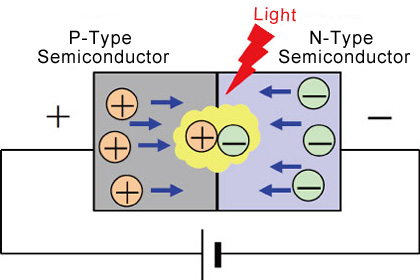
LEDs (Light Emitting Diodes) are semiconductor light sources that combine a P-type semiconductor (larger hole concentration) with an N-type semiconductor (larger electron concentration). Applying a sufficient forward voltage will cause the electrons and holes to recombine at the P-N junction, releasing energy in the form of light.


Compared with conventional light sources that first convert electrical energy into heat, and then into light, LEDs (Light Emitting Diodes) convert electrical energy directly into light, delivering efficient light generation with little-wasted electricity.


Types of LEDs

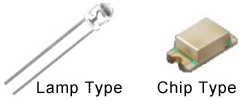
Two types of LEDs are available, a lamp type (leaded) and a chip type (surface mount). Users can select the ideal type based on set requirements.


Wavelength and Color

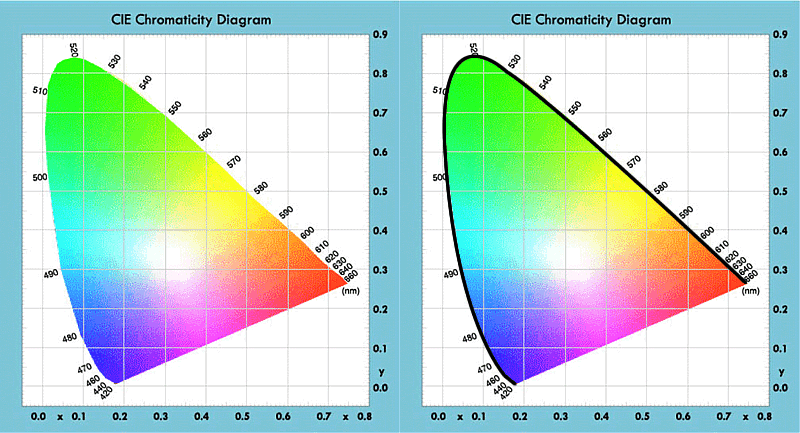
The LED color (emission wavelength) will change depending on materials used. This makes it possible to customize the color to meet certain wavelength specifications required for applications that use traditional bulbs as light sources (for which standards exist), such as traffic lights and automotive lamps.


Two specifications for wavelength are used to indicate color: λP (Peak Wavelength) and λD (Dominant Wavelength), with λD corresponding to the color actually seen by the human eye.


Different wavelengths involved in the process determine the different colors produced from the LEDs. Hence, light emitted by the device depends on the type of semiconductor material used.
Infrared light is produced by using Gallium Arsenide (GaAs) as a semiconductor. Red or yellow light is produced by using Gallium-Arsenide-Phosphorus (GaAsP) as a semiconductor. Red or green light is produced by using Gallium-Phosphorus (GaP) as a semiconductor.

Einstein's mass-energy equivalence (1905):

E = mc2, equation in German-born physicist Albert Einstein’s theory of special relativity that expresses the fact that mass and energy are the same physical entity and can be changed into each other. In the equation, the increased relativistic mass (m) of a body times the speed of light squared (c2) is equal to the kinetic energy (E) of that body.

What does it say?
Energy equals mass multiplied by the speed of light squared.
In other words ...
Mass is really just a super-condensed form of energy.
What did it teach us?
Because of the size of the constant in the equation (the speed of light squared, an unimaginably huge number) a colossal amount of energy can be released through converting a tiny amount of mass.
But was it practical?
Einstein's most famous equation hinted at the potential for the huge amounts of energy released in nuclear fission, when a large unstable nucleus breaks into two smaller ones. This is because the mass of the two smaller nuclei together is always less than the mass of the original big nucleus – and the missing mass is converted into energy.
The "Fat Man" atomic bomb dropped over Nagasaki in Japan on 9 August 1945 converted just one gram of mass to energy, but produced an explosion the equivalent around 20,000 tonnes of TNT.
Einstein himself had signed a letter to US president at the time Franklin Roosevelt recommending the atom bomb be developed – a decision he later regarded as the “one great mistake” of his life.


Earth's atmosphere has a series of layers, each with its own specific traits. Moving upward from ground level, these layers are named the troposphere, stratosphere, mesosphere, thermosphere and exosphere. The exosphere gradually fades away into the realm of interplanetary space.

Troposphere
The troposphere is the lowest layer of our atmosphere. Starting at ground level, it extends upward to about 10 km (6.2 miles or about 33,000 feet) above sea level. We humans live in the troposphere, and nearly all weather occurs in this lowest layer. Most clouds appear here, mainly because 99% of the water vapor in the atmosphere is found in the troposphere. Air pressure drops, and temperatures get colder, as you climb higher in the troposphere.
Stratosphere
The next layer up is called the stratosphere. The stratosphere extends from the top of the troposphere to about 50 km (31 miles) above the ground. The infamous ozone layer is found within the stratosphere. Ozone molecules in this layer absorb high-energy ultraviolet (UV) light from the Sun, converting the UV energy into heat. Unlike the troposphere, the stratosphere actually gets warmer the higher you go! That trend of rising temperatures with altitude means that air in the stratosphere lacks the turbulence and updrafts of the troposphere beneath. Commercial passenger jets fly in the lower stratosphere, partly because this less-turbulent layer provides a smoother ride. The jet stream flows near the border between the troposphere and the stratosphere.
Mesosphere
Above the stratosphere is the mesosphere. It extends upward to a height of about 85 km (53 miles) above our planet. Most meteors burn up in the mesosphere. Unlike the stratosphere, temperatures once again grow colder as you rise up through the mesosphere. The coldest temperatures in Earth's atmosphere, about -90° C (-130° F), are found near the top of this layer. The air in the mesosphere is far too thin to breathe; air pressure at the bottom of the layer is well below 1% of the pressure at sea level, and continues dropping as you go higher.
Thermosphere
The layer of very rare air above the mesosphere is called the thermosphere. High-energy X-rays and UV radiation from the Sun are absorbed in the thermosphere, raising its temperature to hundreds or at times thousands of degrees. However, the air in this layer is so thin that it would feel freezing cold to us! In many ways, the thermosphere is more like outer space than a part of the atmosphere. Many satellites actually orbit Earth within the thermosphere! Variations in the amount of energy coming from the Sun exert a powerful influence on both the height of the top of this layer and the temperature within it. Because of this, the top of the thermosphere can be found anywhere between 500 and 1,000 km (311 to 621 miles) above the ground. Temperatures in the upper thermosphere can range from about 500° C (932° F) to 2,000° C (3,632° F) or higher. The aurora, the Northern Lights and Southern Lights, occur in the thermosphere.
Exosphere
Although some experts consider the thermosphere to be the uppermost layer of our atmosphere, others consider the exosphere to be the actual "final frontier" of Earth's gaseous envelope. As you might imagine, the "air" in the exosphere is very, very, very thin, making this layer even more space-like than the thermosphere. In fact, air in the exosphere is constantly - though very gradually - "leaking" out of Earth's atmosphere into outer space. There is no clear-cut upper boundary where the exosphere finally fades away into space. Different definitions place the top of the exosphere somewhere between 100,000 km (62,000 miles) and 190,000 km (120,000 miles) above the surface of Earth. The latter value is about halfway to the Moon!
Ionosphere
The ionosphere is not a distinct layer like the others mentioned above. Instead, the ionosphere is a series of regions in parts of the mesosphere and thermosphere where high-energy radiation from the Sun has knocked electrons loose from their parent atoms and molecules. The electrically charged atoms and molecules that are formed in this way are called ions, giving the ionosphere its name and endowing this region with some special properties.


Engineers are the inventors, designers, analysers and builders of our modern age. They create the machines, structures and systems we use on a daily basis, most of the time without thinking twice about the work that went into them. The constrains of physics, the confines of the manufacturing technology of the modern age, the limitations imposed by current material properties, requirements in terms of health and safety and cost: all of these are things that engineers must take into account when designing whatever it is they're working on. Luckily, engineers are trained to recognise and solve these problems; but in order to recognise and solve them, engineers have to have a very particular set of skills, skills acquired over a long career, skills that make engineers a nightmare for anything these problems might throw at them. Here are the Top 10 Characteristics of Great Engineers listed below.


1. Teamwork
Teamwork drives the successful completion of a project. No one can complete a project on their own; they need others to contribute. There are functions that can be performed individually, but more often than not, an engineer will be part of a bigger team, and must be able to work well therein.
Courtesy and tact goes a long way in building team trust. Project details are often presented to managers and customers, and these interactions may become confrontational. An engineer must understand everybody’s position and should not feel attacked, keep team members informed, and always present facts accurately.
2. Continuous learning
Technology and methodologies are constantly changing, and nowhere is this truer than in engineering. A successful engineer is able to keep abreast of the latest technological updates and capable of delivering the best value and quality work.
Engineers are curious by nature. They are interested in understanding how things work. This gives them a natural aptitude for learning and allows them to continue building their knowledge. In modern times technology changes quickly, so it is critical to constantly learn and stay up to date. Never assume you know everything.
3. Creativity
It may sound clichéd, but successful engineers have an innate ability to 'think outside the box'. The engineering industry runs on the ability to creatively solve problems. Engineers able to bring passion, creative solutions and big ideas to the table are more valuable as businesses depend on creativity to efficiently resolve problems or improve the efficiency of existing systems and processes. Always be attentive to practicality when proposing creative solutions.
4. Problem solving
Any project, no matter how big or small, will face problems. An engineer must be able to effectively address these as they arise. They must meticulously study the problem, fully understand the impact it has on the project, and then apply their analytical skills in a methodical and efficient way in order to identify the root cause.
To effectively solve problems an engineer must also have the ability to truly listen to the problem 'owner'. By attentively listening an engineer is able to fully comprehend what the problem consists of and means any available solutions are made from a well-informed standpoint.
5. Analytical ability
The ability to effectively solve problems goes hand-in-hand with the ability to properly analyse problems. Engineers are required to think analytically in order to create solutions. Analysing a project scope or product specification ensures that an engineer fully understands the relevant requirements, and efficiently applies resources to achieve the optimal outcome. Various methodologies may have to be tested before committing resources to guarantee a successful solution.
6. Communication skills
Communication is more than reading, writing, speaking or listening. For an engineer it means the ability to not only understand technical complexities, but the ability to succinctly and effectively translate technical jargon into layman’s terms without patronising others.
Engineers communicate with people at many different levels, from unskilled workers to directors. The ability to communicate in a respectful, clear and concise manner is critical to ensure that the core message is effectively relayed.
7. Logical thinking
To fully comprehend complex systems an engineer must understand all aspects of the system. An engineer must know how the system works, what can go wrong and how to fix it. This requires an ability to think logically, and evaluate and understand each element that makes it up.
Successful engineers are naturally curious and always looking for ways to make things better. They have to be able to analyse an existing system, understand how the different pieces work individually and as a unit.
8. Attention to detail
Successful engineers pay meticulous attention to the smallest of details. They understand that the slightest error may cause a structure to fail, a system to malfunction or software to glitch. The smallest error can cost a significant amount of money or, in some cases, be fatal.
Complex projects may have a large number of steps to complete and having one tiny thing out of place may delay an entire project. Being detail orientated during the planning and development phases is pivotal for overall success. Successful engineers know that their success depends on their ability to control the details. Never assume something is too small or insignificant to care about.
9. Mathematical ability
Software has replaced almost all of the complex derivative equations engineers used to do manually. Even though engineers are no longer required to do these complex calculations themselves it does not mean they do not have to possess excellent mathematical skills.
Engineers must be well-versed in trigonometry and calculus in order to use software packages and be able to interpret the results derived from them. They must be able to understand the type of calculations required to ensure the correct type of simulation is performed, and that models are correctly defined when performing simulations.
10. Leadership
Leadership ability encompasses many of the characteristics already mentioned on this list. But being a leader is far more than this. It also requires excellent interpersonal skills and an ability to inspire and motivate others to drive a team to achieve success.
A successful engineer must have excellent mathematical skills, think logically and solve problems. But they also need well-developed 'soft skills' so they can smoothly perform non-technical duties. People who are charismatic, well-spoken and friendly are normally well-liked, and are able to easily garner support.


Powered by Blogger.